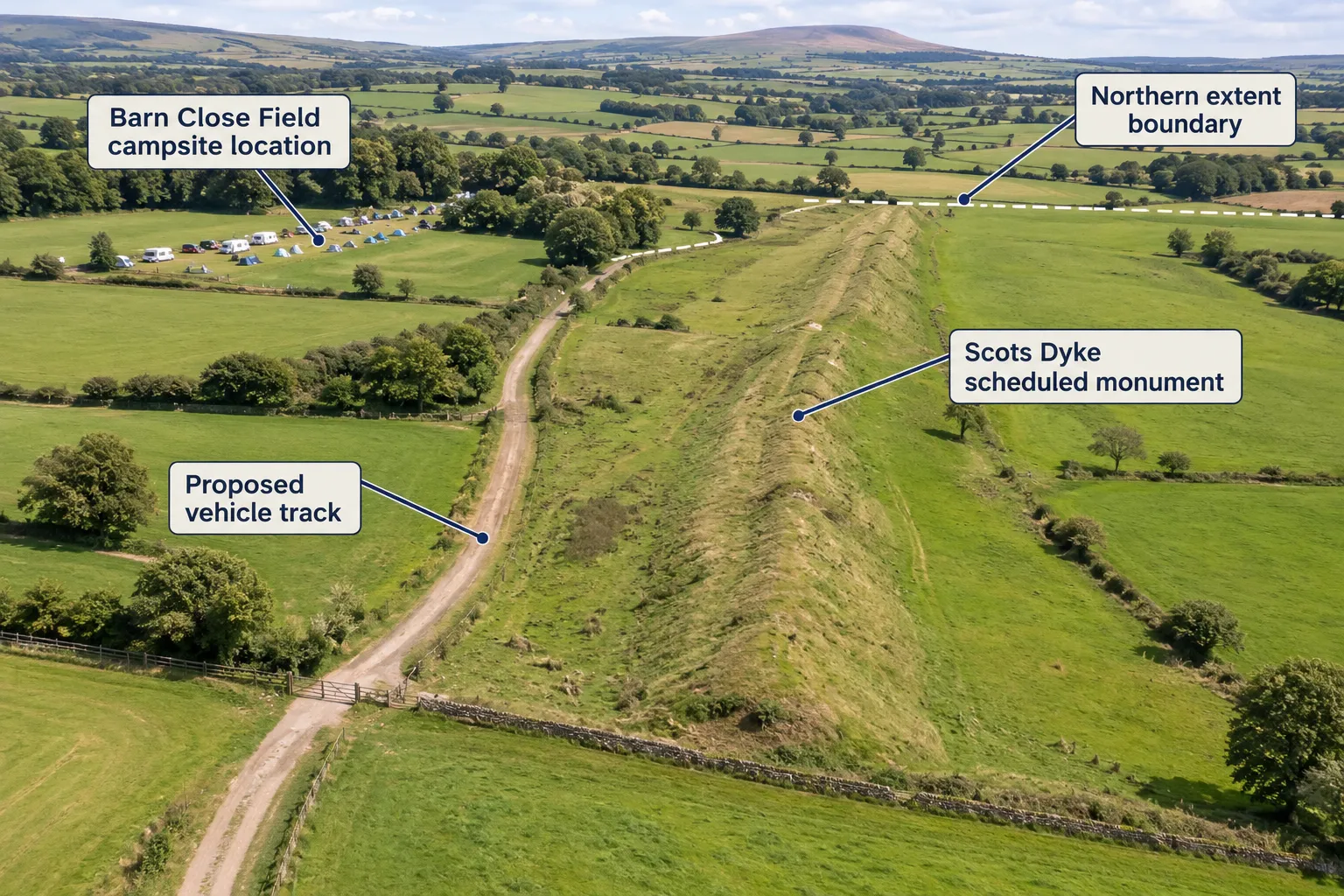
A landowner’s plans to open a pop-up campsite in North Yorkshire have hit a major roadblock after heritage officials warned that a proposed access track could encroach on a protected monument dating back around 2,000 years.
A few metres of disputed land could be enough to derail an entire campsite proposal.
That is the headache facing landowner Mike Green in Richmond, North Yorkshire, after Historic England raised serious objections to plans for a temporary campsite at Barn Close Field.
The heritage watchdog has told planning officials that the proposed vehicle access track would cross into the protected boundary of Scots Dyke, an ancient earthwork that has been safeguarded under national heritage legislation.
And despite the landowner disputing where the monument’s boundary actually lies, Historic England is refusing to back down.
The disagreement has now become a major issue in a planning appeal that could determine whether the campsite ever gets off the ground.
Historic England Says Campsite Road Crosses Protected Ancient Land
The row centres on Scots Dyke, a scheduled ancient monument whose protected boundary appears to extend further into Barn Close Field than the landowner believes.
Historic England has formally advised the Planning Inspectorate that the proposed access track would enter the monument’s protected area.
Jess Tipper, the organisation’s Inspector of Ancient Monuments, has directly addressed the landowner’s alternative interpretation of the boundary.
However, the official position remains unchanged: the proposed track would encroach on protected land.
That could spell serious trouble for the campsite plans because scheduled monuments enjoy special legal protection designed to prevent damage to important archaeological remains.
Even seemingly straightforward work, such as creating or altering a vehicle access route, can require separate Scheduled Monument Consent.
In other words, ordinary planning permission may not be enough.
Landowner Launches TWO Appeals After Campsite Plans Rejected
Mike Green is not giving up without a fight.
The landowner has lodged two separate appeals against North Yorkshire Council’s decisions to refuse the proposed campsite development.
The appeals challenge two key issues.
First, Green disputes the council’s position that permitted development rights cannot be used because the access track crosses the scheduled monument.
Second, he is challenging the advice from Historic England, arguing that the assessment of the protected boundary is incorrect.
Green believes the campsite and its access route can operate without entering the scheduled area.
His appeal documents reportedly include vehicle-tracking measurements intended to demonstrate that cars and campervans can reach the field without crossing the protected boundary.
But until planning officials make their decision, the dispute remains unresolved.
It’s Not Just Ancient History Causing Problems
The monument dispute is not the only obstacle standing in the way of the proposed campsite.
North Yorkshire Council has also raised concerns about road safety, particularly the proposed access via Easby Low Road.
The narrow single-track road has no formal passing places and is regularly used by walkers.
That combination has raised questions about whether additional campsite traffic could create problems for motorists and pedestrians.
So even if the landowner manages to overcome the heritage objections, the road access issue could present another significant challenge.
Why Can’t the Landowner Simply Open a Temporary Campsite?
There is a reason the ancient monument issue matters so much.
Under permitted development rules, certain temporary recreational campsites can operate for up to 60 days a year, with a maximum of 50 pitches, without requiring full planning permission.
However, those rights come with important restrictions.
They do not automatically apply to land designated as a scheduled monument.
That means the protected status of Scots Dyke could prevent the Barn Close Field proposal from benefiting from the simplified campsite rules.
Any development affecting the monument could also require separate heritage consent.
For Green, that creates a significant legal and planning hurdle.
A Few Metres Could Make or Break the Entire Project
The Richmond dispute highlights just how important boundary lines can become when development plans meet Britain’s protected heritage sites.
What might look like an ordinary field entrance to some could represent a potential threat to an archaeological monument that has survived for thousands of years.
Historic England’s position is that the protections must be respected, regardless of disagreements over measurements.
For the landowner, the argument is whether the proposed access can be kept outside the protected area altogether.
The Planning Inspectorate will ultimately have to consider the competing arguments and decide the fate of the appeals.
Will the Richmond Campsite Plans Ever Get the Green Light?
For now, the future of the Barn Close Field campsite remains uncertain.
Green is continuing his challenge, while Historic England is standing firm over its assessment of the ancient monument’s boundary.
The outcome could have wider implications for other landowners hoping to open temporary campsites near protected archaeological sites.
One thing is clear: a few metres of disputed ground have turned what might have appeared to be a straightforward camping proposal into a major planning battle.
And until the appeals are decided, the 2,000-year-old Scots Dyke could prove to be the biggest obstacle standing between Richmond’s would-be campers and their next countryside getaway.