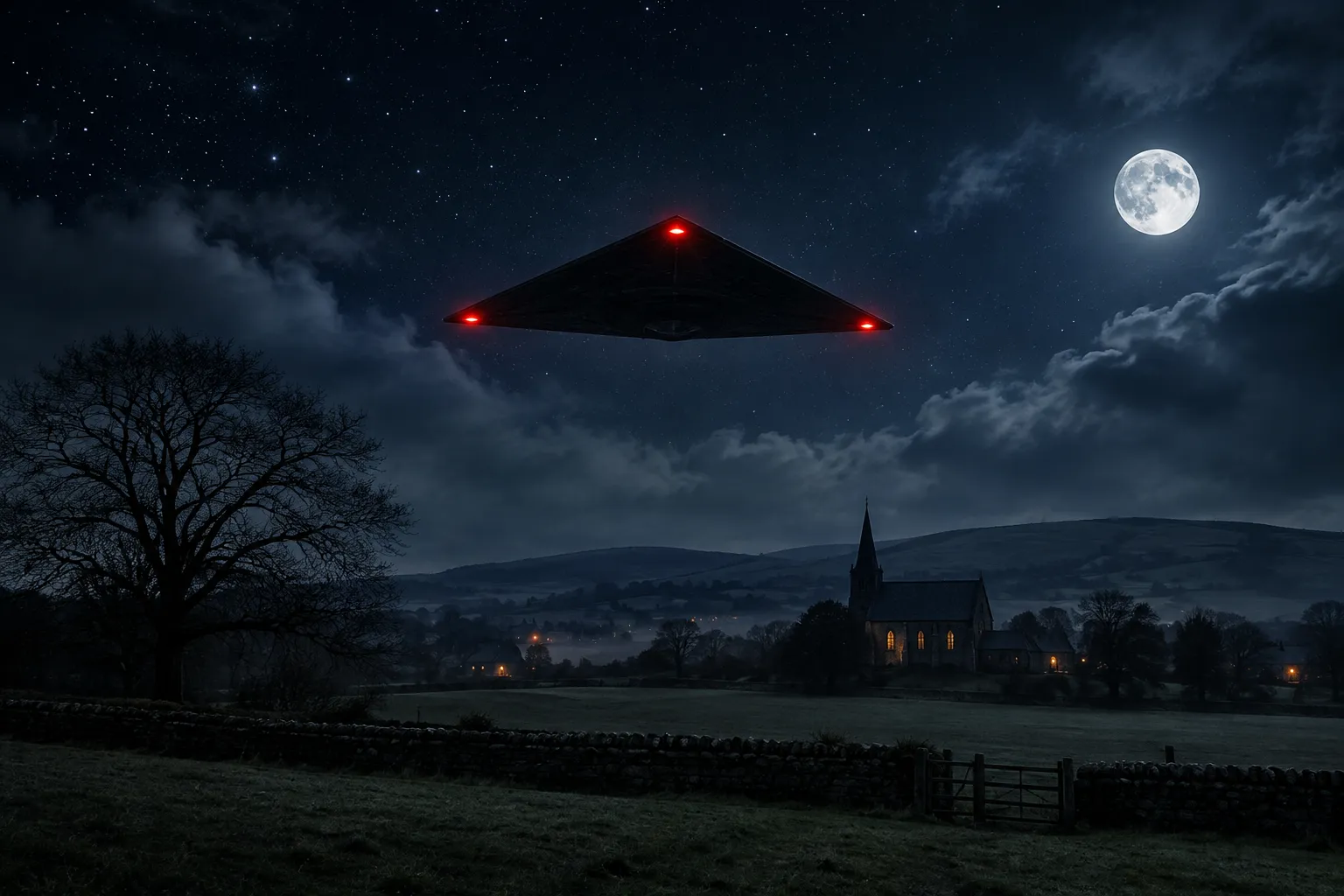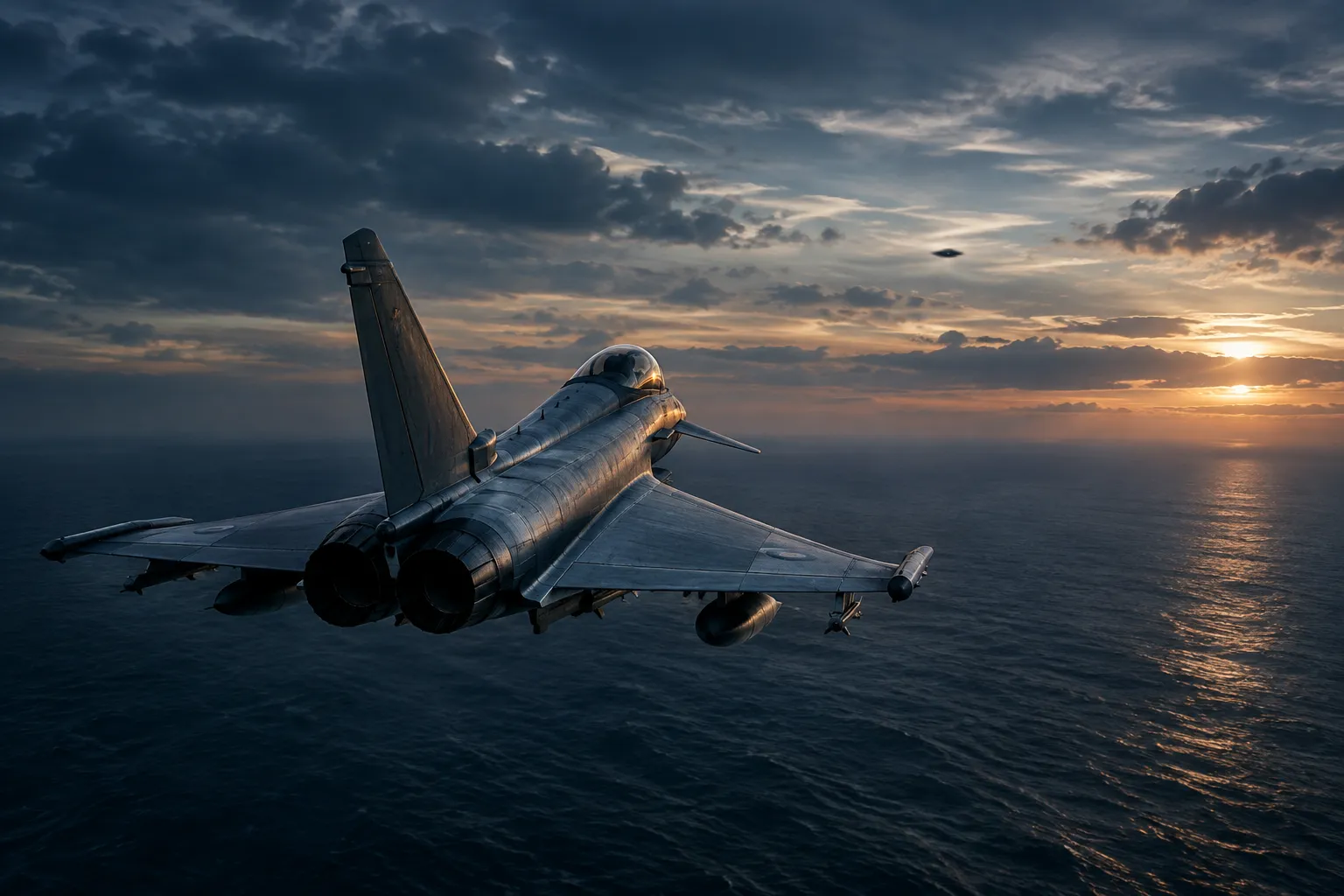
Two separate near-miss incidents in UK military training airspace have pushed an uncomfortable question back onto the Ministry of Defence’s desk: what happens when a fighter jet travelling at hundreds of miles an hour comes within feet of an object that radar cannot see and nobody can identify. According to reporting this week, RAF jets report close encounters with unidentified craft over North Sea training zones, and the altitudes involved rule out the usual explanation of hobbyist drones gone astray [1][2].
The incidents, which surfaced in the press between October 16 and 18, 2026, have reignited a long-running debate inside UK defence circles about the line separating foreign surveillance drones from unexplained aerial phenomena, a distinction officials have so far declined to draw with confidence [3][7].
Key Takeaways
- RAF fast jets reported two separate near-miss encounters with unidentified objects over the North Sea, both logged through official UK air safety channels [2][5].
- The objects appeared at altitudes around 17,000 feet, far beyond the operating ceiling of any legally registered commercial or hobbyist drone [5][7].
- Neither object produced a radar track, meaning the only evidence comes from pilot visual reports and aircraft sensors [3][4].
- The UK Airprox Board is assessing the incidents for collision risk classification, a process distinct from identifying what the objects actually were [6].
- Speculation about hostile-state surveillance drones is circulating in media coverage, but officials have not confirmed any state actor is responsible [7][8].
Timeline, Altitude, and the Near-Miss Details
Multiple outlets reported that the encounters happened within a short window of each other, involving RAF fast jets operating in designated military airspace above the North Sea, a corridor regularly used for training sorties [2][6]. In both cases, pilots reported the unidentified object at close enough range to trigger evasive manoeuvring, a reaction typically reserved for genuine collision-risk scenarios rather than routine airspace clutter [5].
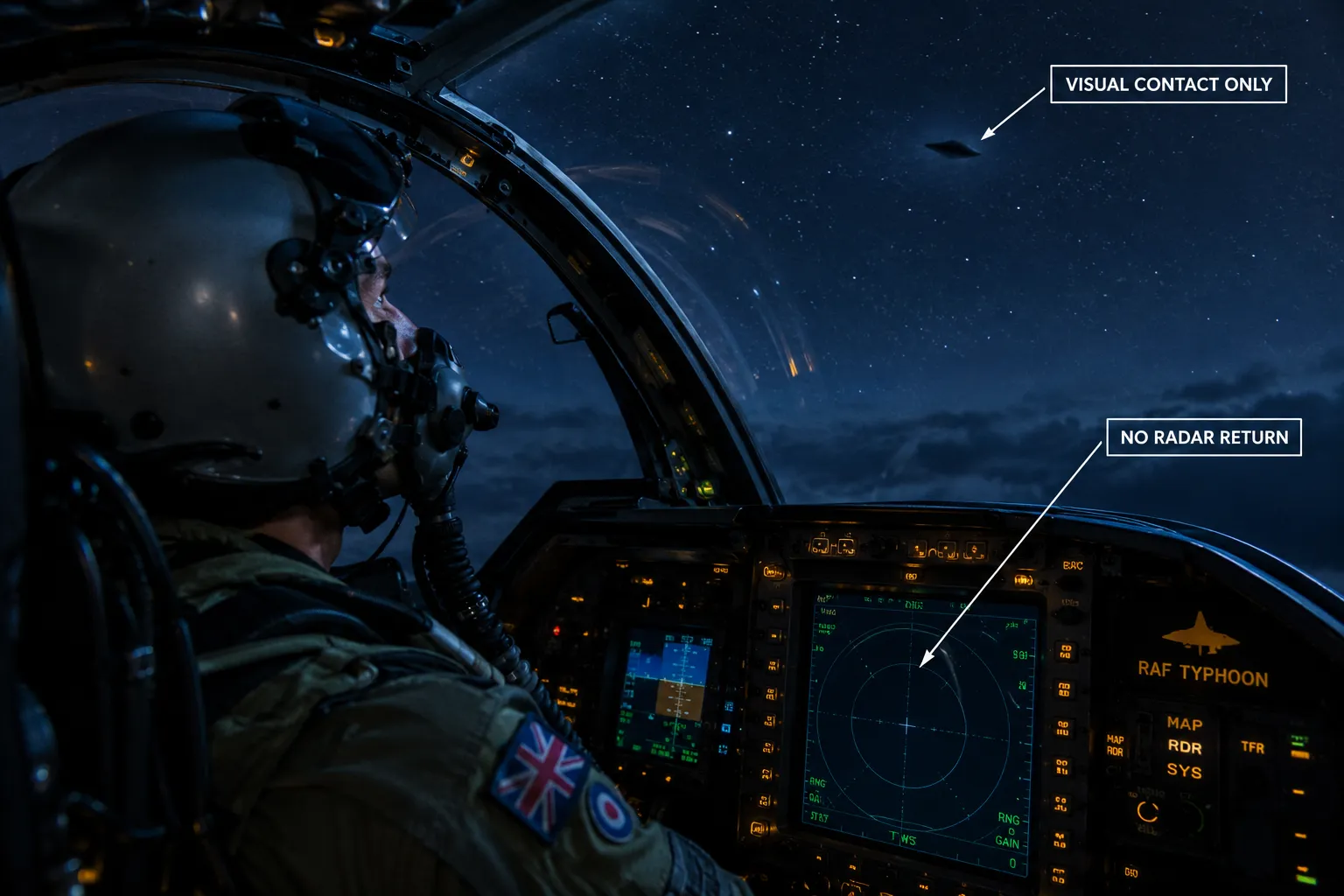
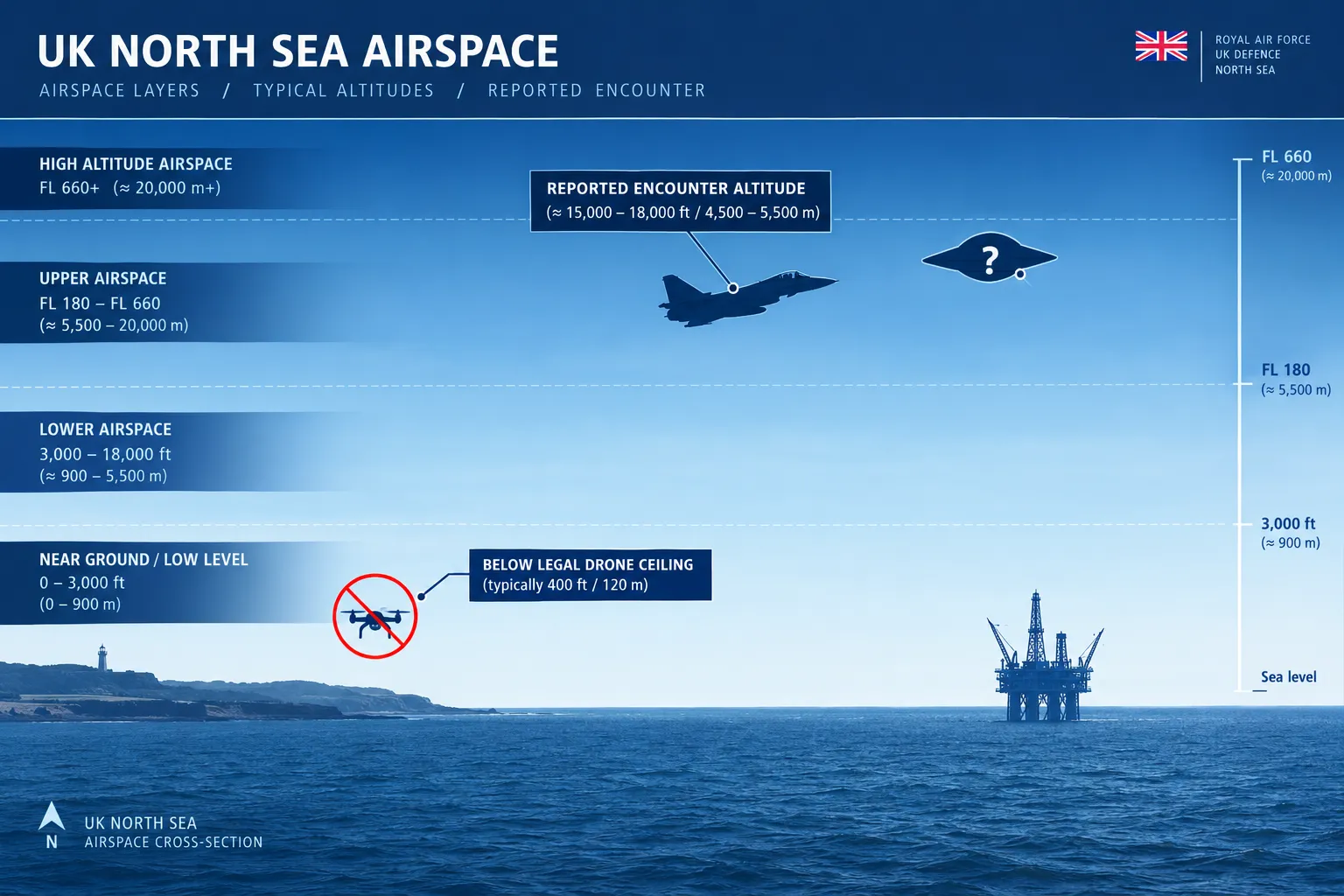
What has drawn particular attention is the altitude. Reports describe the objects appearing near 17,000 feet, a height that sits well outside the operational envelope of consumer or even most commercial surveillance drones, which are generally restricted to altitudes closer to 400 feet under UK aviation rules [5]. That gap between where ordinary drones fly and where these objects were seen is central to why investigators have not simply labelled the incidents as drone incursions.
Descriptions circulating in coverage characterize the objects as dark, compact, and fast enough to force a split-second pilot response [7]. Crucially, the objects left no corresponding radar return, meaning ground-based and onboard detection systems recorded nothing at the moment the pilots reported visual contact [3][4].
Because the incidents happened in UK-controlled military training airspace, they fall under the reporting framework of the UK Airprox Board, the body responsible for assessing near-miss severity between aircraft [6]. The board’s role is specifically to judge whether safety margins were breached, not to determine the origin of an unidentified object, which keeps the identification question open even as the safety review proceeds.
The Ministry of Defence has acknowledged the reports are being examined through standard channels, consistent with how unidentified airspace incursions are typically handled when they intersect with both aviation safety and national security interests [1][8]. This dual-track handling reflects a structural reality: one process checks whether pilots were endangered, while a separate and less transparent process considers whether the objects pose a surveillance or security threat.
The North Sea location adds another layer of sensitivity. The area hosts significant UK maritime infrastructure, including energy platforms and subsea cables, making unidentified aerial activity near this corridor a matter of broader strategic concern beyond aviation safety alone [9][10].
Security Concerns and the Limits of Current Evidence
Coverage of the incidents has leaned heavily into speculation about foreign surveillance activity, with some reports drawing a connection to broader concerns about Russian intelligence-gathering operations near UK critical infrastructure [7]. It is important to be clear that this link remains speculative. No official source has confirmed a hostile state is responsible, and the absence of a radar track makes definitive attribution difficult regardless of theory.
This ambiguity is not new. The UK has faced a string of unexplained drone sightings over sensitive sites in recent years, and officials have repeatedly struggled to draw a firm line between rogue civilian drone operators, foreign reconnaissance craft, and genuinely unexplained aerial phenomena [1][9]. The North Sea incidents fit into that same unresolved pattern rather than representing an isolated anomaly.
“Neither object showed up on radar” is the detail that most outlets have emphasized, because it strips away the easiest explanation and leaves investigators relying almost entirely on pilot testimony [3][4].
By contrast, recent US government disclosures on unidentified aerial phenomena have involved declassified sensor data and multi-agency review panels, a markedly more structured approach than the UK’s current reliance on aviation safety boards to handle what are, at their core, national security questions [8].
What Happens Next: Predictions and Open Questions
Based on how similar cases have unfolded, several outcomes appear likely, though none should be treated as confirmed:
- Expect the UK Airprox Board to issue a formal risk classification in coming weeks, focused narrowly on collision proximity rather than object identity.
- Defence officials may face pressure to clarify whether cross-agency protocols exist for distinguishing drone warfare threats from unexplained aerial phenomena.
- Further sightings near North Sea infrastructure could accelerate calls for dedicated sensor upgrades in that corridor.
- Public attribution to a specific state actor remains unlikely in the near term given the lack of radar corroboration.
The core problem exposed by these incidents is not simply that something unidentified flew near RAF jets over the North Sea. It is that the UK’s existing reporting structure is built to answer one question, whether a collision risk occurred, while leaving the more pressing question of identity and intent largely unaddressed. Readers following this story should watch for the UK Airprox Board’s formal findings and any follow-up statement from the Ministry of Defence, while treating hostile-state theories as unconfirmed speculation until officials say otherwise.
References
[1] Raf Reports Mystery Drones Uk B3068419 – https://www.independent.co.uk/news/uk/home-news/raf-reports-mystery-drones-uk-b3068419.html [2] Raf Aircraft Report Two Near Misses With Suspected Drones Over North Sea 3724546 – https://en.yenisafak.com/world/raf-aircraft-report-two-near-misses-with-suspected-drones-over-north-sea-3724546 [3] economictimes.indiatimes – https://economictimes.indiatimes.com/news/defence/two-british-aircraft-encounter-unidentified-objects-over-north-sea-neither-shows-up-on-radar/printarticle/135018434.cms [4] economictimes.indiatimes – https://economictimes.indiatimes.com/news/defence/two-british-aircraft-encounter-unidentified-objects-over-north-sea-neither-shows-up-on-radar/articleshow/135018434.cms [5] 5nmwlbn – https://www.upday.com/uk/17000-foot-near-miss-mystery-drones-evade-radar-and-buzz-raf-jets-over-north-sea/5nmwlbn [6] Raf Jets Report Mystery Drones Britain 5hjdk4l 2 – https://www.lbc.co.uk/article/raf-jets-report-mystery-drones-britain-5Hjdk4L_2/ [7] timesofindia.indiatimes – https://timesofindia.indiatimes.com/defence/international/black-objects-no-radar-trace-british-jets-report-near-misses-with-mystery-objects-amid-russian-spy-fears/articleshow/135009802.cms [8] Mystery Drones Near Raf Jets – https://www.diplomacyandlaw.com/post/mystery-drones-near-raf-jets [9] Mystery Drones Over British Skies – https://www.londoner.news/mystery-drones-over-british-skies/ [10] Raf North Sea Airspace Encounters – https://demokratis.co.id/en/raf-north-sea-airspace-encounters