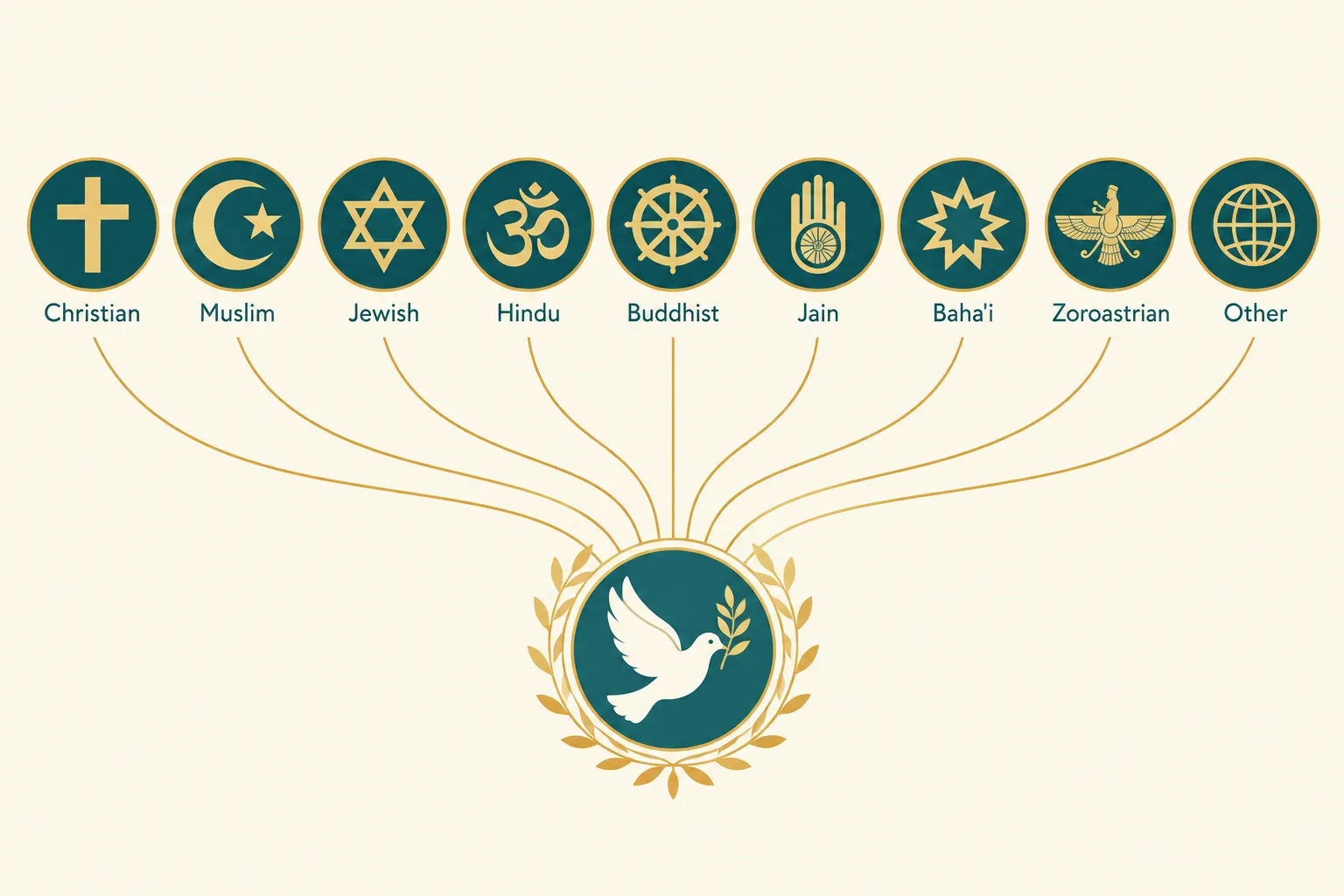
On 19 October 2026, religious leaders representing nine major faith traditions gathered at Westminster Cathedral Hall in London to sign a joint Pledge for Peace, demonstrating a shared commitment to human dignity, mutual respect and peaceful coexistence.
The gathering brought together representatives of Christian, Muslim, Jewish, Hindu, Buddhist, Jain, Bahá’í and Zoroastrian communities, alongside other religious leaders, united by the belief that faith should serve as a force for peace rather than division.
A Shared Commitment to Peace
The event was organised by the Vatican’s Dicastery for Interreligious Dialogue in collaboration with the Catholic Bishops’ Conference of England and Wales. It took place during Cardinal George Jacob Koovakad’s official visit to the United Kingdom, which focused on strengthening interfaith dialogue and cooperation.
The ceremony began with prayers for peace from the participating traditions, followed by a shared moment of silence before the formal signing of the pledge. This opening reflected the spiritual significance of the gathering and the common aspiration to build a more peaceful world.
Among those signing the document were Cardinal Koovakad, Radhika Kadaba of the Hindu Council of Wales, Shaykh Ibrahim Mogra of the Christian Muslim Forum, Dr James Roberts of St Paul’s Cathedral Institute, Padideh Sabeti representing the Bahá’í community, Malcolm Deboo representing the Zoroastrian community, Dr Mehool Sanghrajka representing the Jain community, Brenda Dinsdale representing the Jewish community and Dr Desmond Biddulph representing the Buddhist community.
Their participation highlighted the importance of cooperation between religious communities and the role their leaders can play in promoting understanding, reconciliation and social harmony.
Human Dignity at the Heart of the Pledge
At the centre of the Pledge for Peace is the principle that every human being deserves dignity, respect and compassion, regardless of religious belief or background. It also recognises the importance of treating others as one would wish to be treated, a principle reflected in many of the world’s religious and ethical traditions.
The document strongly rejects the use of religion or the name of God to justify violence, war or hostility. It also calls on religious leaders to address the underlying conditions that contribute to hatred, extremism and conflict.
Rather than focusing on theological differences, the initiative emphasises shared moral responsibilities and the practical contribution faith communities can make to peacebuilding.
Cardinal Koovakad has stressed the responsibility of religions to promote peace and encourage peaceful relations between people and communities. This message provided an important context for the London gathering, particularly at a time when international conflicts and social divisions continue to challenge peaceful coexistence.
Why Interfaith Cooperation Matters
The signing represents an important example of religious leaders working together beyond the boundaries of their individual traditions. Although the participating faiths differ in their beliefs, practices and histories, the pledge demonstrates that cooperation is possible when communities place human dignity and the pursuit of peace at the centre of their engagement.
Interfaith initiatives can help challenge prejudice, reduce misunderstanding and strengthen relationships between communities. They can also create opportunities for religious organisations to work together on shared concerns, including discrimination, social exclusion, intolerance and violence.
London has a long history of interfaith engagement, with religious communities participating in peace walks, community dialogues and initiatives designed to address antisemitism, Islamophobia and other forms of religious prejudice. The October gathering builds on this wider effort by translating shared aspirations into a written commitment.
However, the lasting significance of the pledge will depend not only on the act of signing it, but also on how its principles are put into practice within local communities and beyond.
From Words to Action
The Pledge for Peace sends a clear message: religious differences need not prevent people from working together for the common good. By affirming human dignity and rejecting violence committed in the name of religion, the signatories have placed shared responsibility at the heart of their commitment.
The challenge now is to turn that commitment into meaningful action through community partnerships, educational initiatives, dialogue between religious groups and practical support for those affected by conflict and discrimination.
The gathering at Westminster Cathedral Hall serves as a reminder that peacebuilding is not the responsibility of religious leaders alone. Individuals, community organisations and public institutions all have a role to play in fostering mutual respect and understanding.
Ultimately, the pledge offers a vision of interfaith cooperation in which differences are acknowledged without becoming barriers to solidarity. Its central message is simple: peace begins when human dignity is recognised, diversity is respected and people work together to build a more compassionate world.