JUST FOUR PAGES! That is reportedly all investigative journalist Ross Coulthart says he has received from a much longer Apollo 12 transcript — and now he is challenging NASA’s claim that it has released all its data on mysterious objects spotted in the skies.
The explosive dispute has reignited questions about what America’s space agency knows about unidentified anomalous phenomena, better known as UAPs, and whether decades-old space mission records have been fully opened to the public.
NASA administrator Jared Isaacman has declared that the agency has released all its UAP-related data through President Donald Trump’s PURSUE initiative.
But Coulthart is having none of it!
The veteran UAP reporter argues that releasing selected documents is NOT the same as opening every relevant file held in NASA’s vast historical archives.
And he claims several intriguing pieces of space-age evidence remain missing, incomplete or unavailable to the public.
So, what exactly is still outstanding — and could the missing records finally shed light on some of the most puzzling reports from America’s early space missions?
KEY TAKEAWAYS: THE NASA UFO ROW EXPLAINED
- NASA says the files are out! Administrator Jared Isaacman maintains that the agency has released all UAP data covered by its disclosure initiative.
- Coulthart isn’t convinced! The journalist argues that important historical records may still be missing from the public record.
- Apollo 17’s mysterious ‘blue dots’: Coulthart says footage associated with unidentified bright objects has not been publicly released.
- JUST FOUR PAGES? He claims only a small portion of a longer Apollo 12 transcript has been provided.
- Missing photographs? Images reportedly taken by Apollo 17 astronaut Ron Evans remain a key part of the dispute.
- Gemini 7 and Skylab under scrutiny: Coulthart argues that historical reports from other missions also deserve closer examination.
At the heart of the controversy is one deceptively simple question: when NASA says it has released ALL its UAP data, does that mean every relevant historical document has been made public?
Isaacman’s position is that the agency’s disclosure effort has released its UAP-related data. But Coulthart believes the statement leaves a crucial distinction unanswered.
According to the journalist, NASA may have released the material selected for its disclosure initiative without carrying out a complete review of every potentially relevant record in its archives.
In other words, critics argue that a completed release programme does not necessarily mean every historical file has been examined.
And that is where the row really begins.
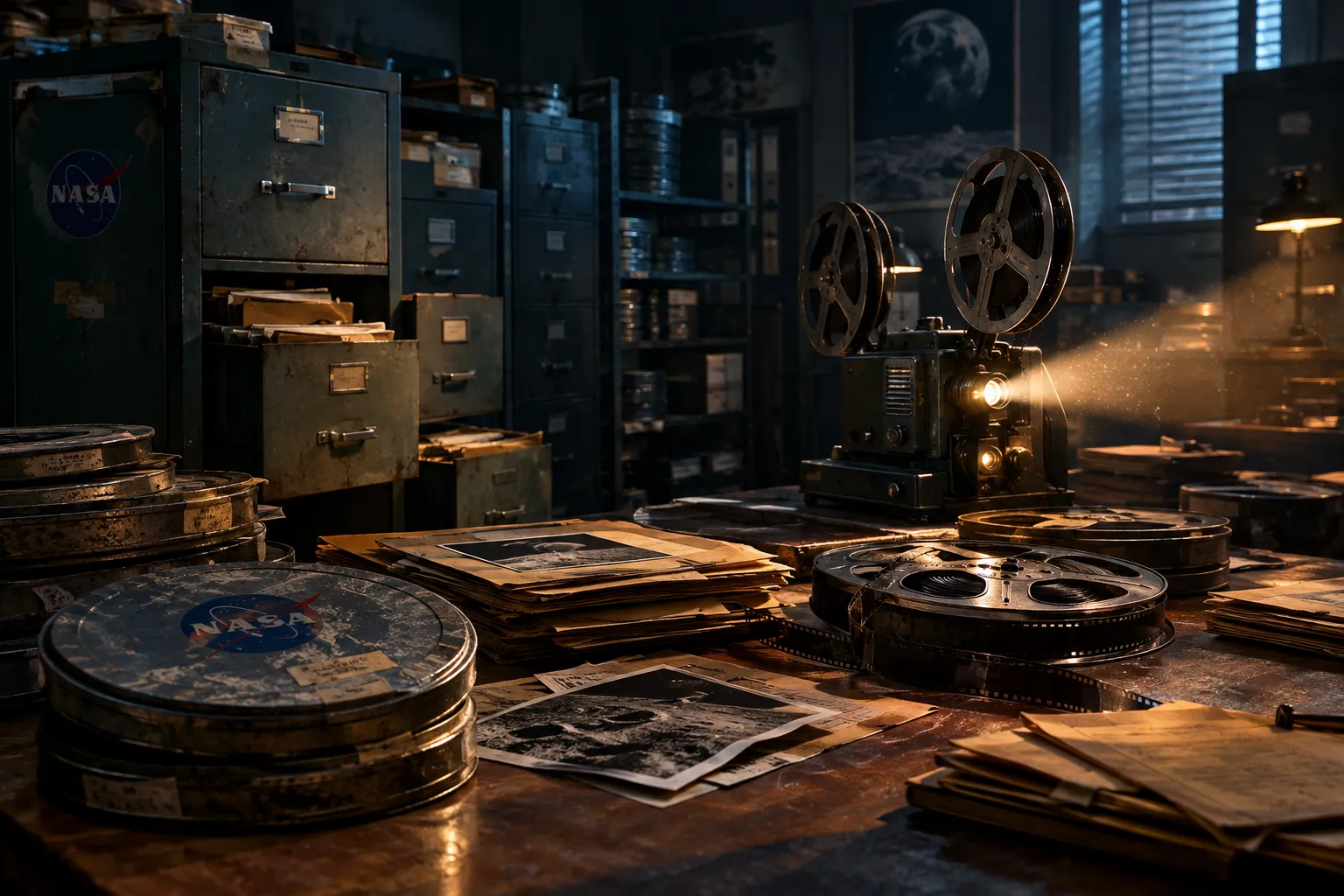
NASA’s archives stretch back decades, covering missions that sent astronauts into orbit and beyond. Coulthart believes some records associated with unexplained observations during those flights deserve further investigation.
His argument is not proof that NASA is concealing evidence of extraterrestrial life. Rather, he wants the agency to account for specific documents and images that he says have not been fully disclosed.
Until those questions are answered, the battle over what constitutes complete transparency is unlikely to disappear.
APOLLO 17’S MYSTERIOUS ‘BLUE DOTS’ — WHERE IS THE FOOTAGE?
One of the most intriguing elements of Coulthart’s challenge involves footage reportedly associated with mysterious bright objects nicknamed the ‘blue dots’.
The journalist has repeatedly pointed to the alleged Apollo 17 film, arguing that the material should be made available for public examination.
But the footage has not emerged as part of the disclosures he has highlighted.
That has fuelled fresh demands for clarification about whether the film exists in the form described, where it is held and whether it has been reviewed for possible release.
There is an important distinction here: an unexplained light or object in space footage is not automatically evidence of an alien spacecraft. Lighting effects, reflections, camera artefacts and ordinary objects can all produce puzzling images.
Nevertheless, making original footage available, alongside its technical context, would allow independent researchers to examine what it actually shows.
For Coulthart, the issue is straightforward: if the material exists and falls within the scope of NASA’s disclosure claims, why has it not been publicly accounted for?
THE FOUR-PAGE APOLLO 12 MYSTERY
And then there is the Apollo 12 transcript.
Coulthart claims that NASA has provided just four pages of a document he believes is considerably longer.
That allegation has become one of the most striking details in the dispute, raising questions about what the transcript contains, how much of it remains unavailable and whether the missing material has any bearing on reports of unusual observations.
The journalist says he has sought the complete document but has not received the full transcript he is looking for.
However, the precise significance of the missing pages remains unclear. Their absence from the material he says he received does not, by itself, establish that they contain evidence of anything extraordinary.
The obvious next step would be for NASA to clarify the document’s length, explain what material has been released and identify any portions that remain unavailable.
Until that happens, the Apollo 12 transcript will remain a major talking point in the wider disclosure row.
APOLLO ASTRONAUT’S MISSING PHOTOGRAPHS ADD TO THE DRAMA
Coulthart has also raised questions about photographs reportedly taken by Apollo 17 astronaut Ron Evans.
Evans is associated with accounts of bright fragments observed during the mission, which he reportedly photographed. Coulthart argues that the images have not appeared in the UAP-related material released so far.
If the photographs can be identified, locating the originals and establishing their context would help researchers assess what Evans observed.
That means examining the images themselves, the circumstances in which they were taken and any available mission documentation.
At present, the central issue is whether the specific photographs Coulthart describes can be located and made available for independent analysis.
Their absence from the releases he has highlighted does not establish that NASA has deliberately withheld evidence. But it does provide another specific question for the agency to address.
GEMINI 7 AND SKYLAB: COULD MORE OLD SPACE FILES BE RELEVANT?
Coulthart’s challenge does not stop with Apollo.
He has also pointed towards historical observations associated with Gemini 7 and Skylab, arguing that these missions should be included in a wider examination of unexplained reports from America’s early space programme.
His broader concern is that the discussion has focused on a limited selection of records rather than a comprehensive review of historical astronaut observations.
He has also suggested that potentially relevant information could exist outside NASA’s own archives, including within military and other government programmes.
That raises a complicated question about who holds which records and which agency would be responsible for reviewing them.
NASA cannot necessarily disclose material held exclusively by another organisation. Equally, a complete picture of historical UAP reports may require information from several different sources.
For researchers seeking answers, the priority is to identify the relevant documents, establish their authenticity and determine whether they contain information that remains unexplained.
NASA’S SHIFTING ATTITUDE TO UFOs — BUT IS TRANSPARENCY ENOUGH?
There is another side to this controversy.
NASA has taken steps to discuss UAPs more openly, helping move the subject away from the stigma that has often surrounded reports of unexplained objects.
But greater openness and complete historical disclosure are two different things.
Coulthart argues that a more accepting attitude towards the subject must be accompanied by a serious effort to account for older records.
An independent review involving former NASA official Mike Gold has also drawn attention to gaps in the historical material under examination, adding to calls for a closer look at the agency’s archives.
Even so, missing documents do not automatically point to a cover-up, and unexplained sightings do not prove an extraterrestrial origin.
The most reliable way forward is through evidence: original records, complete transcripts, authenticated images and clear explanations of what has — and has not — been located.
That is what would allow independent investigators to distinguish genuine mysteries from misunderstandings, technical artefacts or incomplete historical accounts.
WHAT HAPPENS NEXT? FOUR BIG QUESTIONS NASA NEEDS TO ADDRESS
The controversy leaves several important questions hanging.
1. Will the Apollo 17 ‘blue dots’ footage be released?
Researchers want clarification about the film Coulthart has highlighted, including whether it is held by NASA and whether it can be made available for examination.
2. Can the complete Apollo 12 transcript be accounted for?
A clear explanation of the document’s full length, the pages already supplied and any outstanding material would help settle questions surrounding the four-page claim.
3. What happened to the Ron Evans photographs?
Identifying the original images and making their context available would help establish what was photographed during Apollo 17.
4. Will older Gemini 7 and Skylab reports receive a fresh review?
A broader assessment could help determine whether relevant records exist, where they are held and whether they add anything significant to the historical picture.
No definitive answers to these questions have been established in the material discussed here.
THE FINAL VERDICT: UFO COVER-UP OR A FIGHT FOR FULL DISCLOSURE?
The clash between NASA’s declaration that it has released its UAP data and Ross Coulthart’s demand for more historical records has put the spotlight firmly on government transparency.
The Apollo 12 transcript, the alleged Apollo 17 ‘blue dots’ footage and the photographs associated with Ron Evans are now central to his argument that more work remains to be done.
But there is a crucial point that should not be lost in the headlines: missing or unreleased records are not proof of aliens — or proof of a deliberate cover-up.
What they do create is a legitimate demand for clear answers about which documents exist, what has been examined and what remains unavailable.
If NASA can provide a detailed accounting of the disputed material, it could help settle the argument over the scope of its disclosure effort.
Until then, the question remains: has America’s space agency truly opened the books on its mysterious space sightings, or is there still more historical evidence waiting to be examined?
For UFO enthusiasts and sceptics alike, the most valuable breakthrough would not be another sensational claim. It would be the release of verifiable evidence that allows the public to judge the facts for itself.
Tone down the unsupported bombshell language