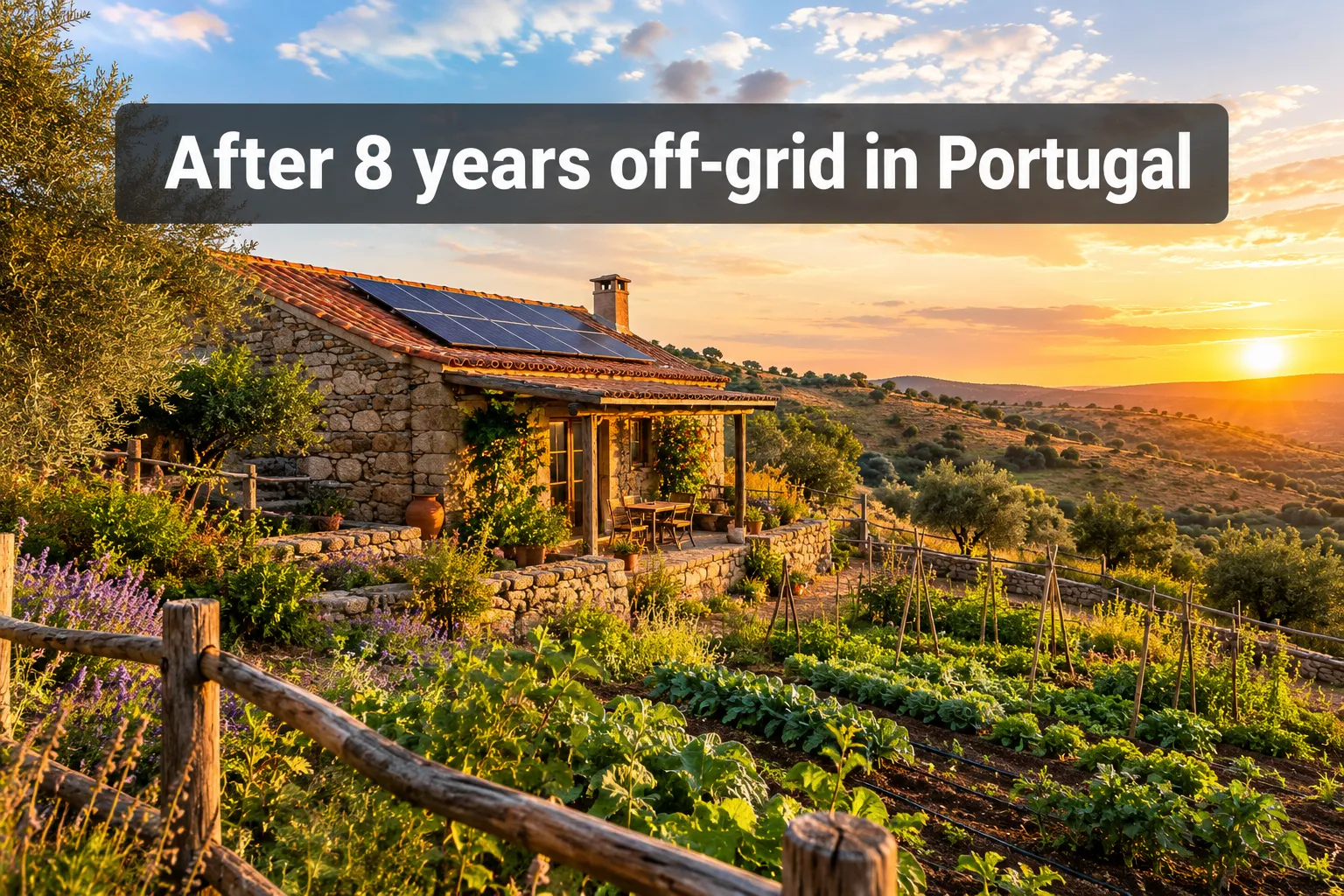
A single phrase from a YouTube video sums up one of the biggest misconceptions about rural self-sufficiency: “simple” does not mean “easy.” After 8 years off-grid in Portugal, couple says ‘simple’ life gave them 100 new jobs, and their honest account is reshaping how people think about escaping the grid entirely.
Luke and Sarah, the couple behind the channel LukeAndSarahsOffGridLife, moved to rural Portugal more than eight years ago chasing freedom from conventional urban routines [1]. They got that freedom. But they also got something they did not fully expect: a daily workload that multiplied far beyond anything a typical job description could capture [1].
Key Takeaways
- Luke and Sarah have lived off-grid in rural Portugal for more than eight years, seeking a simpler, freer lifestyle [1].
- They describe the experience as giving them “a hundred new jobs,” covering physical labor, maintenance, planning, and administration [1].
- The couple’s story reflects a wider trend of self-sufficient and eco-tourism projects across Portugal, including Vale das Estrelas in the Alentejo [4][7][9].
- Rural depopulation and a construction labor shortage are pushing demand for modular and off-grid housing solutions across Portugal [12][13].
- A growing network, including the Grow platform’s 90 listed off-grid communities, shows this lifestyle is becoming an organized movement rather than isolated experiments [15].
What Living Off-Grid in Portugal Actually Looks Like
Rural Portugal has become a magnet for people wanting to step away from city life. Luke and Sarah are among the most visible examples, documenting their homestead for a growing online audience [1]. Their goal was straightforward: trade complexity and consumption for something quieter and more self-directed.
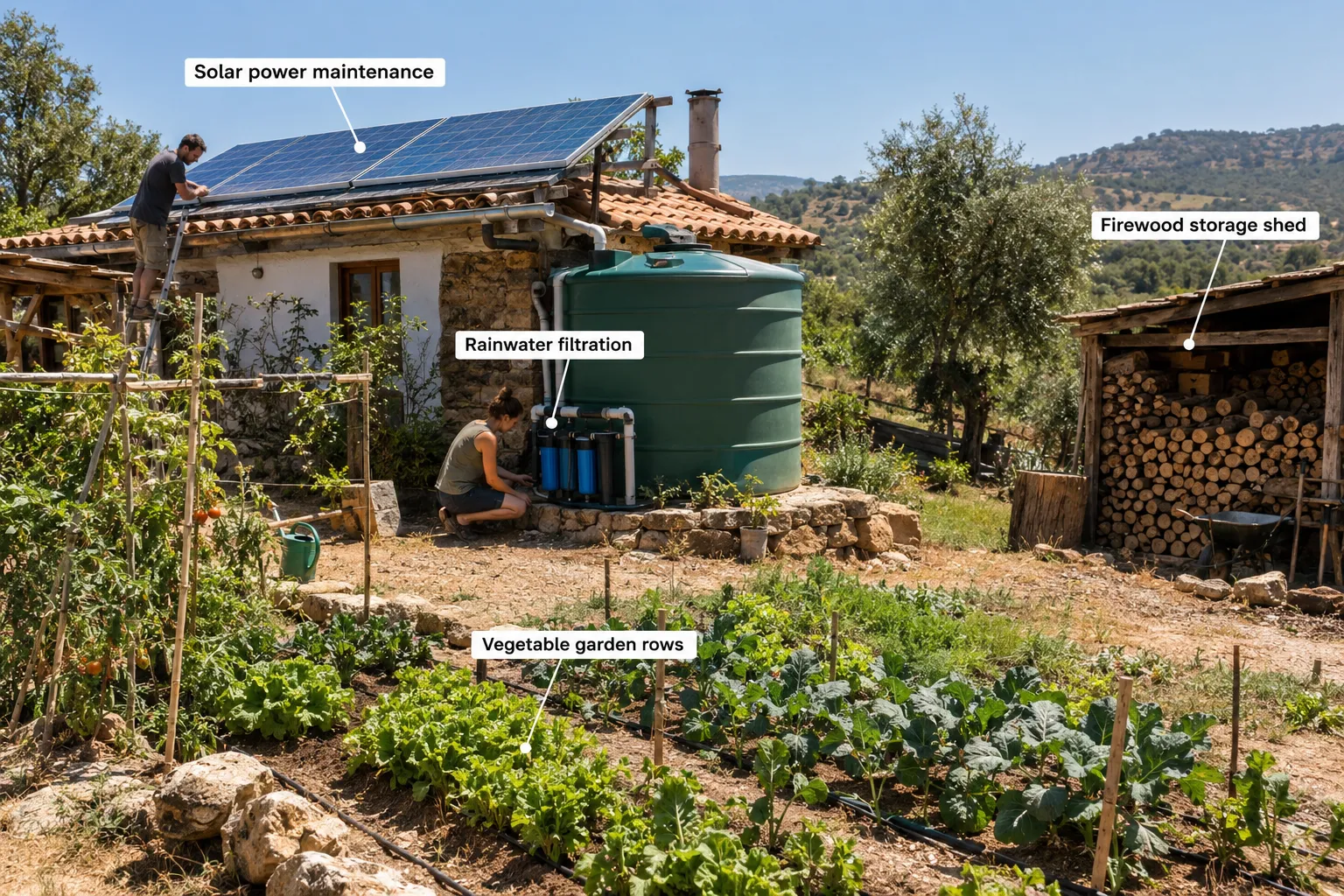
In practice, that quieter life required building nearly everything from scratch. Power, water, food production, and shelter maintenance do not arrive automatically when there is no grid connection. Every system the couple depends on had to be designed, installed, and kept running by hand [1]. This is the paradox at the center of their story: fewer external obligations, but far more direct responsibility for basic survival tasks.
Their experience mirrors a broader pattern seen in Portugal’s off-grid movement. Former BBC correspondent Alastair Leithead and his wife Ana took a similar path when they moved to the Alentejo region to build Vale das Estrelas, an off-grid eco-tourism lodge [4][7][9]. Like Luke and Sarah, they had to self-install power and water infrastructure while also running a functioning business on top of it [9]. The lodge’s system includes 84 solar panels, illustrating just how much technical infrastructure a “simple” off-grid setup can actually demand [9].
Why After 8 Years Off-Grid in Portugal, Couple Says ‘Simple’ Life Gave Them 100 New Jobs Resonates With So Many
The phrase “100 new jobs” is not corporate language. It is shorthand for the sheer variety of roles one household must fill when there is no landlord, utility company, or supermarket supply chain to lean on [1]. Luke and Sarah describe this range of tasks as the defining trade-off of their lifestyle: independence in exchange for constant hands-on labor [1].
“Off-grid living gave them ‘a hundred new jobs’” is how the couple describe the many roles, physical labor, maintenance, planning, and administration, that self-sufficiency demands every single day [1].
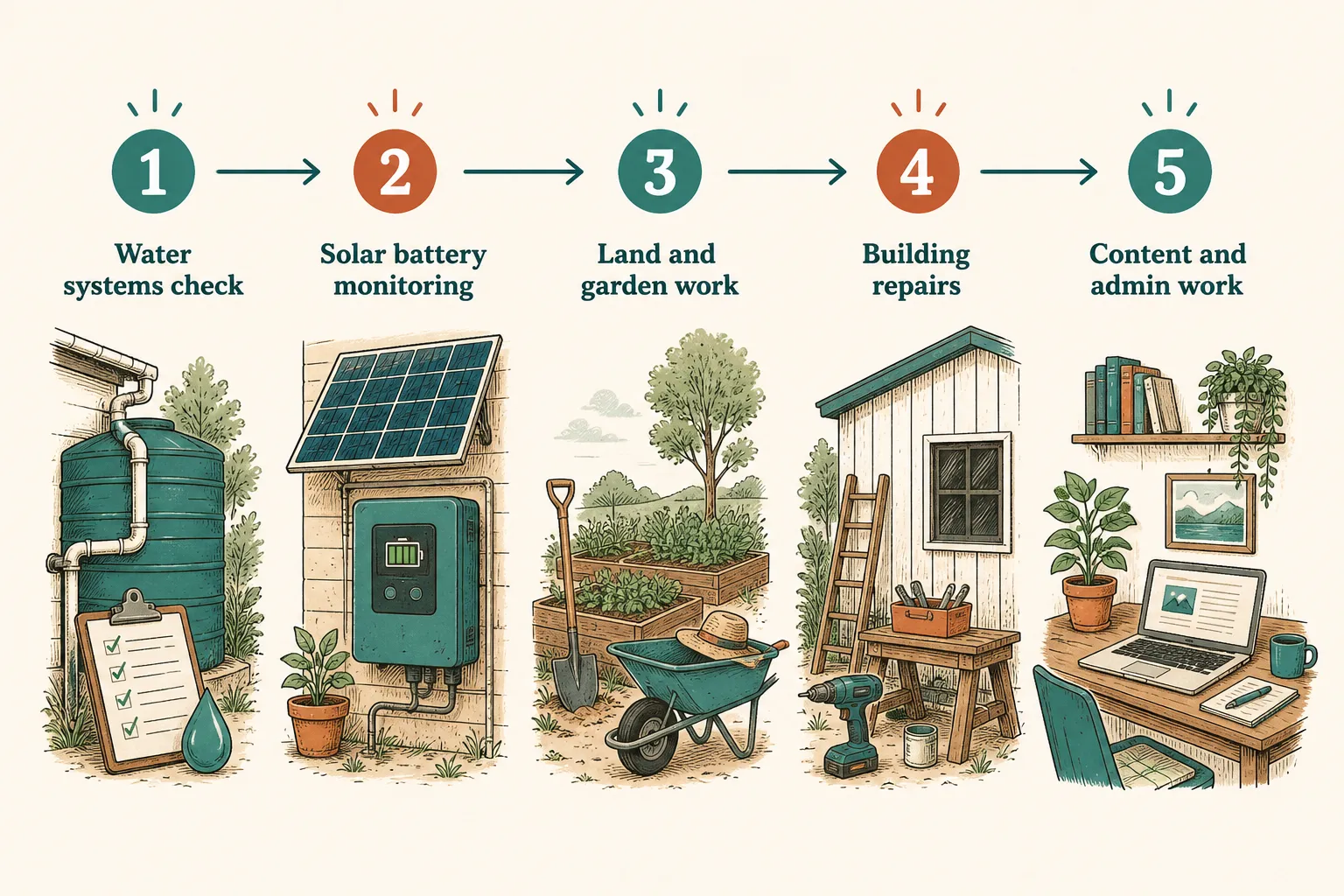
Below is a simplified breakdown of the kinds of roles the couple’s daily routine can involve, based on the categories described in their account [1]:
| Job Category | Example Tasks |
|---|---|
| Power management | Monitoring solar output, maintaining batteries, troubleshooting outages |
| Water systems | Collecting rainwater, filtering supply, repairing pipes |
| Food production | Growing vegetables, tending animals, preserving harvests |
| Structural upkeep | Repairing buildings, maintaining fencing, weatherproofing |
| Administration | Planning finances, documenting content, coordinating supplies |
This table is not exhaustive, but it captures why the couple settled on the number 100. Nearly every function normally outsourced in modern life, from repairs to logistics, becomes an in-house responsibility [1].
The Bigger Picture: Off-Grid Living as a Growing Movement
Luke and Sarah’s story does not exist in isolation. Portugal has become something of a hub for people seeking rural reinvention, and the reasons go beyond personal lifestyle preference.
A February 2026 BBC report on modular housing found that rural regions of Portugal are seeing an influx of new residents just as the country faces a shortage of construction workers [12][13]. This combination is fueling demand for modular wooden and flat-pack homes, which fit naturally with low-infrastructure, off-grid approaches to rural living [12][13]. In other words, the “100 new jobs” experienced by Luke and Sarah are not an isolated quirk, they are a symptom of a structural gap between rural housing demand and the skilled labor available to meet it [12][13].
At the same time, off-grid living in Portugal is becoming more organized. The Grow platform now lists 90 off-grid communities across the country where people can visit, stay, or even work [15]. Its co-founder also runs Spirit Tribe, a permaculture community, signaling that off-grid life increasingly overlaps with structured communal projects and regenerative agriculture rather than remaining a solo homesteading pursuit [15].
There is also an entrepreneurial thread running through these stories. BBC World Service podcast episodes on Alastair Leithead’s project frame his off-grid lodge as a case study in scaling a personal lifestyle choice into a functioning tourism business, one that creates local employment and contributes to regional development [2][3][4][7][8]. Luke and Sarah follow a parallel model, monetizing and publicizing their homestead through video content, turning private daily labor into a shared public resource [1][10].
What This Means for Anyone Considering the Same Move
For people drawn to the idea of rural Portugal and off-grid independence, the lesson from Luke and Sarah’s eight years is not discouragement, it is realistic preparation. Their story after 8 years off-grid in Portugal shows that “simple” living is really a redistribution of effort, not a reduction of it.
A few practical considerations stand out from their experience and the wider Portuguese context:
- Expect infrastructure to be a full-time project. Power, water, and building systems require ongoing skill development, not a one-time install [1][9].
- Factor in the construction labor shortage. Builders are in short supply in many rural regions, which affects timelines and costs for anyone setting up a homestead [12][13].
- Look into modular and flat-pack housing options. These are increasingly common solutions for low-infrastructure rural living [12][13].
- Consider joining an established community first. Networks like those listed on Grow offer a way to experience off-grid life without building everything from zero [15].
- Plan for administrative work, not just physical labor. Documentation, budgeting, and coordination are as demanding as the manual tasks [1].
Conclusion
Eight years in, Luke and Sarah’s account of rural Portugal challenges the romantic idea that off-grid living simply means less to do. Instead, after 8 years off-grid in Portugal, couple says ‘simple’ life gave them 100 new jobs, and that reframing matters for anyone weighing a similar move. The freedom they gained is real, but so is the labor required to sustain it, a pattern echoed in larger off-grid ventures like Vale das Estrelas and in Portugal’s broader shift toward modular housing and organized off-grid communities [1][4][9][12][13][15].
Anyone seriously considering this path should start small: visit an established off-grid community, learn basic solar and water system maintenance, and research regional housing shortages before committing to a full homestead build. The reward can be genuine independence, but only for those ready to take on far more than one job.
References
[1] 8 Years Off Grid Portugal 021100930 – https://www.yahoo.com/lifestyle/articles/8-years-off-grid-portugal-021100930.html [2] W3ct4n4q – https://www.bbc.co.uk/programmes/w3ct4n4q [3] W3ct4mvp – https://www.bbc.co.uk/programmes/w3ct4mvp [4] W3ct4mvp – https://www.bbc.com/audio/play/w3ct4mvp [7] Podcast – http://www.listenersguide.org.uk/bbc/podcast/?p=p002vsxs [8] W3ct4mq0 – https://www.bbc.com/audio/play/w3ct4mq0 [9] Aug 2025 A Sky Full Of Stars – https://tomorrowalgarve.com/aug-2025-a-sky-full-of-stars/ [10] Rewards – https://www.thecooldown.com/rewards/ [12] How modular homes are rebuilding Portugal’s ruins – https://www.bbc.co.uk/programmes/w3ct4n4q [13] How modular homes are rebuilding Portugal’s ruins – https://www.bbc.com/audio/play/w3ct4mvp [15] Grow off-grid communities Portugal – https://tomorrowalgarve.com/aug-2025-a-sky-full-of-stars/
off-grid living, Portugal lifestyle, rural self-sufficiency, sustainable living, eco-tourism Portugal, modular homes Portugal, permaculture community, solar power homestead, rural depopulation, off-grid business, Alentejo Portugal, simple living movement


