Sleep problems are common among people living with Parkinson’s disease, yet many existing treatments focus primarily on managing the condition’s motor and neurological symptoms rather than improving sleep. Cambridge Sleep Sciences is exploring a potential alternative through SleepHub, a bedside device that uses sound technology to support better sleep. The device is being trialled with people living with Parkinson’s disease following earlier research into its use for insomnia in the wider population.
Key Takeaways
- Cambridge Sleep Sciences partnered with Parkinson’s Concierge in March 2021 to explore whether SleepHub could improve sleep quality in people with Parkinson’s disease.
- In March 2026, the parent company, Barkby Group, reported that the Parkinson’s user trial had been expanded, with participants continuing to report encouraging sleep improvements.
- Parkinson’s-specific clinical evidence remains limited, and the findings have not yet been established through a published, peer-reviewed clinical trial.
- Research involving people with insomnia outside the Parkinson’s population has reported improvements in sleep duration, sleep efficiency and the frequency of night-time awakenings.
- A small pilot study involving people with chronic insomnia also reported improvements in sleep quality that persisted after participants stopped using the device.
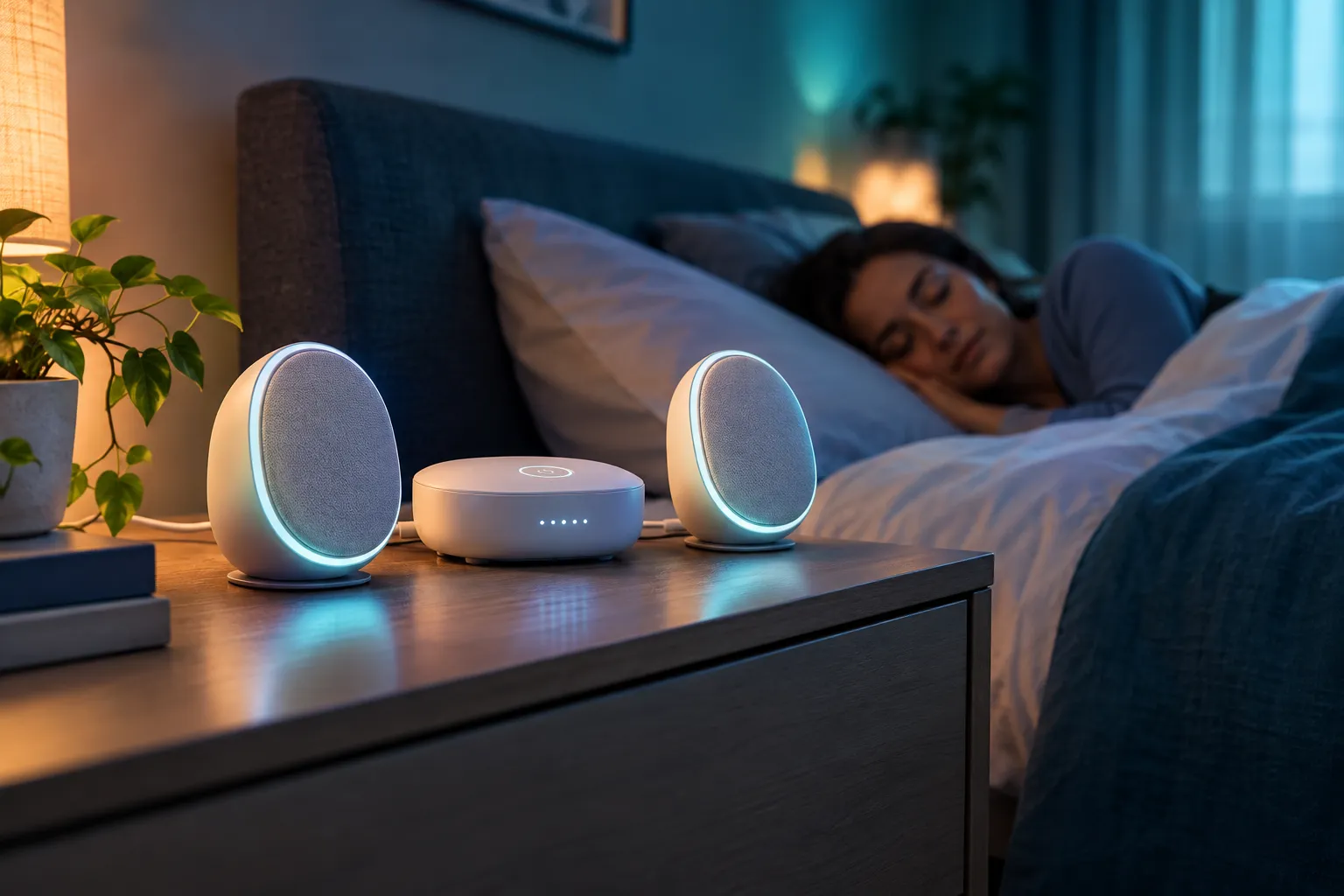
SleepHub is a bedside sleep-support system consisting of a base unit and speakers positioned near the sleeper. Rather than relying on medication, light therapy or physical stimulation, it uses specially designed sound patterns intended to support the brain’s natural sleep processes.
The technology, known as SleepEngine, aims to help regulate disrupted sleep patterns over time rather than simply provide temporary relief on a single night. Its developers believe this approach may offer an alternative for people who struggle to achieve consistent, restorative sleep.
This is particularly relevant to Parkinson’s disease, where sleep difficulties can take several forms. People may experience frequent waking, difficulty falling asleep, REM sleep behaviour disorder and other disturbances associated with the condition. Night-time movement difficulties, medication schedules and other symptoms can also interfere with rest.
A non-drug approach such as SleepHub may therefore be worth investigating, particularly for people who would prefer to avoid adding another medication to an already complex treatment routine. However, its effectiveness for the specific sleep problems associated with Parkinson’s disease still needs to be established.
The Partnership Behind the Parkinson’s Trial
Cambridge Sleep Sciences began collaborating with Parkinson’s Concierge in March 2021 to investigate whether SleepHub could help people living with Parkinson’s improve their sleep.
The initial approach was cautious, beginning with a small pilot and allowing the results to guide decisions about further research. The intention was to explore the technology’s potential before progressing to more extensive clinical investigations.
In March 2026, Barkby Group reported further progress, stating that Cambridge Sleep Sciences had begun additional clinical work to assess the benefits of its sleep technology across different health conditions. The company also confirmed that the initial Parkinson’s user trial had been expanded, with reported improvements in participants’ sleep continuing to be encouraging.
Although this represents progress, it is important to distinguish between promising user experiences and established clinical evidence. Publicly available information has not yet provided a comprehensive, peer-reviewed account of the Parkinson’s trial, including detailed outcome measurements, participant numbers and statistical analysis.
Consequently, the reported improvements should be regarded as preliminary rather than definitive proof that SleepHub is effective for Parkinson’s-related sleep disturbances.
What Research in Other Insomnia Populations Shows
Although evidence specific to Parkinson’s disease remains limited, studies involving people with insomnia provide some background on the technology’s potential.
One diary-based study followed 36 adults experiencing insomnia symptoms over 21 nights. Participants’ reported sleep duration increased from approximately 4.2 hours at the beginning of the study to 6.8 hours by the end. The study also reported fewer night-time awakenings and an improvement in sleep efficiency, which measures the proportion of time in bed spent asleep.
A separate 12-week pilot involving 20 adults with chronic insomnia examined the effects of using the technology among people whose symptoms had persisted for at least six months and who had not responded adequately to conventional treatment. More than two-thirds of participants reportedly experienced a clinically meaningful improvement in sleep quality. Improvements were also reported to persist for eight weeks after use of the device ended.
Other summaries of research into SleepEngine have described additional positive findings in people with insomnia, including improvements measured using the Pittsburgh Sleep Quality Index, a questionnaire commonly used to assess sleep quality.
These findings provide a reason to investigate the technology further. However, results from general insomnia studies cannot automatically be applied to Parkinson’s disease. The underlying causes of sleep disruption may differ, and the device’s effectiveness will need to be assessed in people with Parkinson’s using appropriately designed studies.
Why Better Sleep Matters for Parkinson’s Disease
Sleep disturbance can have a substantial impact on the wellbeing of people living with Parkinson’s disease. Poor sleep may contribute to daytime fatigue, reduced concentration, mood difficulties and a lower overall quality of life. Night-time symptoms can also place additional demands on family members and caregivers.
Parkinson’s-related sleep problems are complex because they can arise from several overlapping factors, including neurological changes, movement difficulties, medication effects and other sleep disorders. This means that a device designed to support sleep may be useful for some people but may not address every underlying cause.
SleepHub’s non-pharmacological approach is potentially attractive because it does not involve taking another drug. Nevertheless, non-drug technology should not be assumed to be risk-free or effective simply because it avoids medication. Its suitability will depend on the individual’s symptoms, and it should complement rather than replace appropriate medical assessment and treatment.
Further research will be needed to determine which people with Parkinson’s might benefit most, what improvements can realistically be expected and whether those benefits are sustained over time.
What Happens Next?
The expansion of the Parkinson’s user trial suggests that Cambridge Sleep Sciences is continuing to investigate SleepHub’s potential beyond the general insomnia market. The next important step will be the publication of detailed Parkinson’s-specific findings.
Ideally, future research would include clearly defined outcomes, an adequate number of participants, appropriate comparison groups and validated measures of sleep quality. It would also help establish whether the device benefits particular symptoms, such as difficulty staying asleep, and whether improvements translate into better daytime functioning and quality of life.
Until these results become available, it remains difficult to assess the size and reliability of any benefit for people with Parkinson’s disease.
Cambridge Sleep Sciences’ SleepHub device represents an interesting developing approach to managing sleep difficulties, including those experienced by people living with Parkinson’s disease. Its sound-based technology has shown encouraging results in studies involving people with insomnia, while the expansion of the Parkinson’s user trial indicates continued interest in its potential application.
However, promising findings in the general insomnia population do not establish effectiveness in Parkinson’s disease. More detailed, independently assessable clinical evidence is needed before firm conclusions can be drawn.
For people with Parkinson’s and their caregivers, SleepHub may be worth following as research develops. Anyone considering using the device should discuss persistent sleep problems with their neurologist or healthcare professional, particularly when symptoms may be linked to medication, REM sleep behaviour disorder or other conditions requiring specific treatment.
The key question is whether future clinical studies can confirm that the technology delivers meaningful, lasting improvements for people with Parkinson’s disease. Until then, SleepHub should be viewed as a promising area of investigation rather than a proven treatment for Parkinson’s-related sleep problems.