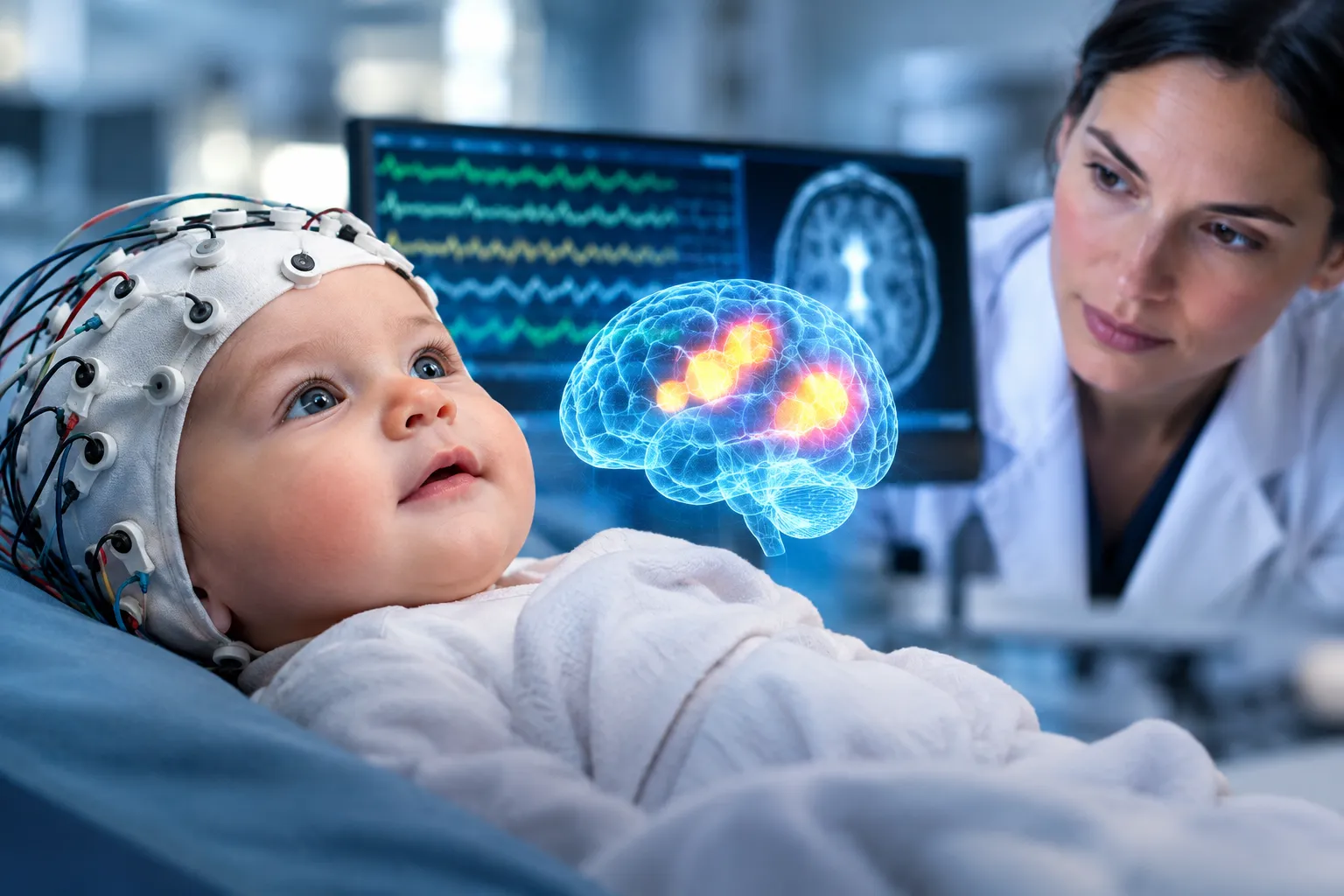
A five-month-old baby cannot tell you what it feels like to see a toy appear and vanish behind a cloth. Yet researchers now believe the infant brain is already producing measurable signals tied to that experience. According to a Robinson College report, scientists pinpoint brain marker of infant consciousness in new Cambridge study, drawing on work by neuroscientist Lorina Naci that links coordinated brain network activity in babies to the earliest signs of conscious awareness [1].
This emerging research doesn’t claim to have solved one of science’s oldest puzzles. Instead, it offers the clearest evidence yet that the building blocks of conscious experience exist far earlier in life than many assumed.
Key Takeaways
- Cambridge-linked research highlights coherent activity across large-scale brain networks as a possible early sign of consciousness in infants [1].
- A landmark 2013 study identified a delayed “late slow wave” brain response in babies, similar to the adult P300 signal tied to conscious perception [2][3].
- Full-term newborns show adult-like default mode and attention network activity that premature infants lack, suggesting consciousness emerges around term age [4].
- Experts increasingly favor combining multiple markers rather than relying on one single signal [5][6][7].
- Many scientists caution that no marker proves subjective experience outright, urging careful interpretation of headlines [8].
How Scientists Pinpoint Brain Marker of Infant Consciousness in New Cambridge Study
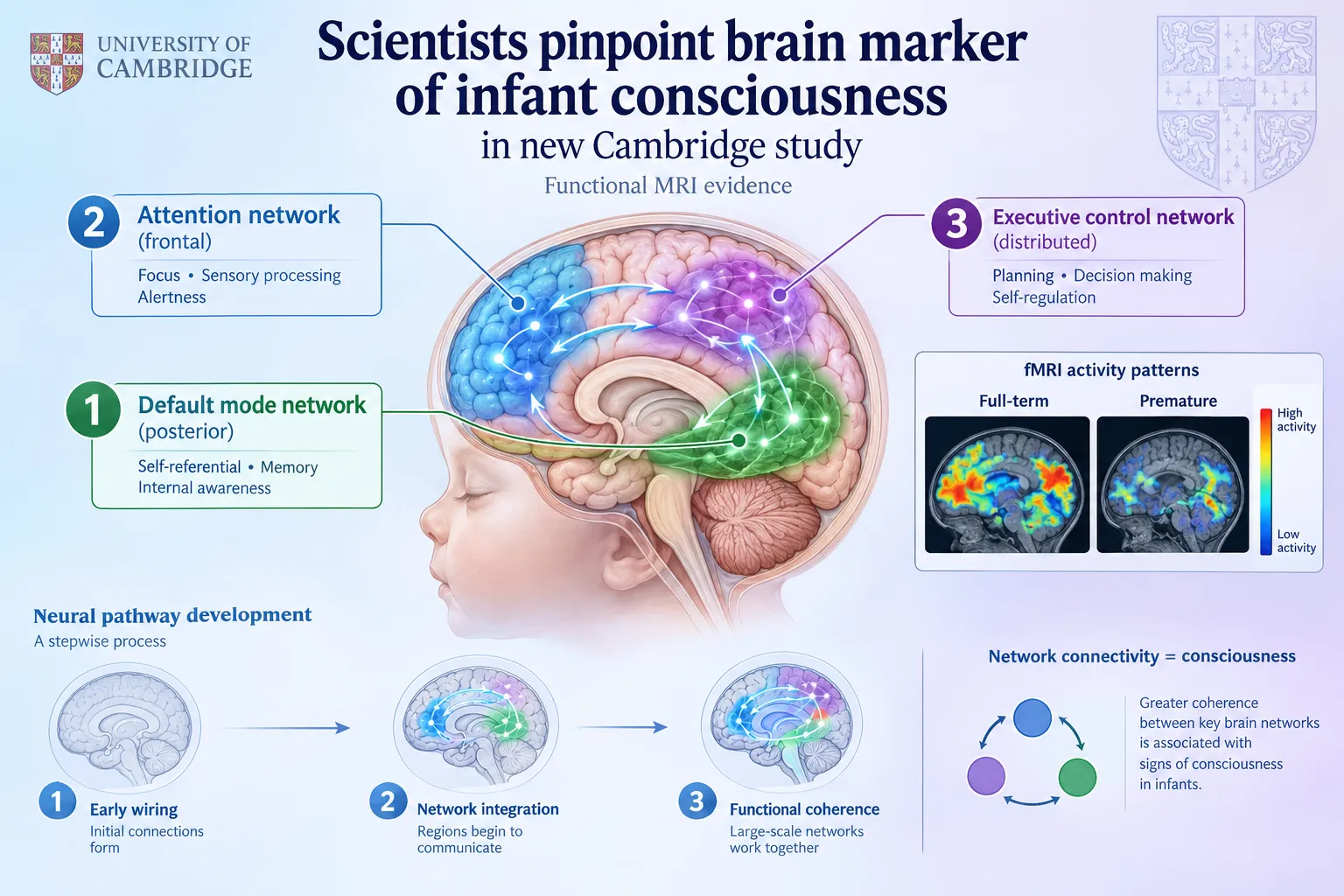
The Cambridge-associated discussion builds on functional MRI work showing that full-term newborns display brain activity resembling the adult default mode, attention, and executive control networks. Premature infants scanned earlier do not show this same pattern [1][4].
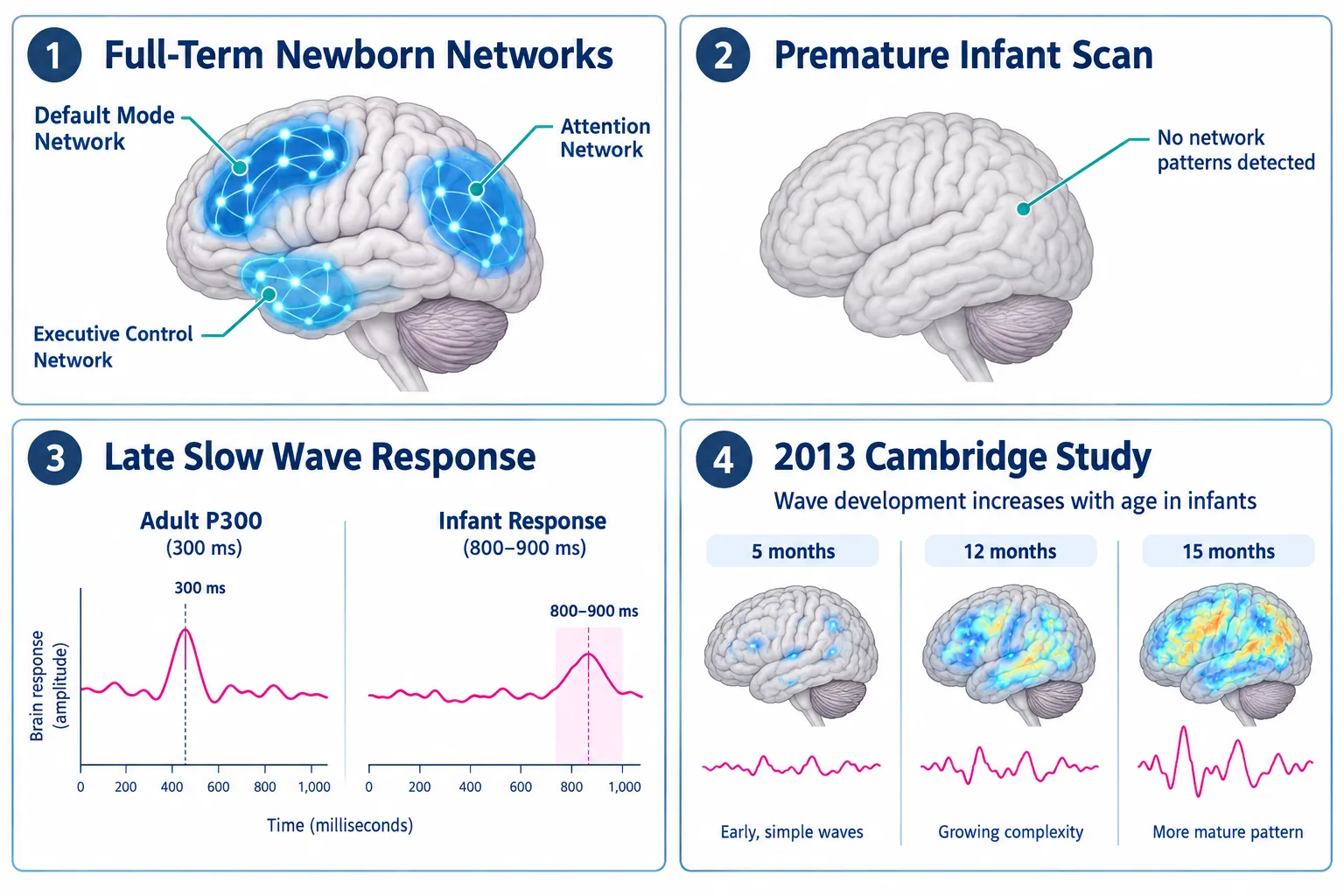
Researchers describe this as a reciprocal “dance” between networks responsible for internal thought and external attention, something long considered a hallmark of conscious experience in adults [4]. When this coordinated dance is absent, as in babies born between roughly 32 and 37 weeks gestation, the networks appear disconnected and immature [4].
This doesn’t mean premature infants lack any inner experience. Rather, it suggests that a key network-level marker tends to emerge closer to full-term development [1][4].
The Late Slow Wave: A Core Piece of Evidence
The most frequently cited brain signal tied to infant consciousness is a delayed, P300-like “late slow wave.” A landmark 2013 Science study recorded brain responses in 80 infants aged 5, 12, and 15 months after brief visual stimuli [2].
In adults, this wave appears about 300 milliseconds after a stimulus and strongly correlates with conscious perception. In infants, the same pattern showed up, but much slower:
- Around 1,000+ milliseconds in 5-month-olds
- About 800-900 milliseconds in 12- and 15-month-olds
- Roughly 300 milliseconds in adults [2][3][8]
Researchers interpreted this gradual “speeding up” as evidence that the neural machinery for conscious perception exists early, even if its timing is still maturing [2][8].
“The results suggest infants already have the neural tools for conscious perception, even if those tools work more slowly than in adults.”, summarized from 2013 Inserm findings [3]
Importantly, this wave disappears when stimuli are masked from conscious perception, reinforcing its link to awareness rather than simple sensory processing [3].
Why One Marker Isn’t Enough
Not every researcher is comfortable relying on a single signal. A 2024-2025 theoretical framework proposed by Jacobo Frohlich and philosopher Tim Bayne argues for a “cluster-based” approach using four combined indicators:
- Late cortical responses (P300-like waves)
- Global-oddball auditory responses
- Functional connectivity across large brain networks
- Attentional blink and visual masking effects [5][6]
Their analysis concludes that, taken together, these markers make consciousness “highly probable” by around five months of age, and possibly present even earlier [5][6].
A related 2024 Neuron review focused specifically on newborns and late-term fetuses, identifying similar markers and noting P300-like responses to unexpected sounds in alert three-month-olds [4][7].
German researchers have also tested this using magnetoencephalography, exposing sleeping newborns to patterns of low and high tones. Distinct brain signals appear when the pattern is unexpectedly broken, an effect similar to how adult brains register surprising changes in their environment [7].
What Scientists Still Don’t Know
Despite these findings, experts remain cautious about overstating the evidence. Coverage from New Scientist and other outlets stresses that these markers measure brain activity correlated with consciousness, not subjective experience itself [8].
Several unresolved questions remain:
- Exactly when neural timing becomes “fast enough” for full conscious awareness
- Whether consciousness is better understood as a graded spectrum rather than an on/off switch [9]
- How ethical and philosophical concerns should shape future infant research
As one NYU commentary put it, these tools help researchers infer consciousness indirectly, not confirm it outright.
Conclusion
The claim that scientists pinpoint brain marker of infant consciousness in new Cambridge study reflects a meaningful step forward, not a final answer. Converging evidence from brain imaging, late slow waves, and auditory response tests suggests that by around five months of age, and possibly earlier, infants may already possess the neural foundation for conscious experience [10].
For parents, caregivers, and clinicians, the practical takeaway is simple: treat infants as likely aware, responsive beings whose inner experience may be developing earlier than previously assumed. For researchers, the next step is refining multi-marker frameworks and continuing ethically careful studies into when, and how, consciousness truly begins.
References
- Pinpointing When IT Begins Young Humans Scientists Hope Better Understand What Consciousness. robinson.cam.ac.uk.
- Science.1232509. science.org.
- Are Babies Endowed with Consciousness. presse.inserm.fr.
- Consciousness Birth Imaging Studies Explore Possibility. science.org.
- Researchers Propose a New Way to Identify When Babies Become Conscious. birmingham.ac.uk.
- Consciousness Neurodevelopment 25799. neurosciencenews.com.
- S0896 6273(24)00285 X. cell.com.
- Dn23401 Emerging Consciousness Glimpsed in Babies. newscientist.com.
- We May Have to Rethink Consciousness Completely Heres Why. sciencefocus.com.
- 231012161754. sciencedaily.com.