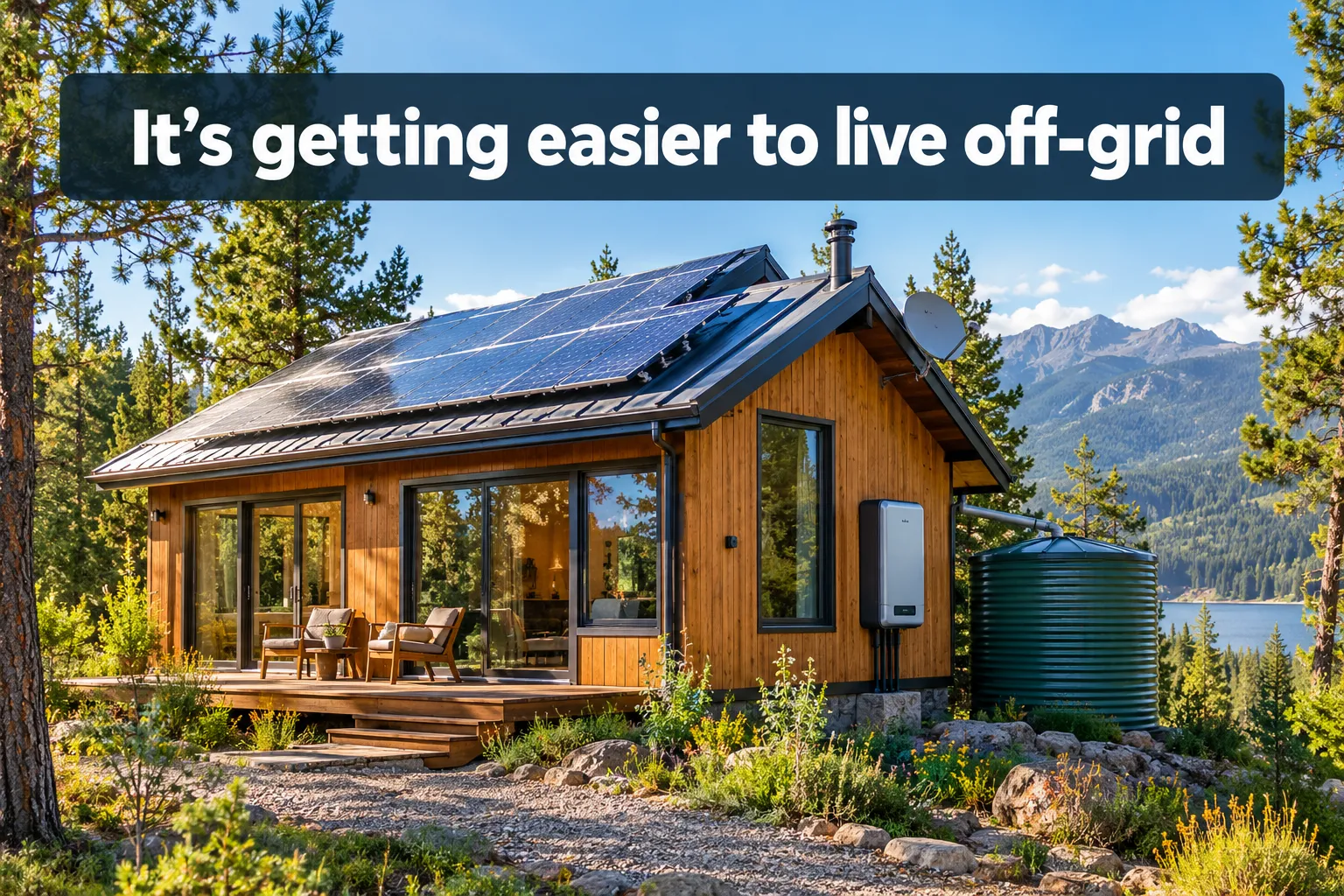
More than 4.2 million rooftop solar systems now sit on homes in a single advanced market, and over 460,000 home batteries were added in less than a year.[9] That kind of scale would have seemed unthinkable a decade ago. Yet the same data that proves off-grid living is more accessible than ever also reveals a stubborn truth: it’s getting easier to live off-grid, but it comes with certain costs that go far beyond the price of a solar panel.
Batteries, permits, satellite internet subscriptions, and even child-welfare investigations are now part of the off-grid conversation. This article breaks down what has actually changed, what it still costs, and what to weigh before disconnecting from the grid.
Key Takeaways
- Rooftop solar and home battery adoption have surged, making partial or full off-grid setups more technically achievable than ever.[9]
- A typical 10-13.5 kWh home battery still costs roughly $9,000 to $18,000 installed, before incentives.[16][19][20][21][22][26][30]
- Solar hardware alone can run $2.74,$3.30 per watt, pushing full systems into the tens of thousands of dollars.[10]
- Off-grid living is legal in all 50 U.S. states, but local codes and “minimum standards of care” laws can still force a grid connection.[12]
- New microgrid rules in places like Nigeria and New Mexico add registration, permitting, and renewable-energy requirements for community-scale systems.[35][37][38][40][41]
It’s Getting Easier to Live Off-Grid: What’s Changed
The hardware behind off-grid living has matured quickly. Rooftop solar has moved from a niche upgrade to a mainstream home feature, and battery storage has followed close behind, with hundreds of thousands of units installed in less than 12 months in one major market alone.[9] This growth reflects falling technical barriers, not just consumer enthusiasm. Solar panels are more efficient, batteries last longer, and installers have more experience wiring systems that can run a home independently of the utility grid.
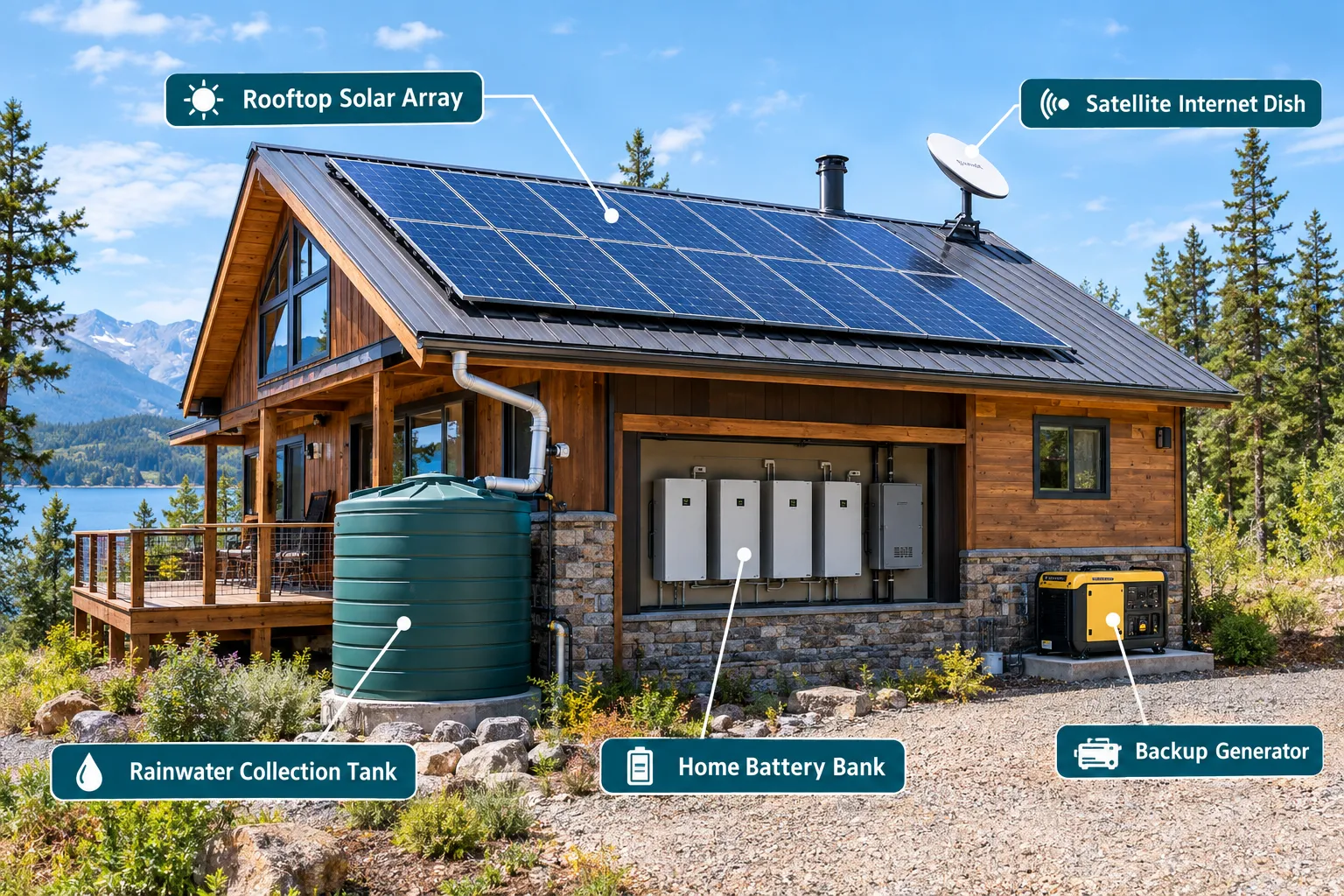
Connectivity has closed another major gap. Newer satellite internet hardware, such as the latest Starlink dish generation, delivers speeds above 375 Mbps while drawing only 35-50 watts on average, roughly half the power draw of earlier models.[10] That efficiency matters enormously for a home running entirely on stored solar energy, since every watt used by a router or dish is a watt not available for lighting, refrigeration, or water pumps.
Household appliances designed specifically for off-grid use are also emerging. In April 2026, an Indian energy company launched an off-grid solar cooking system built for homes operating outside or at the margins of the national grid, offering an alternative to gas or biomass fuel.[15] Community infrastructure is expanding too. A platform tracking off-grid living lists roughly 90 communities, mostly in Portugal, where people can visit, live, or work, turning what was once a solitary lifestyle into something closer to a network.[2]
But It Comes With Certain Costs: The Real Price Tag
Despite the technological progress, the financial reality of full independence is steep. In 2026, a 10-13.5 kWh home battery system, the size needed to carry an average household through an evening or a cloudy day, typically costs between $9,000 and $18,000 installed, or roughly $700 to $1,300 per usable kilowatt-hour before any incentives.[16][19][20][21][22][26][30] That is before counting the solar panels themselves.
Solar hardware pricing adds further weight to the bill. One 2026 technical review estimated branded residential solar installations at $2.74 to $3.30 per watt before incentives, meaning a modest household system can climb into the tens of thousands of dollars once panels, batteries, and installation labor are combined.[10]
“The technology to go off-grid has never been more available. The bill to actually do it has not shrunk nearly as fast.”
Not every off-grid build is expensive, though. A 21-year-old Australian artist rebuilt a bushfire-destroyed home in Tasmania into an off-grid cabin for about AU$7,000, using salvaged materials alongside rooftop solar, battery storage, and rainwater tanks.[8] That example shows cost can be minimized with labor, salvage, and remote-area ingenuity, but it also required significant personal time and physical work that most households cannot or will not take on.
Legal and Regulatory Hurdles That Can Undermine Off-Grid Plans
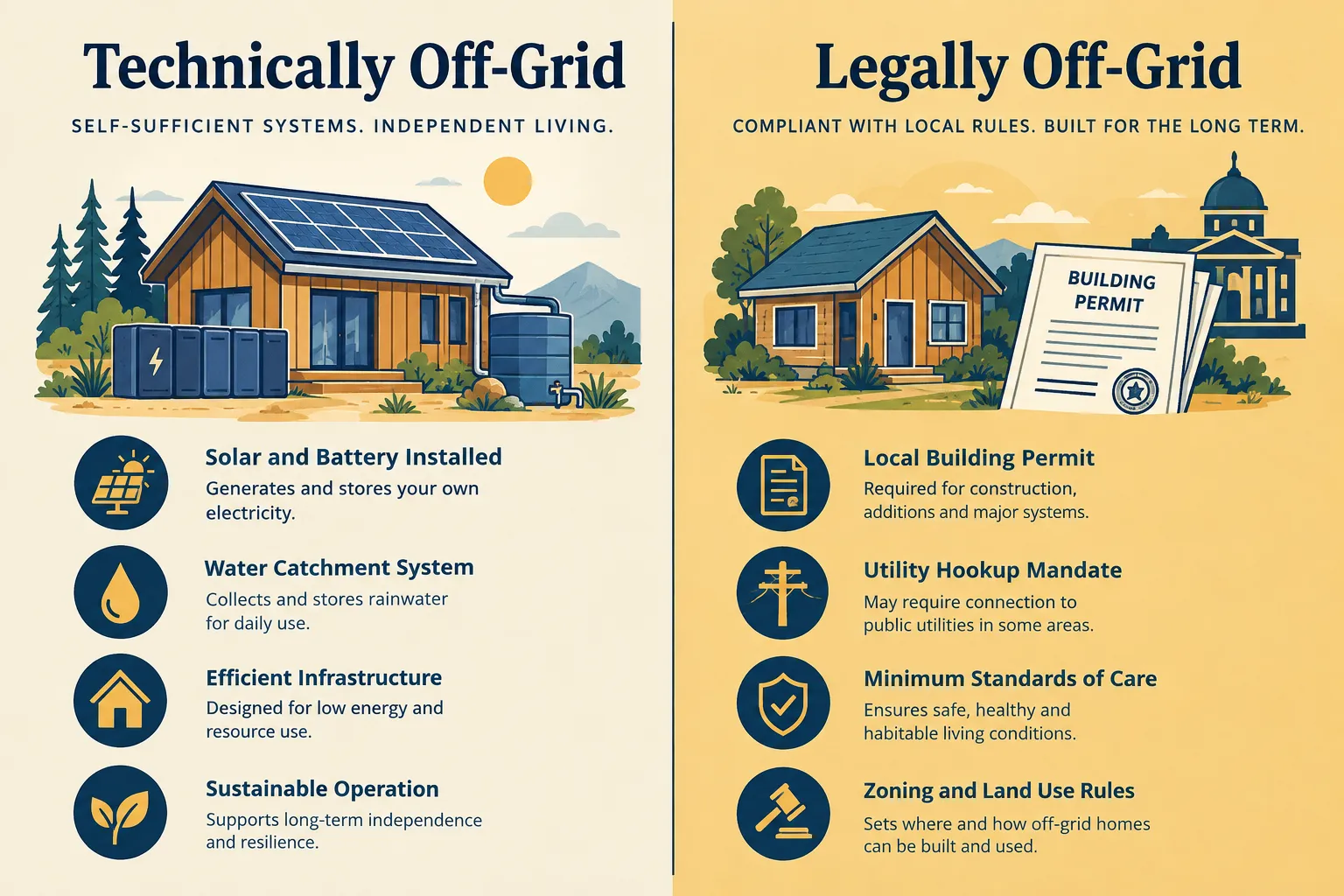
Technology and money are only two parts of the equation. Legal status is the third, and it is often overlooked. Off-grid living is technically legal in all 50 U.S. states, but local building codes, mandatory grid-tie requirements, and “minimum standards of care” laws in states such as Florida, California, and Alabama can still require a physical utility connection before a home can be legally occupied.[12] A household can own solar panels, batteries, and a well, and still be out of compliance simply because the local code demands a grid hookup.
Community and microgrid projects face their own layer of rules. Nigeria’s Mini-Grid Regulations 2026 set a detailed framework for isolated systems up to 5 megawatts and interconnected systems up to 10 megawatts, requiring registration for anything under 100 kilowatts and full permits with ongoing reporting for larger projects.[35][37][38][44] In the United States, New Mexico’s Microgrid Oversight Act, effective around May 20, 2026, gives state regulators authority over larger microgrids and requires new projects to start at 40% renewable energy, rising to 100% zero-carbon power by 2045.[33][40][41]
Social risk is a less obvious but real cost. In 2026, an off-grid couple living in woodland in central Italy had their three children removed by child protection authorities, a case that drew international attention even after the family was later granted more access.[1] Unconventional living arrangements can trigger official scrutiny, particularly where children, sanitation, or safety standards are involved.
Weighing the Trade-Offs Before You Go Off-Grid
| Factor | Getting Easier | Still Costly or Risky |
|---|---|---|
| Solar hardware | More efficient, widely available | $2.74,$3.30 per watt before incentives[10] |
| Battery storage | Mainstream adoption growing fast[9] | $9,000,$18,000 per system[16][19][20][21][22][26][30] |
| Connectivity | Efficient satellite dishes now available[10] | Ongoing subscription dependency |
| Legal status | Legal in all 50 U.S. states[12] | Local codes may force grid connection[12] |
| Community support | Nearly 90 communities now listed[2] | Regulatory reporting for larger systems[35][40] |
Large-scale investment is also reshaping the supply chain that off-grid households depend on. Romania recently allocated roughly €650 million for solar and storage on public buildings, and U.S. solar installers added 11.4 gigawatts of new capacity in a single quarter, a 45% jump year-over-year.[3] That kind of scale lowers equipment costs over time, even though most of that capacity serves grid-connected homes rather than fully independent ones.
Conclusion
The evidence is clear: it’s getting easier to live off-grid, but it comes with certain costs that extend well beyond the sticker price of a solar panel. Hardware has become more capable and more efficient, and support communities have grown, yet battery systems, satellite subscriptions, permits, and legal compliance still demand serious money, time, and paperwork. Anyone considering the leap should start by checking local building codes and utility-connection requirements before buying equipment, then budget realistically for battery storage, not just solar panels. Talking to an existing off-grid community, whether local or through a listed network, can also reveal practical costs that spreadsheets miss. Independence is more achievable than ever, but it rewards careful planning far more than enthusiasm alone.
References
[1] Off Grid Uk Australian Couple Italy Given More Access To Children Court Ntwnfb – https://theguardian.com/australia-news/2026/sep/02/off-grid-uk-australian-couple-italy-given-more-access-to-children-court-ntwnfb [2] theportugalnews – https://www.theportugalnews.com/news/2026-08-28/grow-lists-90-off-grid-communities-to-visit-stay-or-work-at/1076597 [3] News – https://www.offgridlivingsurvival.com/news [8] timesofindia.indiatimes – https://timesofindia.indiatimes.com/world/rest-of-world/at-21-an-australian-artist-bought-25-acres-in-tasmania-18-months-later-a-bushfire-destroyed-her-first-home-so-she-rebuilt-it-from-salvage-materials-into-an-off-grid-cabin-for-au7000-10000/articleshow/134086025.cms [9] It Getting Easier To Live Off Grid But It Comes With Certain Costs – https://www.bignewsnetwork.com/news/279314724/it-getting-easier-to-live-off-grid-but-it-comes-with-certain-costs [10] The Definitive Off Grid High Tech Log Home – https://glitchwire.com/news/the-definitive-off-grid-high-tech-log-home/ [12] Off-grid living legal explainer – referenced via off-grid law and policy research [15] SWELECT Energy Systems off-grid solar cooking announcement – referenced via industry news research [16][19][20][21][22][26][30] Home battery cost analyses – referenced via 2026 market research [33][40][41] New Mexico Microgrid Oversight Act – referenced via state legislative research [35][37][38][44] Nigeria Mini-Grid Regulations 2026 (NERC-R-001-2026) – referenced via regulatory research


