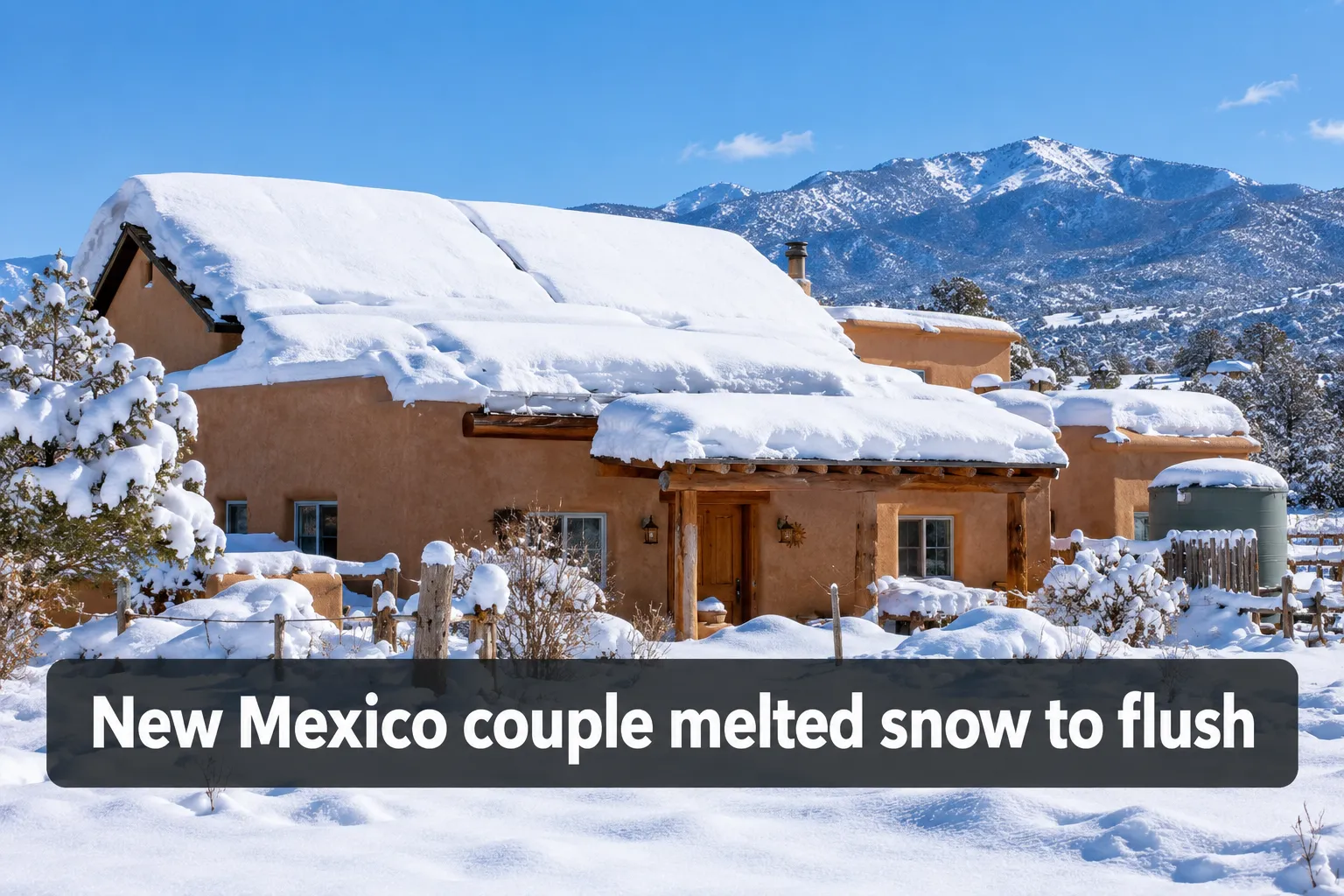
A single heavy snowfall can shut down an entire off-grid home in hours. That is exactly what happened to a couple living on 40 acres of remote land in northern New Mexico, when snow completely covered their rooftop solar panels, cut power to their well pump, and left them melting snow by hand just to flush a toilet during a family visit [2][3][4]. Their story, first published as a personal essay in September 2026, has since spread across multiple outlets as a cautionary tale about the hidden fragility of off-grid living [1][2].
The incident is a small but telling example of how quickly comfort and sanitation can unravel when a home depends entirely on weather-sensitive power systems. It also raises a bigger question for anyone considering off-grid life in a snowy climate: what happens when the sun disappears under a foot of white powder?
Key Takeaways
- A New Mexico couple melted snow to flush toilets after winter buried their off-grid solar panels, cutting power to their well pump during a family gathering [2][3][4].
- The couple’s 40-acre property has no municipal utility connection, relying solely on rooftop solar and an electric well pump for water [2][3][4].
- Family members used the bathroom before realizing the toilets could not refill, forcing an improvised fix using melted snow [2][3][4].
- Experts note that snow cover on rooftop panels can fully shut down power output, and recommend better panel placement, tilt angles, and snow-management planning [1].
- Regional snowpack data show 2025 was actually a low snow year overall, meaning localized heavy accumulation can still overwhelm a system even during a broader “snow drought” [12].
How Winter Snow Buried This Off-Grid Solar System
The couple’s home sits on roughly 16 hectares, or about 40 acres, far from any city grid [2][3][4]. Like many off-grid properties, their setup depends on two connected systems: rooftop solar panels that generate electricity, and an electric pump that pulls water from a private well. When one system fails, the other usually fails with it.
During a stretch of heavy winter weather, snow piled up directly on the solar array, blocking sunlight from reaching the panels. Without sunlight, the panels stopped producing usable power. Without power, the well pump could not run. Without the pump, no water moved into the home’s pipes, including the tank that lets a toilet refill and flush [2][3][4].
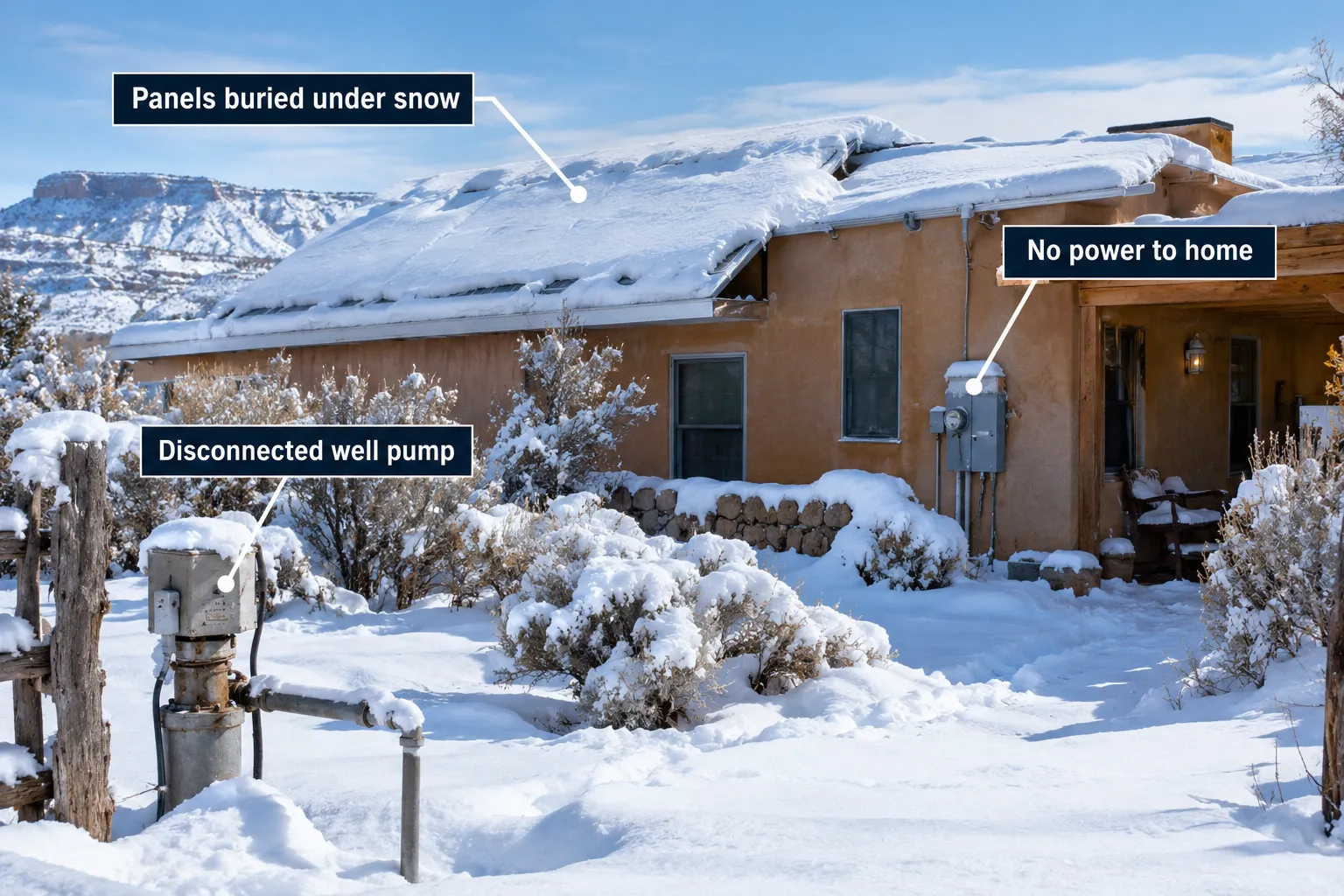
This chain reaction is not unique to one household. Sustainable-living outlet The Cool Down has pointed to this exact case as proof that snow accumulation on rooftop panels can shut down an entire off-grid power supply, not just reduce it [1]. Unlike grid-connected homes, where a cloudy or snowy week is merely an inconvenience on an electric bill, off-grid homes have no backup utility to lean on when the panels go dark.
New Mexico Couple Melted Snow to Flush Toilets: What Happened Next
The problem became urgent during a holiday gathering. At least two visiting family members used the bathroom before anyone in the household realized the toilets were not refilling [2][3][4]. With guests in the house and no working plumbing, the couple needed a fast, low-tech solution.
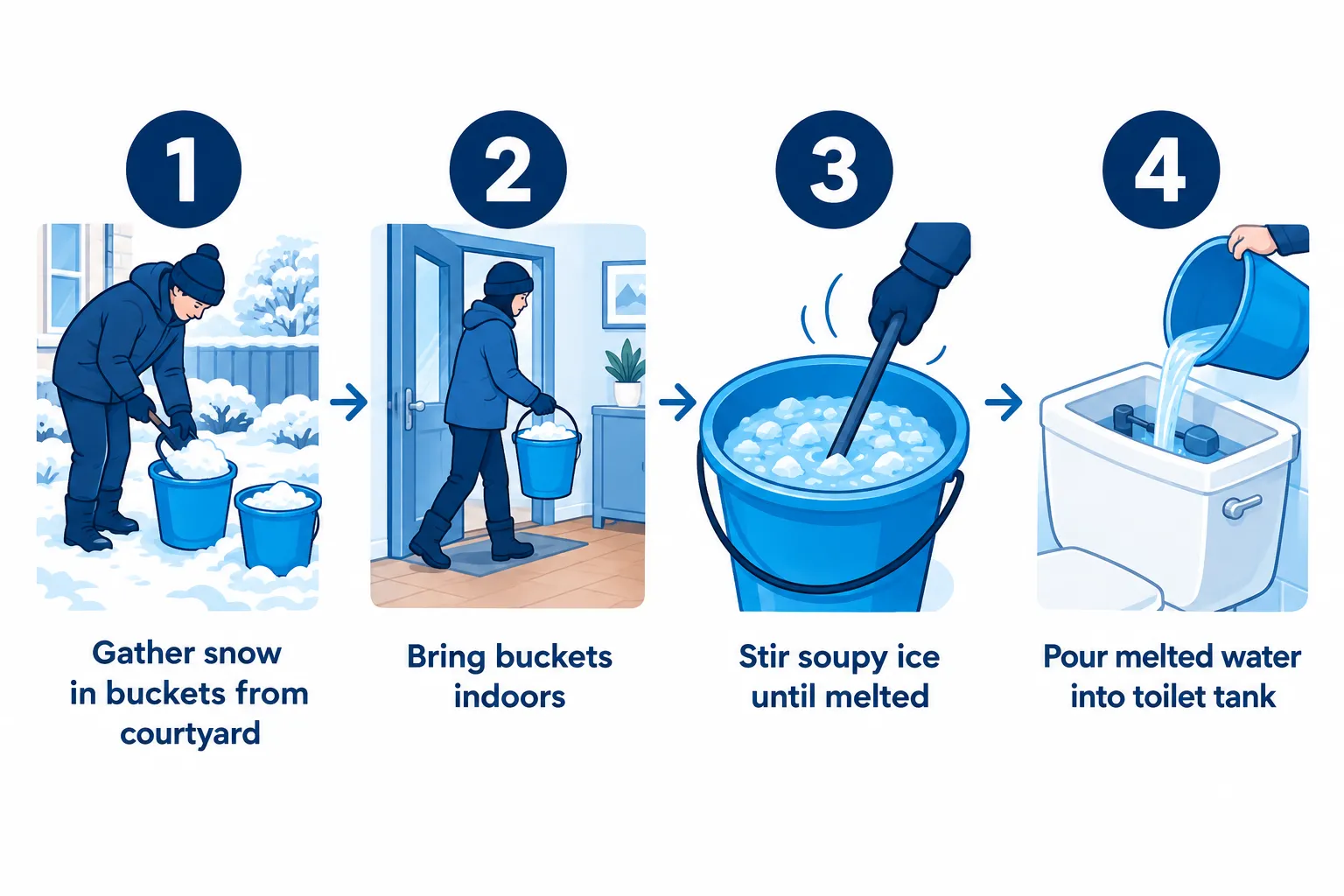
They turned to the snow already piled in their courtyard. Working with family members, they filled buckets with snow, brought it inside, and stirred the mixture until it turned into what one account described as “soupy ice,” eventually melting into dirty water flecked with twigs and debris [2][3][4]. That melted snow was then poured directly into the toilet tanks, giving the household just enough water pressure to flush.
“It was one of several unexpected challenges of off-grid life,” the homeowners later wrote, describing the moment as both stressful and oddly memorable [2].
It worked, but only as a stopgap. The couple still needed to restore power to the solar array and pump before normal water service could resume.
Why Off-Grid Homes Are Vulnerable to Snow and Power Loss
This story highlights a structural weakness common to many off-grid properties: a single point of failure connecting power and water. When solar is the only electricity source and a well pump is the only water source, any disruption to the panels ripples instantly into the bathroom.
Industry guidance on off-grid solar installation in New Mexico stresses the importance of “winter design conditions,” meaning systems should be engineered around the region’s coldest, snowiest scenarios, including panel placement, tilt angle, and safe access for clearing snow [11]. A poorly angled array or one mounted low on a roof can accumulate snow far more easily than a steeply tilted, elevated system designed with winter loads in mind.
Ironically, official snowpack data for the broader region show that Water Year 2025 was actually a below-average snow year across New Mexico and Arizona, with snow-water equivalent generally under half of the historical median at most monitoring stations [12]. That regional shortfall did not prevent a heavy, localized snow event from burying one rooftop array, a reminder that averages can mask serious local extremes.
Better Solutions: Designing Off-Grid Systems for Winter Resilience
Some off-grid homes in the same region have engineered around this exact failure mode. Earthship-style homes near Taos, New Mexico, for example, are built to capture roughly 12 inches of annual precipitation, including snowmelt, and reuse each gallon of water up to four times: first for drinking and washing, then indoor irrigation, then toilet flushing, and finally outdoor landscaping [7][9].
Other eco-conscious off-grid builds use large underground cisterns, sometimes paired 1,700-gallon tanks, to collect rain and snowmelt from rooftops, then filter, pressurize, and route that water through gray-water systems before it ever reaches a toilet [10]. These designs remove the dependency on a single electric pump tied to a single power source.
| Approach | Water Source | Power Dependency | Resilience to Snow |
|---|---|---|---|
| Couple’s system | Private well pump | Fully dependent on solar | Low |
| Earthship-style home | Roof-collected rain/snowmelt | Minimal pump reliance | Higher |
| Cistern-based system | Underground storage tanks | Partial | Higher |
Survival guides on temporary water outages also confirm that melting snow indoors, in buckets or bathtubs, is a recognized emergency technique, but they frame it clearly as a short-term fix, not a sustainable strategy for daily living [6].
Lessons for Off-Grid Homeowners in Snowy Climates
The wider media narrative around this case treats it as part of a larger warning: off-grid living can be far less romantic than social media makes it look [1][2]. Seasonal access problems, extreme weather, and single-system failures are common realities that rarely appear in glossy photos of remote cabins.
For anyone building or buying an off-grid property in a snowy region, a few practical steps can reduce the risk of repeating this couple’s experience:
- Install panels at a steep tilt angle so snow slides off naturally.
- Elevate arrays or ensure safe rooftop access for manual snow clearing.
- Add battery storage sized for multi-day outages, not just overnight use.
- Consider backup water storage, such as cisterns, separate from the electric pump.
- Plan for guest usage spikes during holidays, when demand on limited systems increases suddenly.
Conclusion
The story of the New Mexico couple who melted snow to flush toilets after winter buried their off-grid solar panels is more than a quirky anecdote. It is a real-world illustration of how a single weather event can disable both power and water in a home with no utility backup. The fix they improvised, melting snow by hand, worked in the moment, but it underscores why off-grid design should plan for the worst winter scenario, not the average one. Anyone considering this lifestyle should study panel placement, backup water storage, and pump redundancy before the first snowstorm arrives, not after.
References
[1] Off Grid Living New Mexico Snow Toilets – https://www.thecooldown.com/green-home/off-grid-living-new-mexico-snow-toilets/ [2] 3k6zw8t – https://africa.businessinsider.com/news/we-once-had-to-melt-snow-just-to-flush-our-toilet-it-was-one-of-several-unexpected/3k6zw8t [3] Wir Zogen In Ein Netzunabhaengiges Haus Diese 3 Dinge Ueberraschten Uns – https://www.businessinsider.de/leben/wir-zogen-in-ein-netzunabhaengiges-haus-diese-3-dinge-ueberraschten-uns/ [4] Wir Zogen Auf 16 Hektar Ohne Stromnetz Diese 3 Dinge Ueberraschten Uns Besonders – https://www.businessinsider.de/leben/wir-zogen-auf-16-hektar-ohne-stromnetz-diese-3-dinge-ueberraschten-uns-besonders/ [6] How To Survive Temporarily With No Running Water – https://www.littlehouseliving.com/how-to-survive-temporarily-with-no-running-water.html [7] Your Next Home Could Be An Earthship – https://www.altaonline.com/culture/architecture/a69500861/your-next-home-could-be-an-earthship/ [9] Earthships Sustainable Housing – https://www.wbur.org/hereandnow/2024/06/24/earthships-sustainable-housing [10] 4 Eco Friendly Off Grid Homes What They Cost To Build – https://tinyhousegiantjourney.com/2026/04/22/4-eco-friendly-off-grid-homes-what-they-cost-to-build/


