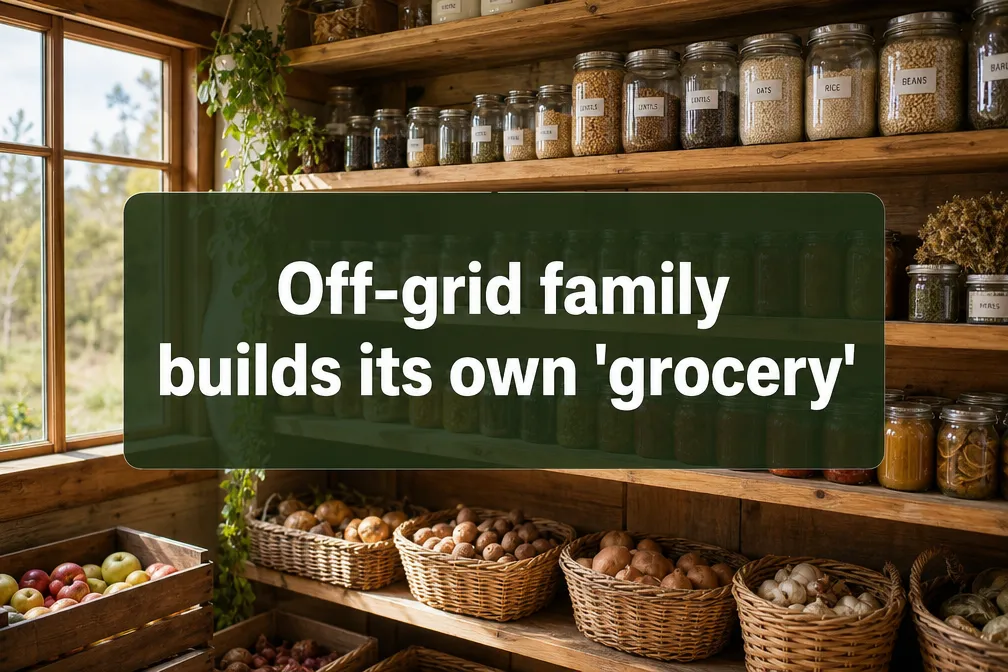
A family living without a connection to the public power grid recently turned a spare room into a scaled-down grocery store, complete with labeled shelves, organized food zones, and a rotation system rivaling many small markets. Their question afterward was simple but pointed: what actually belongs inside a pantry built to replace regular store runs? The story of how this off-grid family builds its own “grocery store” pantry, asks what belongs inside has resonated with readers because it addresses a growing concern for self-reliant households: how to stock a home efficiently, safely, and affordably when the nearest supermarket isn’t a quick trip away [1].
This trend isn’t isolated. Home “grocery store” pantries have appeared in coverage throughout 2026, from basement supermarkets built for under £400 to full pantry tours shared online [2][3][4]. The common thread is a shift toward centralized, well-organized food storage that mimics retail logic inside a private home.
Key Takeaways
- The off-grid family builds its own “grocery store” pantry, asks what belongs inside as part of a wider 2026 movement toward self-sufficient, in-home food storage [1][6].
- A functional pantry typically needs caloric staples, fats, proteins, produce, sweeteners, and condiments, plus basic health supplies [9].
- Experts recommend targeting roughly 2,000 calories per person daily, meaning a family of four needs about 240,000 calories for a 30-day supply [9].
- Storage conditions matter as much as the food itself: control oxygen, moisture, heat, and light using Mylar bags, oxygen absorbers, and food-grade buckets [9].
- Comparable home “supermarkets” have been built for under £400, showing that a grocery-store-style pantry does not require a large budget [3][4].
Why the Off-Grid Family Builds Its Own “Grocery Store” Pantry
The featured household lives without grid power, which changes how food shopping and storage normally work. Rather than making frequent trips to town, they created a dedicated space that keeps staples organized and accessible, described as supporting “a more self-sufficient routine” [1]. This approach bridges everyday convenience with long-term resilience, a balance that matters most when weather, terrain, or infrastructure limits regular access to stores [1][6].
The Cool Down’s Green Home section places this story alongside coverage of power shutoffs and neighborhood resilience, signaling that a stocked pantry is increasingly viewed as infrastructure preparedness, not just a design trend [6]. For off-grid families, a home “grocery store” reduces dependency on unpredictable trips and rising fuel or transportation costs.
What Belongs Inside an Off-Grid “Grocery Store” Pantry
When the family asked what belongs inside, the answer draws from both prepper-style planning and minimalist food philosophy. Combining these perspectives creates a practical, well-rounded list.
Core categories for a resilient pantry:
| Category | Examples | Purpose |
|---|---|---|
| Caloric staples | White rice, oats, whole wheat, pasta, dried beans | Provide bulk energy and shelf stability [9][12] |
| Fats | Olive oil, coconut oil, ghee, shortening | Add calories and cooking versatility [9][12] |
| Proteins | Canned meats and fish, dried legumes, peanut butter | Support nutrition without refrigeration [9][12] |
| Produce | Freeze-dried vegetables, canned tomatoes, onions, garlic, carrots, potatoes | Fill nutrient gaps and add flavor [9][12] |
| Sweeteners | Honey, sugar | Preserve well and aid morale foods [9] |
| Condiments | Salt, spices, vinegar | Improve taste of basic staples [9] |
| Extras | Tea, coffee, dried fruit, seeds | Support comfort and long-term variety [12] |
Basis Land’s guidance reinforces this list, recommending only shelf-stable, multi-use items with at least a three-month shelf life, while explicitly discouraging frozen foods, fresh bread, short-life dairy, and pre-packaged snacks in an off-grid setting [12].
Building the Pantry Like a Small Grocery Store
Turning a spare room into a functioning “store” requires more than shelves. It needs a system.
Steps used by similar households:
- Zone the space by category, grains, proteins, produce, condiments, just as a store organizes aisles [2][3].
- Use uniform containers, such as glass jars, metal baskets, or wooden crates, for visual clarity and pest resistance [3][4].
- Add a fridge or freezer if power allows, extending options beyond dry goods [3].
- Rotate stock every 12 to 18 months to keep supplies fresh and usable [9].
- Repackage bulk items into smaller, bug-proof containers for daily access [12].
This mirrors a three-layer storage model: long-term bulk storage in Mylar bags and food-grade buckets, mid-term rotating stock in jars and cans, and a rapid-deploy cache for immediate grab-and-go needs [9]. One family building a similar “grocery store” documented stocking the same products they typically buy in stores, effectively mapping supermarket aisles into their own home [2].
How Much Food an Off-Grid “Grocery Store” Pantry Actually Needs
A common mistake is underestimating quantity. Nutrition guidance suggests targeting 2,000 calories per person per day. For a family of four, a 30-day supply requires roughly 240,000 calories, achieved mainly through bulk rice, beans, and oats [9].
“Building a full-calorie reserve doesn’t happen overnight, it happens $20 to $30 at a time, added to every grocery run.”
This incremental approach, recommended by resilience planners, allows households to reach a 30-day supply before expanding toward 90 days or more [9]. It also matches how the Daily Mail-profiled mother and a separate couple built home supermarkets for under £400 by buying organic or bulk items on sale over time rather than all at once [3][4].
Storage Conditions That Make or Break the Pantry
Even the right foods fail without proper storage. Four factors determine shelf life: oxygen, moisture, heat, and light [9].
Practical storage tips:
- Use Mylar bags with oxygen absorbers for bulk grains and legumes [9].
- Store dry goods in airtight containers or jars, kept cool and dark [12].
- Choose under-bed, wood-box, or below-ground storage where possible [12].
- Rotate older stock to the front so nothing expires unnoticed [9][12].
These practices matter especially for an off-grid family builds its own “grocery store” pantry setup, where refrigeration may be limited and replacing spoiled food isn’t a quick errand.
Beyond Food: What Else Belongs Inside
Several homesteading resources emphasize that a true self-sufficient pantry includes more than groceries. Basic medicine shelves, first-aid supplies, household items, and hygiene products often sit alongside food staples, reducing dependency on outside stores for everyday needs [8][10][11]. This broader view answers part of what belongs inside: not just calories, but the essentials that keep a household functioning independently.
Conclusion
The story of an off-grid family builds its own “grocery store” pantry, asks what belongs inside reflects a practical response to rising costs, unpredictable power, and the desire for genuine self-reliance. The clearest answer combines caloric staples, fats, proteins, produce, sweeteners, condiments, and household basics, all stored with attention to oxygen, moisture, heat, and light control.
Anyone inspired by this approach can start small: pick one category, add $20 to $30 of shelf-stable food to the next grocery run, and build toward a 30-day supply before expanding further. Over time, the result is not just a stocked room, but a dependable system that functions like a personal grocery store, ready regardless of what happens outside the front door.
References
[1] Off Grid Family Builds Own 230500305 – https://www.yahoo.com/lifestyle/articles/off-grid-family-builds-own-230500305.html [2] Watch – https://www.youtube.com/watch?v=80ZIfMlrN90 [3] Mother Builds Grocery Store Home Make Sure Family Eats Healthily – https://www.dailymail.co.uk/lifestyle/article-15557193/Mother-builds-grocery-store-home-make-sure-family-eats-healthily.html [4] Couple Build Own Supermarket At Home For Less Than 400 So They Can Eat More Healthily – https://whatsthejam.com/lifestyle/couple-build-own-supermarket-at-home-for-less-than-400-so-they-can-eat-more-healthily/ [6] Green Home – https://www.thecooldown.com/green-home/ [8] Watch – https://www.youtube.com/watch?v=1iOaO5f2SKs [9] Prepper Pantry Food Storage Guide – https://shelterinsider.com/prepper-pantry-food-storage-guide/ [10] Watch – https://www.youtube.com/watch?v=sckHfH0yhAY [12] Basis Land minimalist pantry guide (June 11, 2026)


