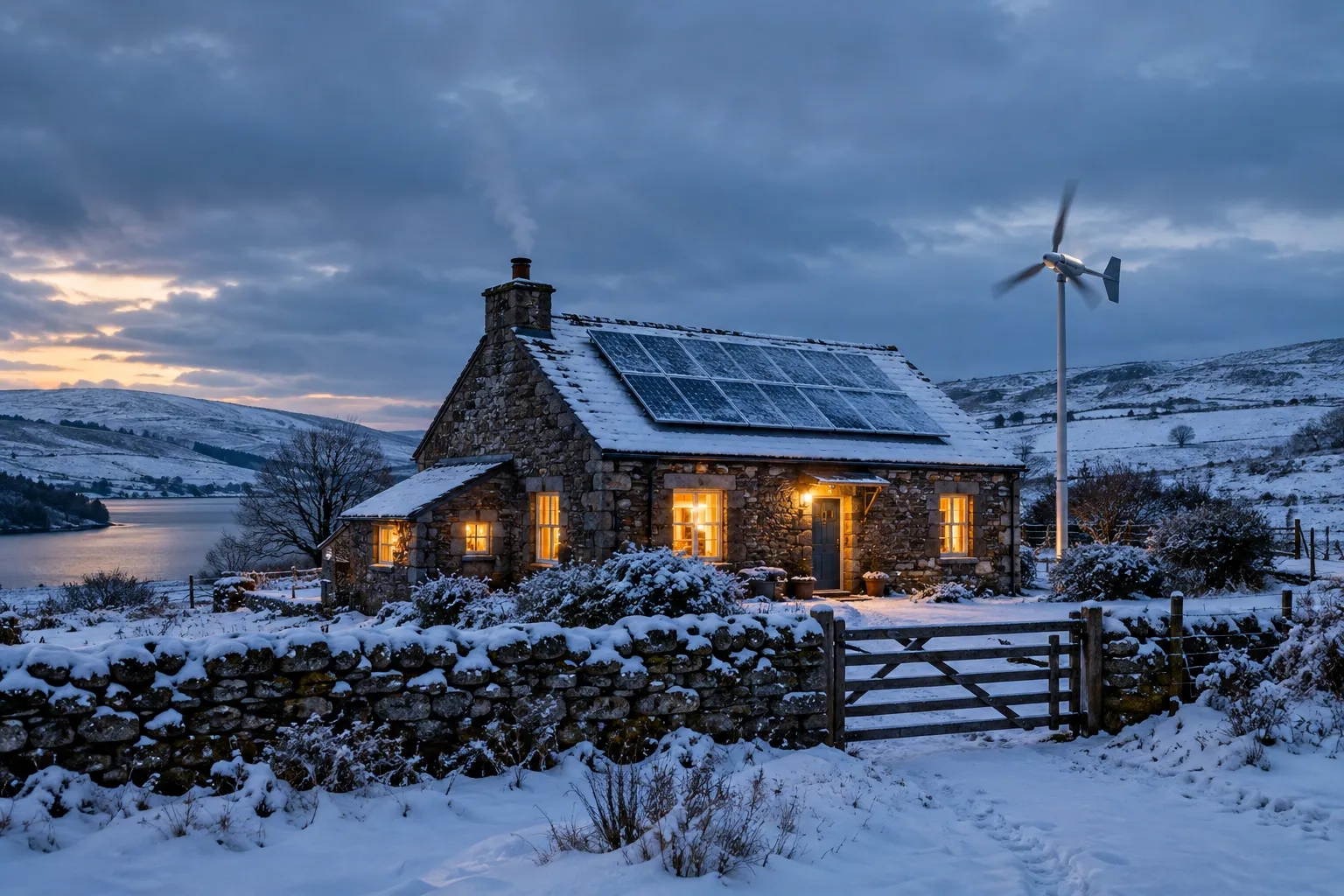
A single dark January week can drain a battery bank faster than three months of summer sunshine ever could. That gap between what off-grid systems promise and what British winters actually deliver is the central tension behind off-grid living in the UK: real costs and the winter problem, and it catches out far more newcomers than most marketing brochures admit.
Interest in energy independence has grown steadily across rural Britain, driven by rising grid connection costs, remote plots, and a desire for resilience. But according to industry data compiled by Powering Homes, the real costs of going off-grid vary enormously depending on location, household size, and how much backup capacity is built in [1]. Understanding both the financial picture and the seasonal physics of solar power is essential before committing.
Key Takeaways
- Full off-grid setups in the UK typically range from a few thousand pounds for a basic cabin system to tens of thousands for a family home with battery storage and backup generation [2].
- Winter solar output can fall to a fraction of summer levels, creating what engineers call the “winter problem”, a seasonal energy deficit that off-grid living in the UK: real costs and the winter problem must account for [3].
- Off-gas-grid homes face some of the highest heating bills in the country, making heat decisions a major cost driver even for grid-connected rural households [4].
- New Boiler Upgrade Scheme grants now offer higher support for off-grid and oil-heated properties switching to heat pumps [5].
- Experts increasingly argue for hybrid, technology-neutral solutions rather than a single-fuel mandate for rural resilience [6][7].
The Real Costs Behind Off-Grid Living in the UK
Capital costs are only part of the equation. A basic solar-and-battery setup for a small dwelling can start around £5,000 to £10,000, while a full off-grid home system with sufficient winter backup, inverter capacity, and battery storage often reaches £20,000 to £40,000 or more [1][2]. These figures depend heavily on roof space, battery chemistry, and whether a backup generator is included.
Running costs matter just as much as upfront spending. Batteries degrade over time, inverters need replacing roughly every decade, and generators require fuel and servicing [1]. Total cost of ownership calculations should stretch across 15 to 20 years, not just the installation year, because the cheapest system upfront is rarely the cheapest over its lifetime [2].
Heating adds another layer. Off-gas-grid homes already pay more to heat than grid-connected properties, often relying on oil, LPG, or electric storage heaters that cost significantly more per unit of warmth [4]. For anyone considering off-grid living in the UK: real costs and the winter problem must include heating, not just electricity generation, since heat demand spikes exactly when solar output collapses.
Off-Grid Living in the UK: Real Costs and the Winter Problem of Solar Deficit
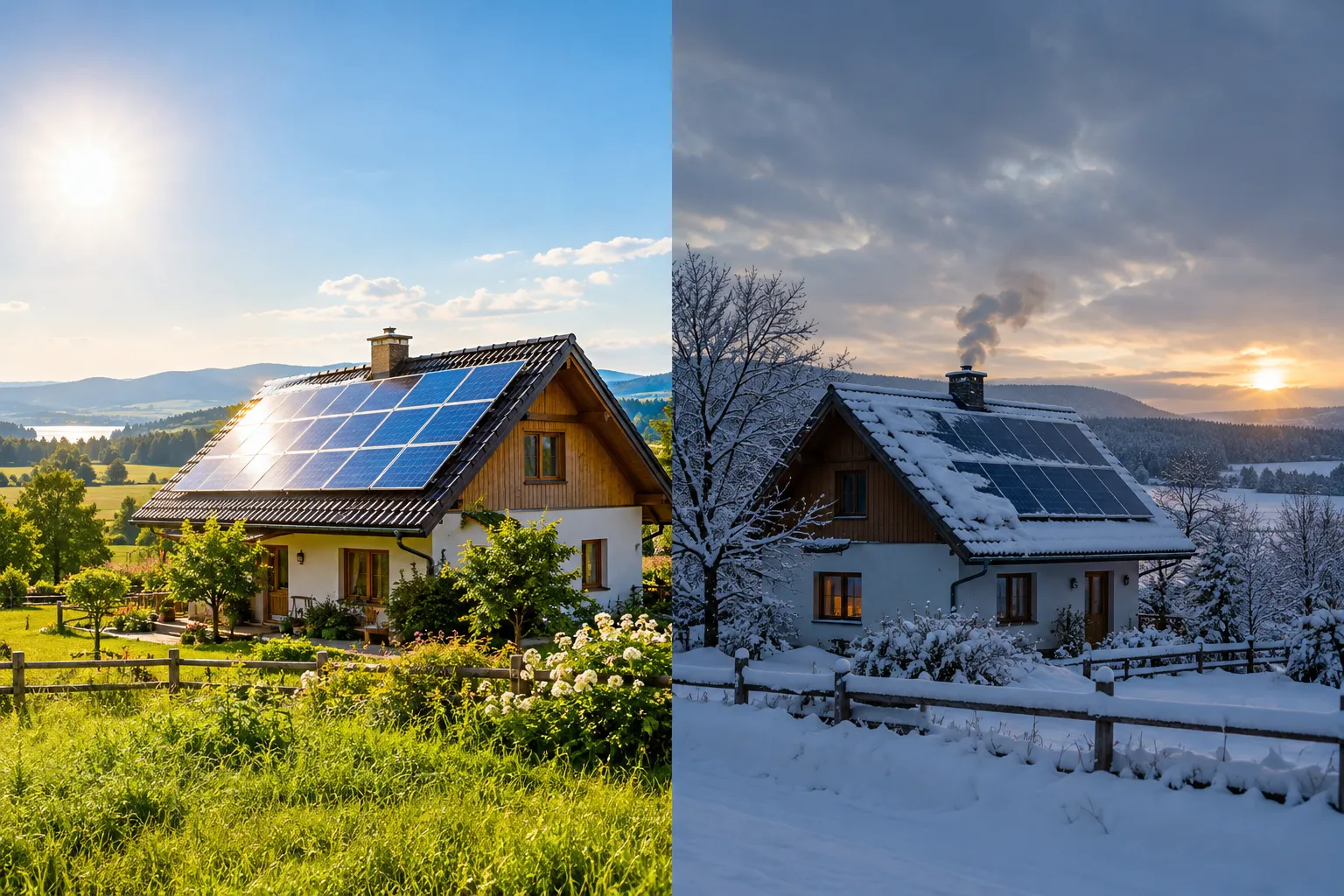
Solar panels in Britain produce dramatically less power between November and February than in summer months. Shorter days, lower sun angles, and frequent cloud cover combine to create what industry sources describe as a serious seasonal solar deficit [3]. A system sized for summer comfort can leave a household short on power for weeks at a time in winter.
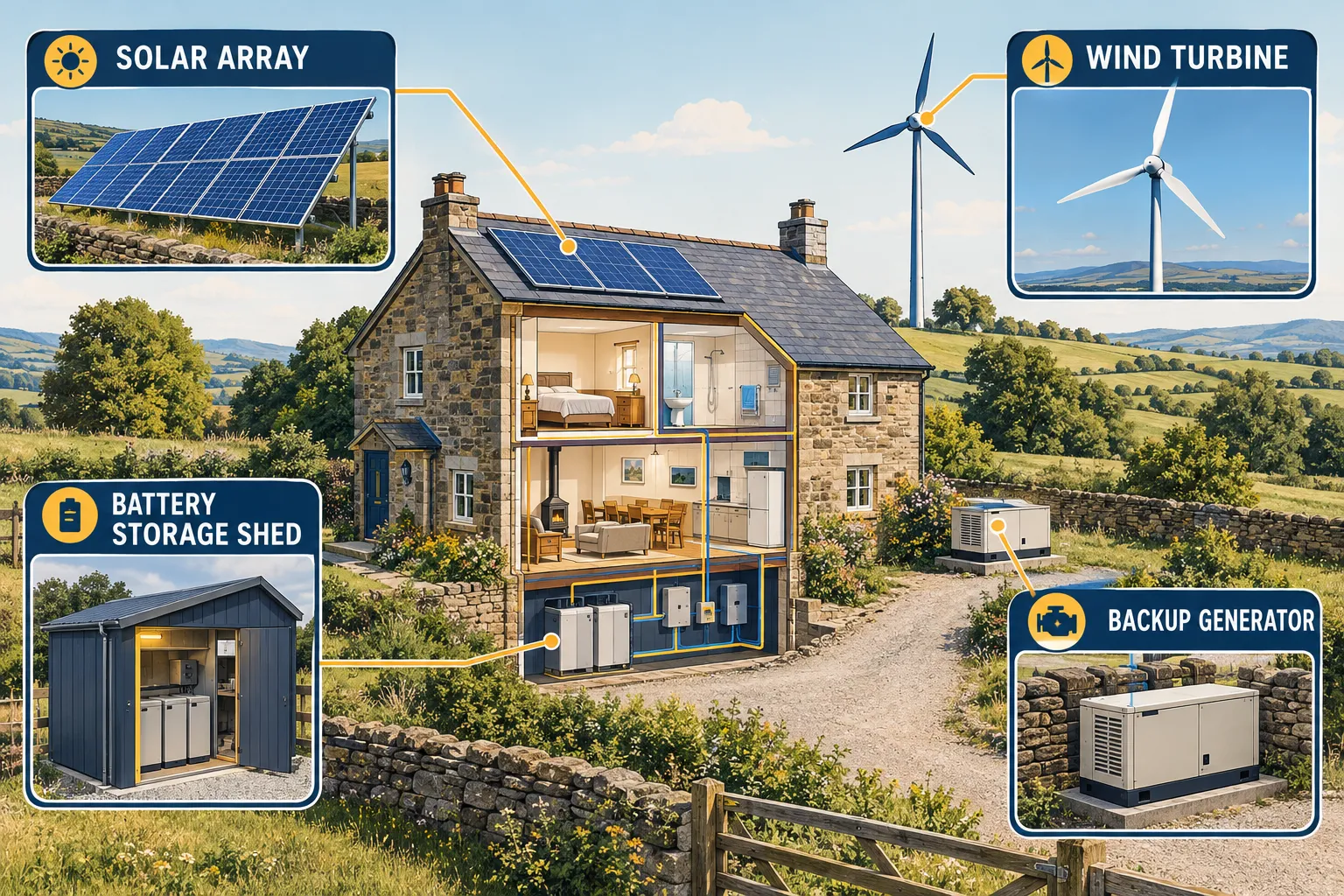
This is why most credible off-grid designs in the UK include backup generation, whether diesel, petrol, or a small wind turbine, rather than relying on solar and batteries alone [2][3]. Typical rural architectures often combine:
- A solar array sized generously beyond summer needs
- Battery storage for several days of autonomy
- A backup generator or wind turbine for extended low-sun periods
- Efficient appliances and insulation to reduce overall demand
Without this layered approach, the winter problem becomes a lived reality rather than a theoretical risk.
Policy Shifts and the Heat Pump Debate
Government support has recently shifted toward off-grid and oil-heated homes. The Boiler Upgrade Scheme now offers enhanced grants for these properties switching to heat pumps, recognising that off-gas-grid households face some of the highest heating costs nationally [5]. Boilerjuice reported that a government consultation specifically targeted off-grid heating as a policy priority [8].
However, this heat-pump-first strategy has drawn criticism. Energy Voice reported industry warnings that there is “no silver bullet” for roughly one million rural homes still using oil burners, since heat pumps are not always practical or affordable for older, poorly insulated rural properties [7]. The Institute of Gas Engineers and Managers similarly called for a technology-neutral approach that considers hybrid systems rather than a single mandated solution [6].
Advocacy groups have pushed back further, arguing that rural households need practical choices and genuine winter resilience rather than a one-size-fits-all mandate [6][7]. This debate matters directly for off-grid living in the UK: real costs and the winter problem, since heating technology choices shape both capital outlay and seasonal reliability.
Off-Grid Versus Off-Gas-Grid: A Useful Distinction
Not every rural household is truly off-grid. Many are simply off the gas network while still connected to electricity, facing high heating costs without full energy independence [4][9]. True off-grid living means no mains electricity or gas connection at all, requiring self-generated power and heat.
For many households, a realistic middle path is “off-grid-like” partial independence: solar plus battery storage to reduce grid reliance, paired with a grid connection as backup. UK Homesteading notes this compromise often delivers much of the resilience benefit without the full capital burden of true off-grid systems [9].
Conclusion
Off-grid living in the UK: real costs and the winter problem reveals a picture more nuanced than enthusiastic marketing suggests. Capital costs can reach tens of thousands of pounds, running costs stretch across decades, and winter solar deficits demand serious backup planning. Anyone considering this path should get a detailed site-specific quote, size systems for winter rather than summer performance, and weigh heat pump grants against practical insulation and backup heating needs. A hybrid, well-insulated approach paired with realistic winter backup remains the most dependable route to genuine energy resilience.
References
- Off Grid Cost. poweringhomes.co.uk.
- Going Off Grid. poweringhomes.co.uk.
- Off Grid Solar. poweringhomes.co.uk.
- Off Gas Grid Homes. poweringhomes.co.uk.
- The Boiler Upgrade Scheme. vaillant.co.uk.
- Igem Response to Rsn Call for Evidence Rural Resilience and Off Gas Grid Heating. igem.org.uk.
- No Silver Bullet For 1m Rural Homes Using Oil Burners. energyvoice.com.
- Government Off Grid Heating Consultation. boilerjuice.com.
- Living Off Grid UK. ukhomesteading.com.