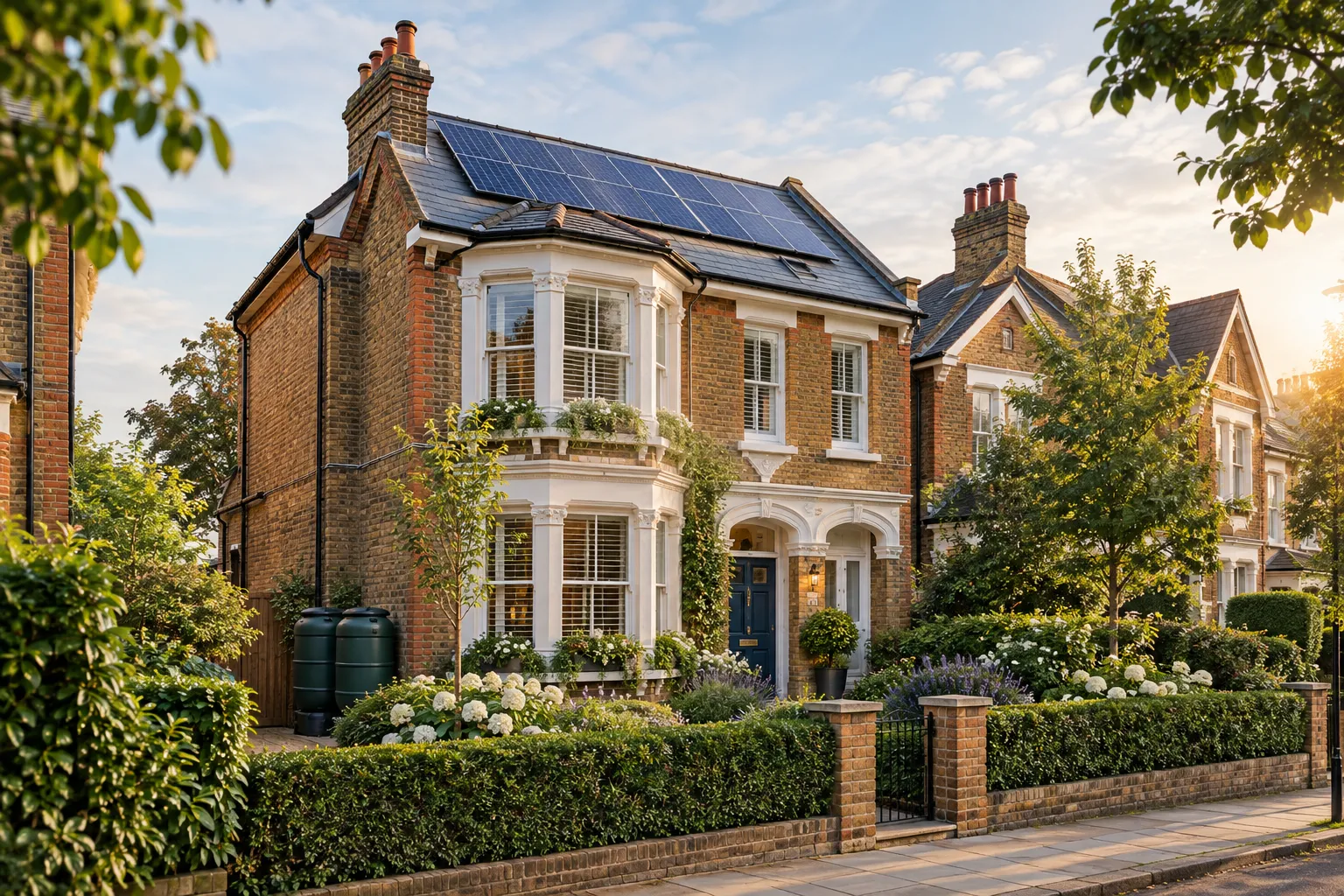
When you picture off-grid living, misty Welsh valleys or rugged Scottish crofts come to mind, not multi-million-pound leafy avenues in London. Yet right in the heart of one of the capital’s richest suburbs, residents are cutting the cord on mains infrastructure to prove urban self-reliance is possible. Off-Grid in Affluent London: The Rise of Urban Self-Sufficiency is no longer a fringe experiment; it is becoming a visible lifestyle statement among wealthy homeowners who want resilience, savings, and independence without leaving the city.
A Deutsche Welle feature put this trend on the map, documenting a resident who transformed a luxury London home into a largely self-sufficient dwelling complete with closed-loop systems for energy and water.[1] The report frames this choice as deliberate, driven by resilience and principle, not financial desperation.
Key Takeaways
- Off-Grid in Affluent London: The Rise of Urban Self-Sufficiency is driven by wealthy homeowners combining solar, batteries, rainwater capture, and composting within tight suburban plots.[1]
- Rooftop solar paired with battery storage can deliver roughly 50 to 74 percent household energy self-sufficiency, with some systems reaching zero grid draw on over 130 days a year.[2]
- London itself cannot become fully energy self-sufficient, since around 94 percent of its energy currently originates outside the city.[3]
- Rising standing charges and water rates are nudging city dwellers toward decentralized micro-utilities even without full disconnection.[3]
- Some affluent households now use large batteries for energy trading and backup rather than pure independence, blurring the line between off-grid and grid-optional living.[4]
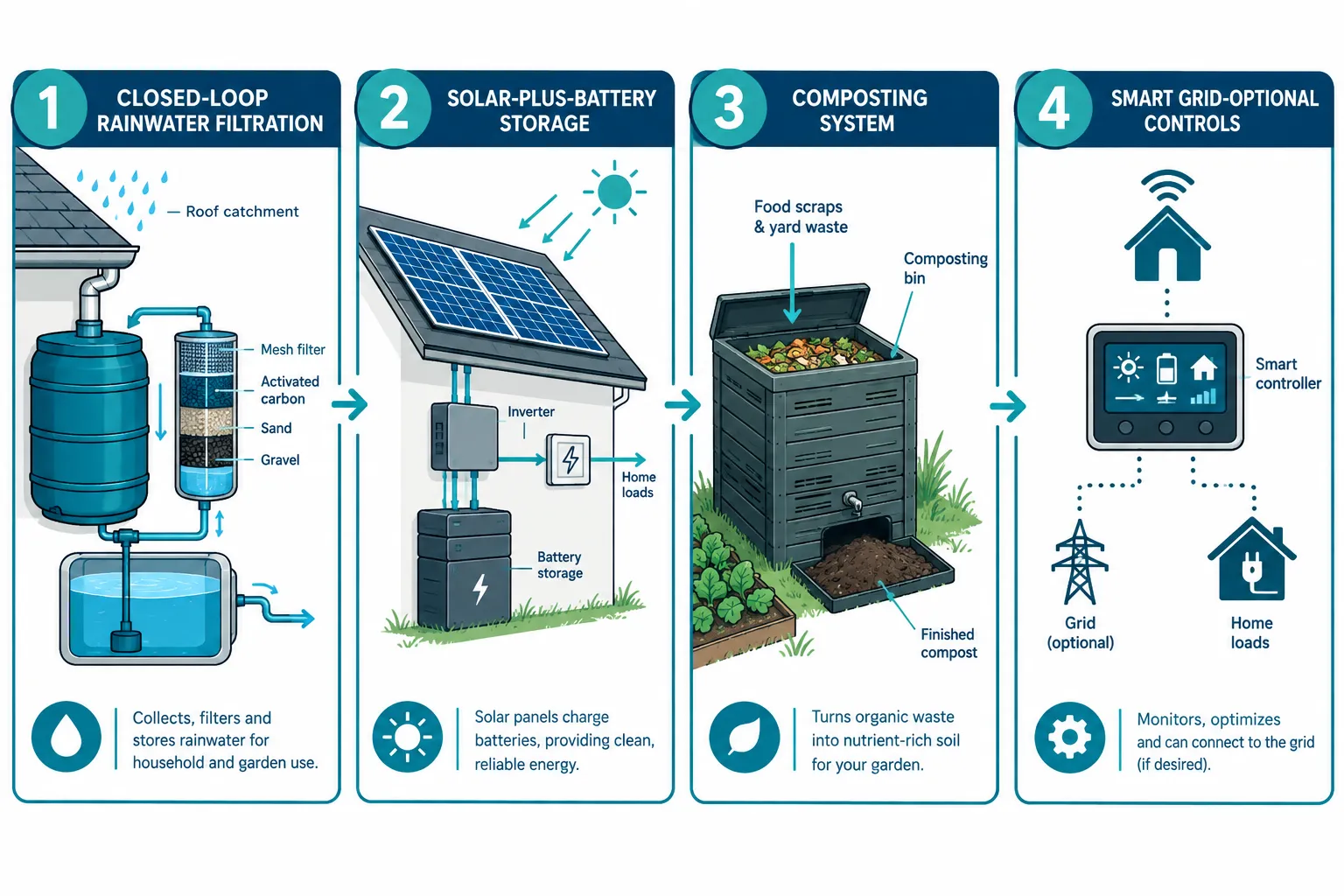
The DW report’s subject did not relocate to the countryside. Instead, the homeowner retrofitted an existing property with a rainwater filtration loop, solar generation, and battery storage, alongside composting systems for organic waste, all squeezed into a conventional suburban footprint.[1] This is the practical face of Off-Grid in Affluent London: The Rise of Urban Self-Sufficiency: not a cabin in the woods, but a terraced house running its own closed loops for water, power, and waste.
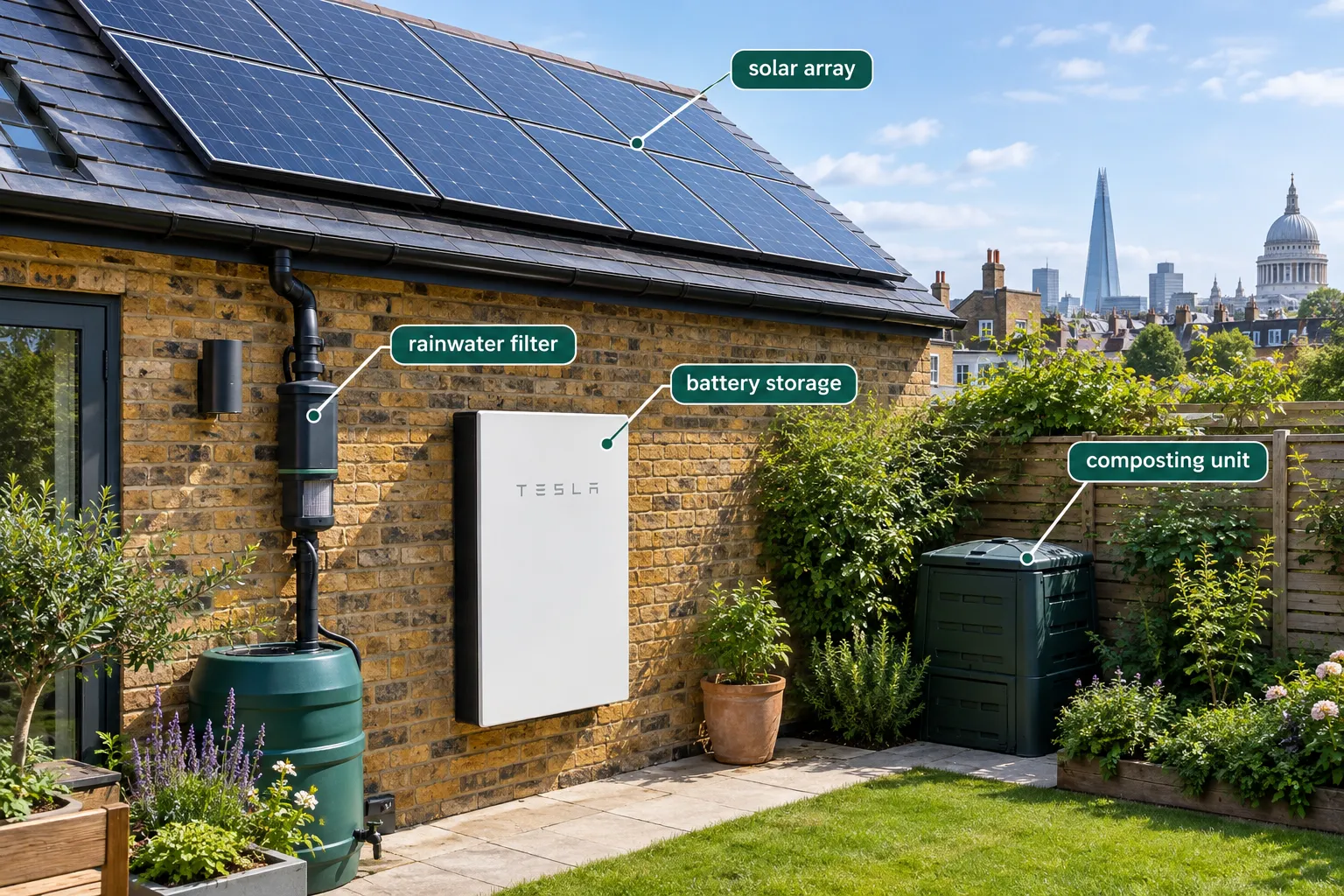
Other examples reinforce this pattern. The “London Solar House” in Primrose Hill uses an expanded rooftop photovoltaic array to power heat pumps, hot water, lighting, and a 13 kW battery for EV charging, running nearly off-grid as of May 2026. Meanwhile, a modern rented London property with 15 solar panels and two Tesla Powerwalls storing 27 kWh let a five-person household spend only £556 on gas and electricity across ten months while working from home and charging an electric car.
Studio Bark, an East London architecture practice, has designed multiple off-grid and “somewhat off-grid” homes using 2 to 4 kWp solar arrays, lithium battery banks, and biofuel generators combined with heavy insulation.[5] While many of these projects sit in rural settings, the firm’s London client base shows affluent urban residents are actively commissioning off-grid-inspired design as both environmental statement and practical hedge.[5][6]
The Economics Pushing Londoners Toward Micro-Utilities
Rising standing charges on electricity connections and escalating water rates are a quiet but powerful driver behind this shift. Rather than abandoning the grid entirely, many households are building decentralized micro-utilities that reduce reliance on mains infrastructure while keeping a connection for backup.
Modelling from Elite Renewables shows that a typical gas-heated UK home fitted with 4 kWp of solar and a 5 kWh battery can reach about 74 percent self-sufficiency in electricity.[2] Larger heat-pump homes with 6 kWp solar and 10 kWh storage can avoid buying any grid electricity on roughly 136 days a year, almost entirely between April and September.[2]
UpVolt Energy’s June 2026 analysis cautions that most UK homeowners gain more value from grid-tied solar with battery backup than from going fully off-grid, since true independence requires panels and storage sized to cover an entire year, including winter.[7] This is echoed by a Bloomberg feature from September 2026 describing an affluent London household using a 200 kWh battery to buy cheap daytime power and sell it back during a heat-wave evening peak for roughly £60, proof that staying grid-connected can be profitable, not just a backup plan.[4]
A few structural realities frame these choices:
- Permitted development rules and clean air requirements limit how off-gridders can install generators, panels, or biofuel systems in dense London boroughs.
- London’s own planning data shows the city sources about 94 percent of its energy from outside its boundaries, so full citywide self-sufficiency remains impossible.[3]
- Academic comparisons of London, Copenhagen, Hamburg, and Amsterdam confirm no major European city is fully energy self-sufficient, reinforcing that resilience, not total independence, is the realistic goal.
London’s own strategic plans back a middle path: increasing decentralised, low-carbon energy to roughly a quarter of citywide demand by 2025 and a majority by 2050, with one estimate suggesting 25 percent decentralised supply could cut 2.57 million tonnes of CO2 annually.[8] CIWEM’s review of the Mayor’s manifesto also notes a push to add 100 MW of solar capacity by 2030, partly to counter the reality that one in ten London households must choose between heating and food.[9]
“London can never be fully self-sufficient in energy,” according to the Greater London Authority’s climate mitigation assessment, yet individual households are proving they can get remarkably close.[3]
Off-Grid in Affluent London: The Rise of Urban Self-Sufficiency reflects a broader rebalancing of how wealthy city dwellers think about energy, water, and waste. While London as a whole cannot disconnect from national infrastructure, individual homes, armed with solar arrays, battery banks, rainwater systems, and composting setups, are proving that significant independence is achievable within strict urban footprints. For homeowners considering this path, the practical next step is a professional energy audit to size solar and battery needs accurately, followed by a check of local permitted development rules before installing any generation or water system. The direction is clear: more London homes will likely become “grid-optional” over the next decade, staying connected mainly for backup and trading rather than daily dependence.[2][4][7]
References
- Video 79745649. dw.com.
- Energy Independent Home. eliterenewables.co.uk.
- Climate Change Mitigation and Energy. london.gov.uk.
- Consumers Profit Off Solar Batteries Selling Excess Energy Back to Grid. bloomberg.com.
- Off Grid Home. studiobark.co.uk.
- studiobark.co.uk.
- Can You Run Solar Off Grid. upvolt-energy.com.
- Cpt7. planvu.co.uk.
- Mayors Mainfesto for London. ciwem.org.