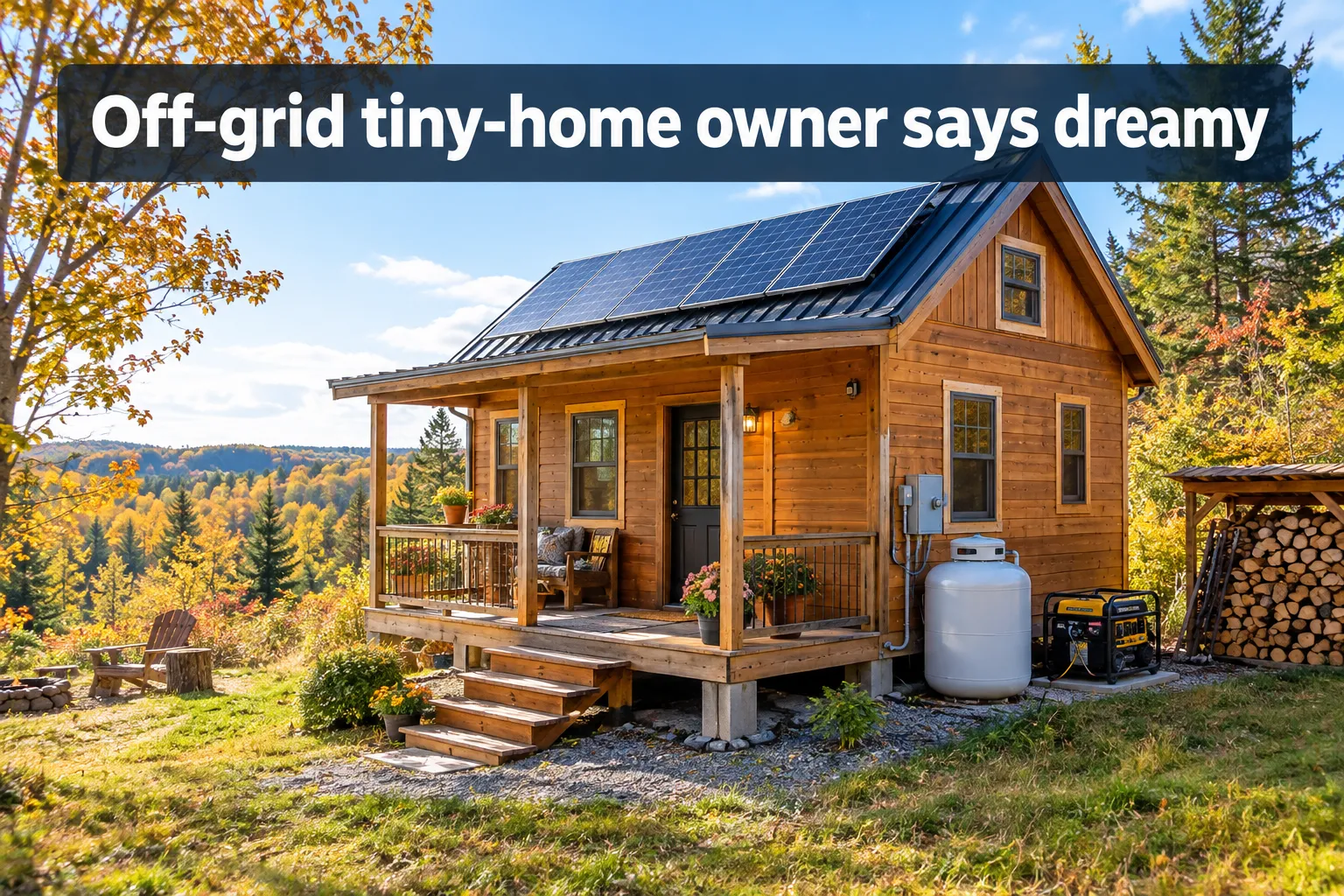
A rural tiny home surrounded by solar panels and wildflowers looks perfect in a 30-second clip. What that clip rarely shows is the generator refusing to start on a cold morning, the monthly propane bill, or the mosquito swarm waiting at the door. An off-grid tiny-home owner says dreamy videos don’t show the fuel costs, bugs, and backup plans that define daily life off the grid, and that warning is backed by real numbers and firsthand experience from people already living the lifestyle.[1]
This gap between social media polish and physical reality matters because thousands of viewers are inspired to attempt off-grid living each year based on aesthetics alone. Understanding the true costs and redundancy requirements can prevent expensive mistakes.
Key Takeaways
- An off-grid tiny-home owner says dreamy videos don’t show the fuel costs, bugs, and backup plans that make up daily off-grid reality, including generator strain and pest control.[1]
- Monthly off-grid expenses commonly range from $500 to $2,000, covering propane, generator fuel, vehicle costs, internet, and maintenance funds.[6][14][15]
- Cold-climate households can spend more than $10,000 a year on combined propane, diesel, and firewood alone.[13]
- Experienced off-gridders treat backup heat, backup water, backup power, and backup food as non-negotiable, not optional extras.[1]
- Upfront homestead costs typically fall between $35,000 and $150,000, though fully built properties can exceed $300,000.[12][14]
Why an Off-Grid Tiny-Home Owner Says Dreamy Videos Don’t Show the Fuel Costs
Social media thrives on aesthetics. A sunlit cabin, a crackling fire, and a quiet forest make for compelling footage. But according to the off-grid tiny-home owner featured in a September 2026 profile, that visual story leaves out the mechanics that keep the home running at all.[1] Generators require regular refueling, and gas becomes genuinely expensive when it’s used often rather than saved for rare emergencies.[1] The owner also reported that overloading the generator can cause it to fail outright, leading to sudden power loss and forcing reliance on backup systems that many newcomers never planned for.[1]
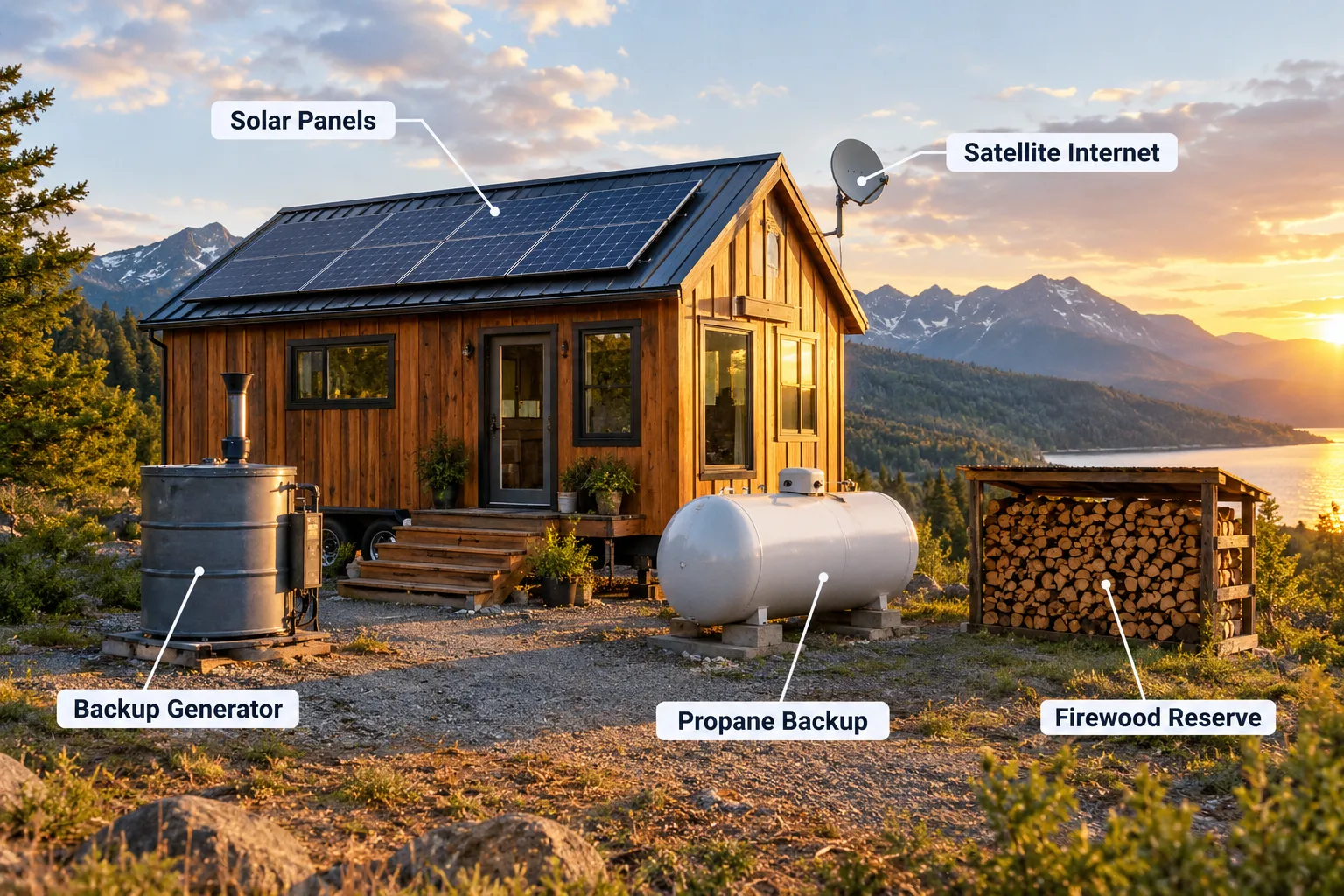
This isn’t a rare complaint. A 2026 beginner’s guide to off-grid living estimates monthly costs of roughly $620 to $1,230 for a typical setup, including Starlink internet near $120 a month, propane between $30 and $80, vehicle fuel and insurance from $150 to $300, and a maintenance fund of $50 to $100.[12] Even at the low end, fuel-related costs alone can rival a small apartment’s rent.
Cold climates raise the stakes further. A July 2026 case study of a northern off-grid household found annual energy costs “well over $10,000,” driven by propane averaging about $1,100 a month from mid-October to mid-April, roughly $200 a month in diesel for generators, and about nine cords of firewood per winter costing $3,200 annually.[13] The report notes that many aspiring off-gridders never budget for a full season of heating and backup generation, which is exactly the kind of detail a scenic video tour tends to skip.[13]
A separate 2026 cost analysis backs this up, finding that ongoing monthly expenses generally land between $500 and $1,500, with vehicle fuel and maintenance taking $200 to $400, and propane or backup fuel adding another $60 to $150.[14] A 2025-2026 survey of off-grid setups similarly found realistic monthly fuel spending of $40 to $350, plus $120 to $400 for vehicle fuel, showing that “cheap” off-grid narratives rarely reflect the full lifecycle cost of running a property.[15]
The Hidden Price of Backup Systems
Backup infrastructure is not optional padding; it’s the difference between comfort and crisis. A January 2026 systems guide recommends solar paired with LiFePO4 batteries, costing $15,000 to $60,000, as the strongest overall choice for 2026, while solar plus propane backup runs $12,000 to $35,000 as a budget-friendly hybrid.[6] The same guide explicitly warns that relying on a generator alone, despite a lower $2,000 to $8,000 price tag, is “not recommended” due to constant fuel costs, noise, and mechanical wear.[6]
“Off-grid living is far from effortless when a single power source has to carry the whole load.”
Bugs, Backup Plans, and the Realities Dreamy Videos Skip
Beyond fuel, pests are a persistent and rarely filmed nuisance. The off-grid tiny-home owner described constant bug issues tied to living in a rural setting, a detail that almost never appears in polished home tours.[1] Rural land near woods, water, or open fields naturally attracts insects, and without municipal pest control or sealed suburban infrastructure, homeowners manage this themselves year-round.
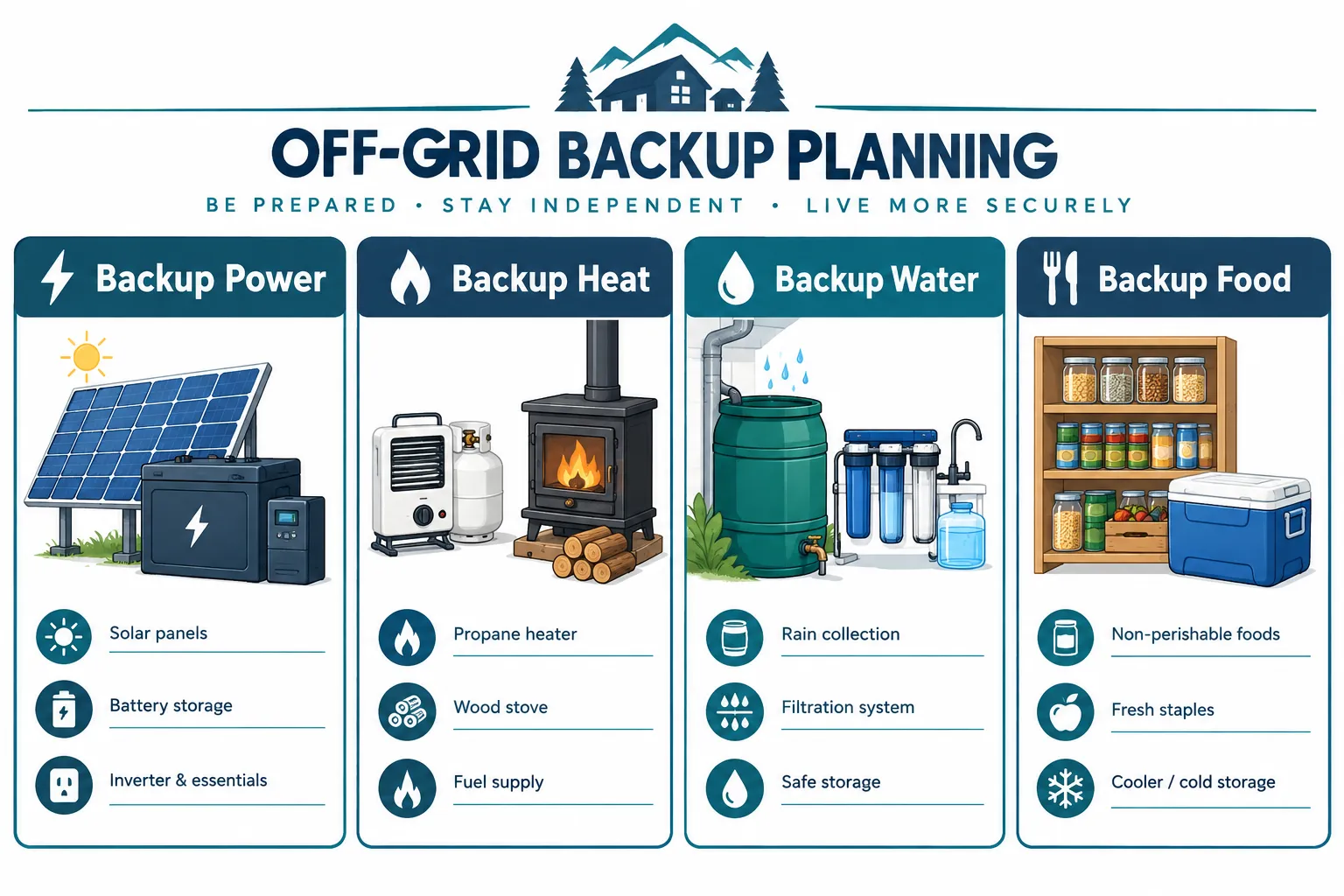
Viewer reaction to the original video reinforced this reality. Commenters emphasized that experienced off-gridders build in backup heat, backup generators, backup water, and backup food as standard practice, not emergency afterthoughts.[1] This layered redundancy reflects a mindset: one failure should never mean one household going without power, warmth, or water.
A long-form report on off-grid experiences echoes this, noting that even people “living the dream” need reliable power, water, tools, a dependable vehicle, and a backup generator, with housing and land rental alone often exceeding $1,100 a month before fuel and utilities.[7] Another account from a tiny-house owner lists overlooked costs like gravel and foundation work, propane tanks, satellite internet installation, and separate insurance policies for the home and vehicle, arguing that online content spotlights aesthetic freedom while downplaying administrative and financial burdens.[11]
Mobile tiny homes carry their own quiet costs. A June 2025 analysis found that owners relying on dump stations can spend $15 to $25 weekly in fuel just managing waste, while remote locations without wired internet often push owners toward cellular or satellite plans costing $150 to $300 a month.[5] Vibration and settling during travel or seasonal shifts can add $200 to $400 a month in maintenance, another expense rarely shown in a golden-hour drone shot.[5]
What Off-Grid Backup Planning Actually Costs
The table below summarizes commonly cited monthly and annual figures from current cost analyses.
| Category | Typical Monthly Cost | Source Notes |
|---|---|---|
| Propane (cooking, backup heat) | $30,$150 | Varies by climate and season[4][6][14] |
| Generator/diesel fuel | $10,$200 | Higher in cold climates with heavy use[1][13] |
| Vehicle fuel and insurance | $150,$400 | Often underestimated by newcomers[12][14][15] |
| Internet (Starlink or cellular) | $120,$300 | Remote areas lack wired options[5][12] |
| Maintenance and repair fund | $50,$400 | Covers generators, batteries, structural wear[4][5][14] |
Upfront investment varies just as widely. A basic but functional homestead, including land, shelter, solar, water, and septic, typically requires $35,000 to $75,000, while a more comfortable build runs $75,000 to $150,000.[12] A separate 2026 analysis found setup costs starting near $40,000 and exceeding $300,000 for fully built homesteads with permanent structures and complete solar-water systems.[14] Land-focused reports add that ongoing annual costs of $1,000 to $5,000 for property taxes, fuel backups, and maintenance persist long after construction ends, even in low-tax regions.[9]
Conclusion
The message from an off-grid tiny-home owner who says dreamy videos don’t show the fuel costs, bugs, and backup plans is simple: the lifestyle is achievable, but only with realistic budgeting and layered redundancy. Fuel expenses, pest management, and backup systems for power, heat, water, and food are not glamorous content, but they are the actual foundation of a functioning off-grid home.
Anyone considering this path should build a full annual budget before buying land, price out backup heat and power separately from primary systems, and talk to current off-gridders about seasonal fuel use rather than relying on short-form video alone. Planning for redundancy from day one, not after the first generator failure, is what separates a sustainable off-grid life from an expensive learning experience.
References
[1] Tiny Home Off Grid Living Challenges – https://www.thecooldown.com/green-home/tiny-home-off-grid-living-challenges/ [4] Real Costs Of Living Off Grid What To Expect – https://gridfreelife.com/real-costs-of-living-off-grid-what-to-expect/ [5] 7 Hidden Risks Of Tiny Home Living – https://www.habitatista.com/75013/7-hidden-risks-of-tiny-home-living/ [6] Off Grid Tiny Homes – https://readypaths.com/off-grid-tiny-homes/ [7] Living Off The Grid Is Not Cheap – https://www.vice.com/en/article/living-off-the-grid-is-not-cheap/ [9] Off Grid Living On Raw Land 2026 Real Costs Hidden Risks Success Stories – https://landlimited.com/blogs/off-grid-living-on-raw-land-2026-real-costs-hidden-risks-success-stories [11] (Tiny-house cost narrative referenced via industry reporting) [12] (2026 beginner’s guide to off-grid living cost estimates) [13] (July 2026 northern off-grid household case study) [14] (2026 cost analysis of off-grid living) [15] (2025-2026 off-grid cost survey)


