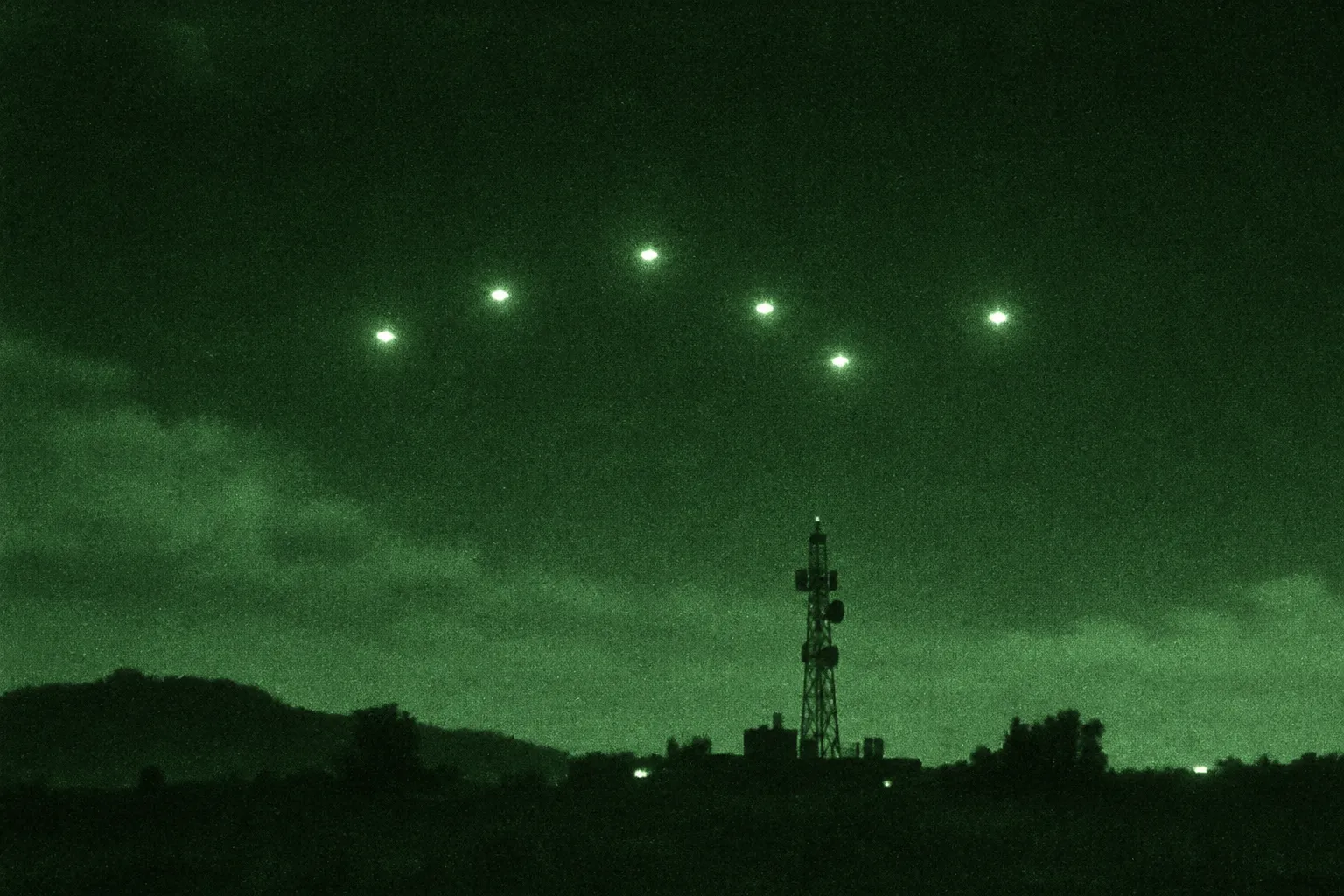
A military aircraft flying over the Middle East in 2025 recorded six glowing shapes moving in tight formation at an estimated 480 mph. Eighteen months later, a team of scientists concluded something far less dramatic than extraterrestrial craft: the six infrared dots in a declassified UAP video is a flock of birds, not an advanced flying object.
The footage became one of the most talked-about clips in the sixth batch of declassified UAP files released by the U.S. Department of War in September 2026. Viral posts framed it as potential evidence of alien technology. A peer-reviewed-style preprint published on 7 October 2026 tells a much simpler story.
Key Takeaways
- A technical analysis led by Jacob Haqq-Misra and colleagues, including Harvard’s Avi Loeb, found the six dots brighten and dim at 7.1 to 7.9 times per second, each with its own timing, matching independent bird wingbeats rather than sensor flicker.
- The apparent 480 mph speed likely came from parallax caused by the aircraft’s own motion, not the objects’ true speed.
- Only two to four glowing points appear in the footage at any single moment; the number six came from the crew’s verbal report, not a frame-by-frame count.[4]
- Similar wingbeat-rate flicker was independently recorded in Galileo Project ground cameras near Las Vegas, strengthening the bird explanation.[2]
- Pentagon UAP file reviews show at least 19 other cases already identified as birds, placing this case within a known pattern of infrared misidentification.[9]
The Declassified Video and the Six Infrared Dots in a Declassified UAP Video is a Flock of Birds Claim
The original mission report described six small spherical objects flying together over a tower, changing direction repeatedly. Officials confirmed the footage was authentic but stressed that “unidentified” never implied alien origin.
That distinction mattered once independent researchers examined the raw frames. A case summary circulated by UAP catalog sites notes that the video rarely shows all six lights at once; instead, the visible count shifts between two and four points as objects move in and out of the camera’s resolution.[4][8] This detail alone undercuts the idea of a rigid, coordinated craft. Loose, shifting clusters are a textbook signature of birds flying near each other, not a fixed mechanical formation.
Avi Loeb’s own review of the same clip, released through PURSUE and reported by UAP news aggregators, examined just four consecutive frames spanning about one second.[8][7] His conclusion aligned with the broader technical paper: the pattern fits birds flying close to the aircraft, with distance and motion exaggerating their apparent speed through parallax.[7]
How Researchers Proved the Six Infrared Dots in a Declassified UAP Video is a Flock of Birds
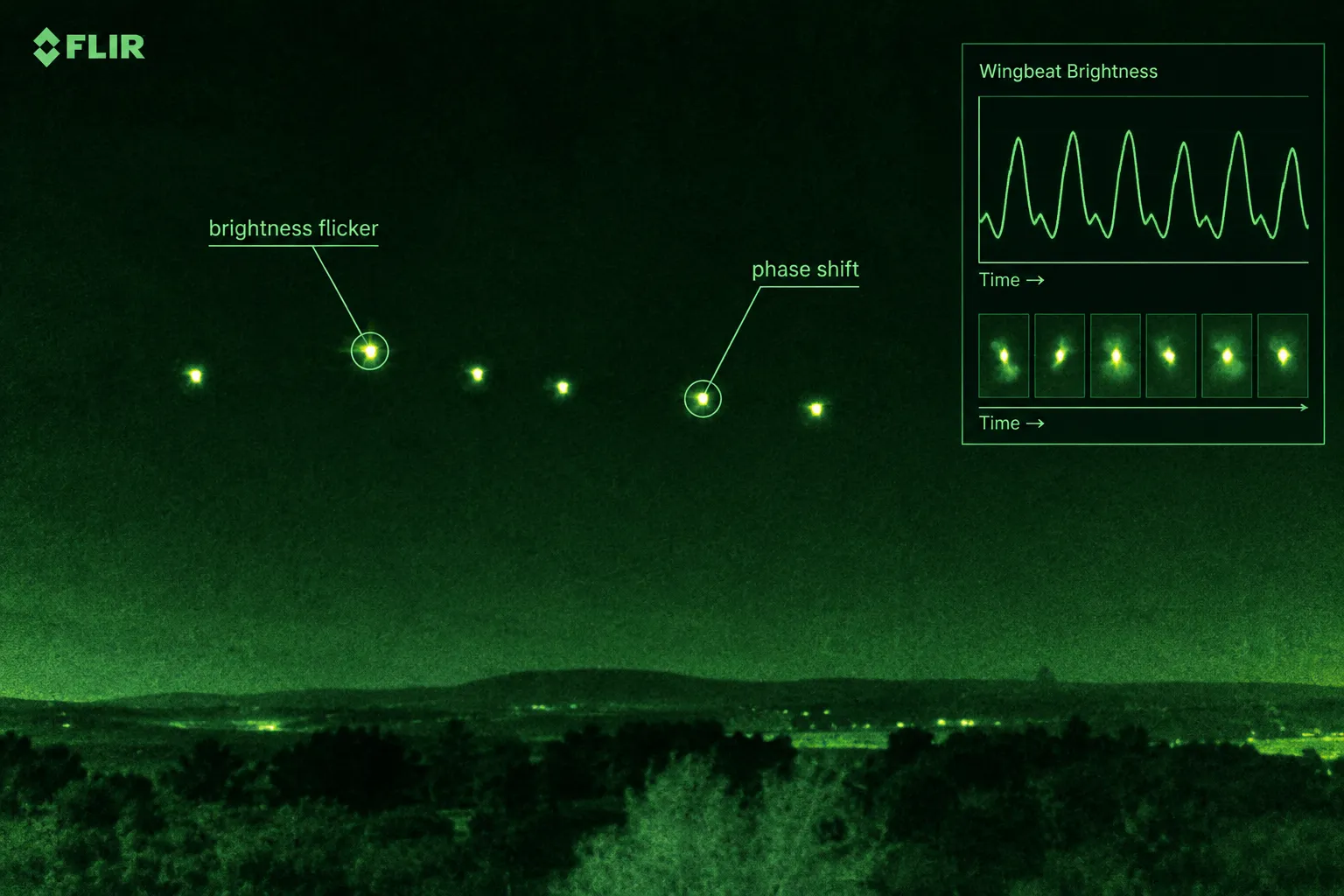
The strongest evidence came from measuring brightness, not shape. Researchers tracked each of the six points frame by frame and found they pulse steadily between 7.1 and 7.9 times per second. Crucially, each dot flickers at its own frequency and timing, with phase differences between pairs ranging from 30 to 170 degrees. Eight of those pairs differed by more than 90 degrees.[2]
That variation rules out a sensor glitch. A true flicker artifact, caused by the camera or display, would affect every point in the frame the same way at the same time. Independent, out-of-sync pulsing instead matches the natural rhythm of a living flock, where each bird flaps its wings on its own cycle.
Two interpretations fit the data:
- If each brightness cycle represents two wing strokes, the real wingbeat rate falls between 3.6 and 4.0 Hz, close to measurements for terns.
- If each cycle represents one wingbeat, the rate of 6.6 to 8.5 Hz matches ducks, grebes, and wading birds.
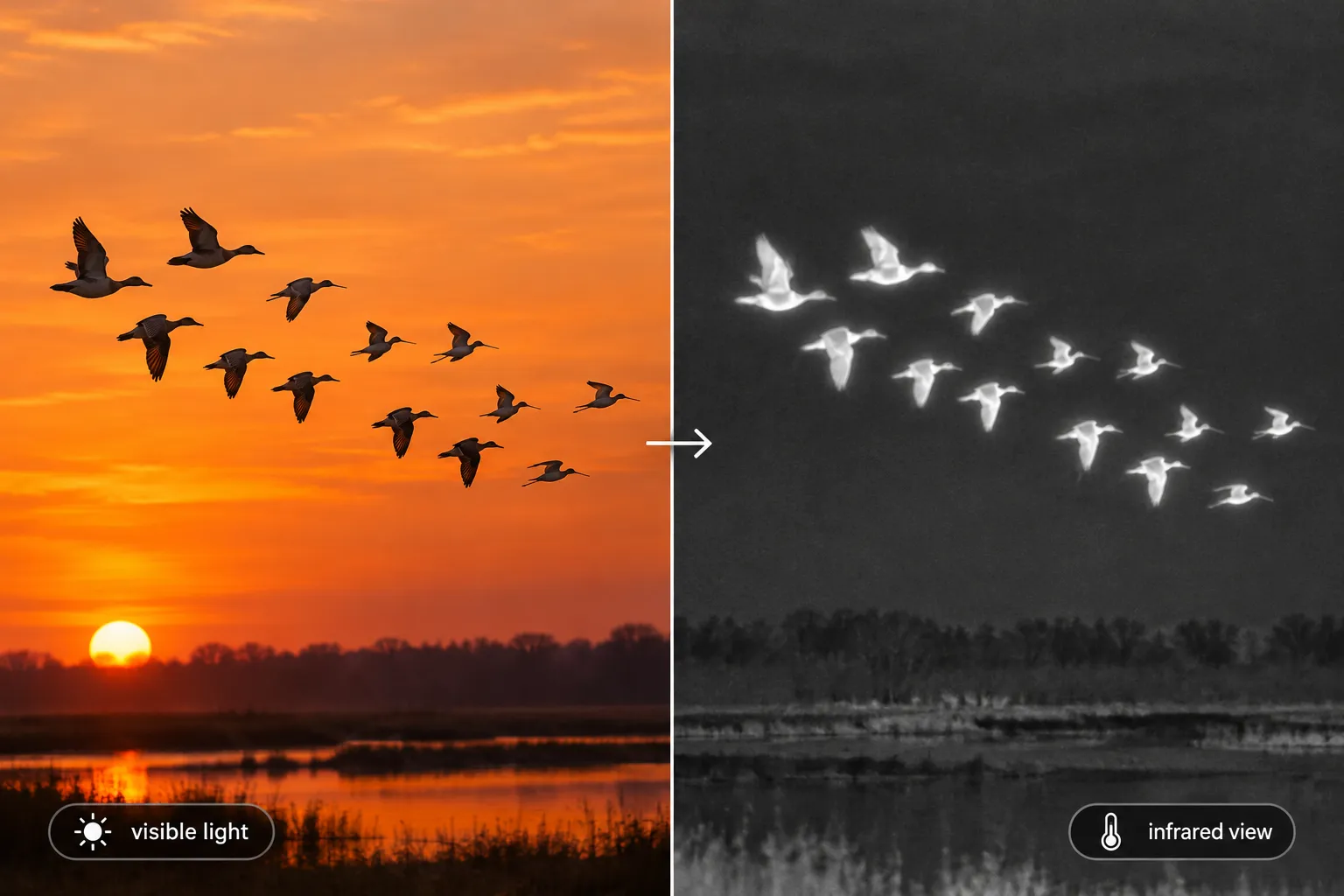
Either way, the numbers land squarely inside normal bird physiology. Radar tracking in southern Israel, near where the footage was recorded, regularly detects large nocturnal flights of migrating waterfowl and waders, giving the bird explanation strong environmental support.
Researchers then tested the method on infrared footage from the Galileo Project’s ground cameras near Las Vegas. Flying animals there showed flicker rates of 3.4 to 10.0 Hz, overlapping the range seen in the military video and confirming the technique reliably detects bird wingbeats in thermal imagery.[2]
Why This Case Matters for Future UAP Reviews
Members of a UAP Science Advisory Council have publicly endorsed the same conclusion, stating plainly that the six infrared dots in a declassified UAP video is a flock of birds rather than an unresolved anomaly.[2][5] Case databases that track declassified Department of War footage have updated their listings accordingly, moving this event from “unresolved” to “identified.”[3][6][10]
This is not an isolated correction. A review of 162 Pentagon UAP documents found at least 19 cases already attributed to birds, many recorded at dawn or dusk when infrared sensors produce “blooming” effects that make ordinary animals look like structured objects.[9] Media coverage of the reversal noted how quickly viral claims of “aliens in 16 days” collapsed once scientists applied basic frame-by-frame measurement.[1][4]
References
[1] Watch – https://www.youtube.com/watch?v=LzELRKbnwIE&xstg=CAMSBhUDze3xHw== [2] Members Of The Uap Science Advisory Council Have – https://www.reddit.com/r/UFOs/comments/1x0wcvg/members_of_the_uap_science_advisory_council_have/ [3] Tehran 1976 – https://www.disclosureufo.com/cases/tehran-1976 [4] The Six Infrared Dots In A Declassified Uap Video Is A Flock Of Birds 2933 – https://alientavern.com/news/2026-10-07/the-six-infrared-dots-in-a-declassified-uap-video-is-a-flock-of-birds-2933 [5] ufonewsarchive – https://ufonewsarchive.com/ [6] Tic Tac 2004 – https://www.disclosureufo.com/cases/tic-tac-2004 [7] uapinsight – https://uapinsight.com/ [8] Today – https://uapinsight.com/today [9] Pentagon Uap May 2026 162 Documents – https://insiderrelease.com/pentagon-uap-may-2026-162-documents/ [10] disclosureufo – https://www.disclosureufo.com/map