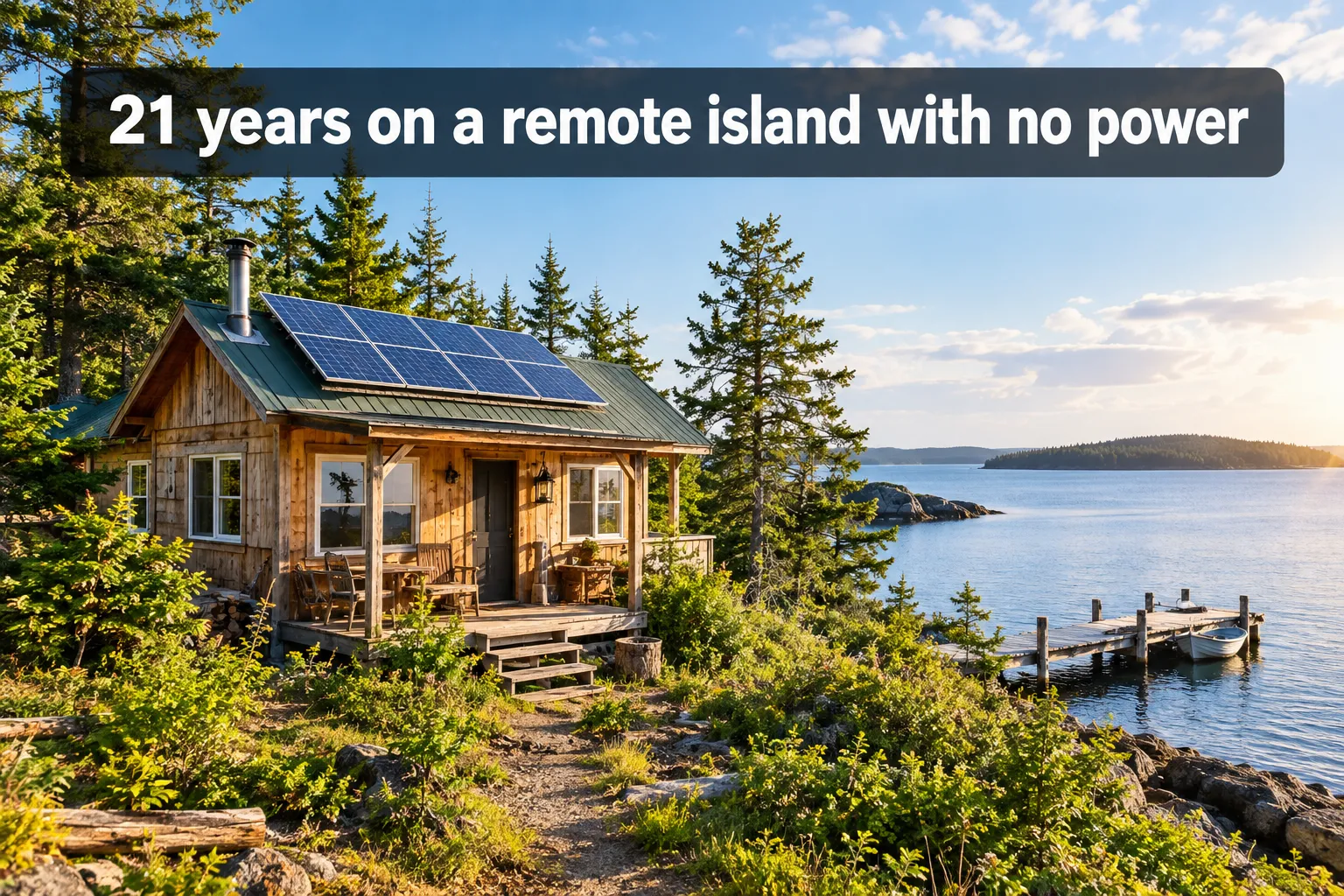
One man built an entire life from raw timber and salvaged parts, and never once plugged into a utility line. That single fact, 21 years on a remote island with no power grid, no building codes, and no regrets, has quietly become one of the most-watched stories in the natural-building world, drawing attention from documentary filmmakers, homesteading forums, and readers who never imagined off-grid life could last two decades without a single complaint [2].
The appeal isn’t nostalgia. It’s proof. A homestead built entirely by hand, powered by sun and stored rainwater, standing strong after 21 years, challenges a common assumption: that modern comfort requires modern infrastructure.
Key Takeaways
- A self-built cabin and homestead on a remote British Columbia island has operated for 21 years with no connection to a power grid [1].
- The builder relied on solar power, rainwater collection, and hand-constructed timber framing instead of municipal utilities or permits [1][2].
- The story gained traction after being featured in a documentary and shared widely across natural-building and off-grid media channels [2][7].
- Lasqueti Island, the community where this homestead sits, has no public electricity grid at all, making off-grid living the local norm rather than the exception [1].
- Similar long-term island dwellers, from Roatan to remote Scottish islands, show this is a repeatable pattern, not a one-off stunt [8][10].
Inside the Homestead: 21 Years on a Remote Island With No Power Grid, No Building Codes, and No Regrets
The homestead at the center of this story sits on Lasqueti Island in British Columbia, Canada, built entirely by its owner over two decades using hand tools, salvaged materials, and simple carpentry methods passed down through natural-building traditions [1]. There was no architect, no zoning office, and no inspection process. The structure grew organically, shaped by available materials and the owner’s own experience rather than a fixed blueprint [2].
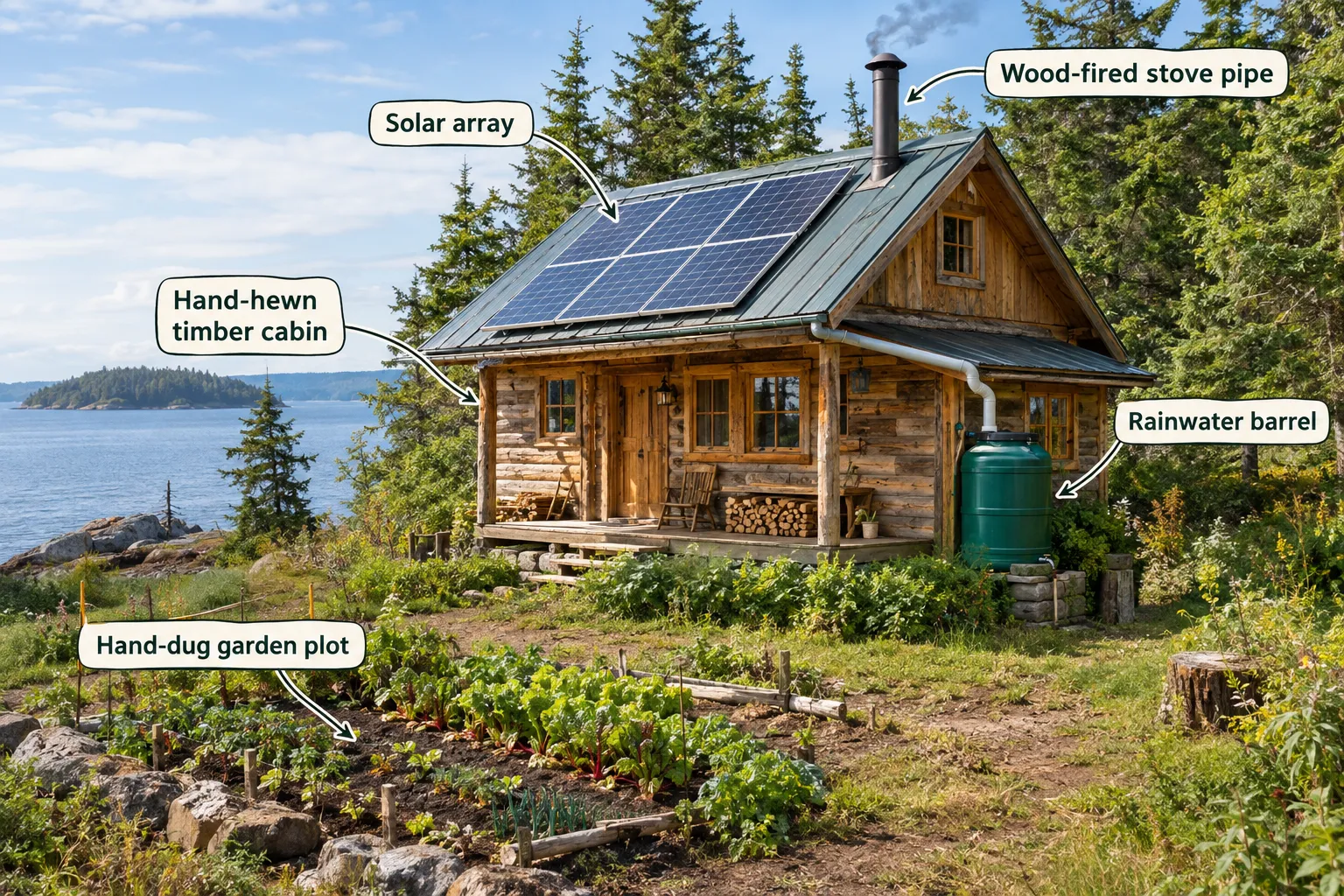
This kind of scope is rare in mainstream construction. Walls were raised using timber cut nearby. Roofing and insulation choices were driven by climate and cost, not code compliance. The result is a livable, durable home that has weathered 21 years of coastal weather without structural failure, according to coverage from natural-building outlets that documented the site firsthand [1].
What makes the project notable isn’t just that it exists, but that it has lasted. Off-grid builds often struggle with long-term durability when they skip formal engineering review. This one didn’t.
Life Without a Power Grid or Building Codes
No power grid means no monthly electric bill, no blackout risk tied to a utility company, and no dependence on infrastructure that doesn’t reach the island in the first place [1]. Instead, the homestead runs on a self-managed system built around a few core components:
- Solar panels for daily electricity needs
- Rainwater catchment for drinking and washing
- Wood heat for cooking and warmth through winter
- Composting and manual waste systems in place of municipal sewage
The absence of building codes shifted responsibility entirely onto the builder. Every structural decision, from roof pitch to foundation depth, was self-taught and self-tested. That freedom cuts both ways. It allows faster, cheaper construction, but it also removes the safety net that formal inspections usually provide [2].
Twenty-one years without regret suggests the trade-off worked. But it also reflects a specific mindset: patience, willingness to learn from mistakes, and comfort with slow, incremental building rather than a fast move-in timeline.
Lasqueti Island: A Community Built on Off-Grid Norms
Lasqueti Island is unusual even among remote Canadian communities. It has no public electrical grid connecting it to the mainland, which means every resident who lives there full-time has already made peace with generating their own power [1]. This isn’t a fringe choice on Lasqueti. It’s the baseline expectation.
That community context matters. A single off-grid homestead in a grid-connected suburb would face pressure from neighbors, municipal officials, and lenders. On Lasqueti, the same setup is simply normal life. This shared culture of self-sufficiency likely explains why a 21-year off-grid project could develop without external friction or code enforcement pushing back [1].
How the Story Reached the World
The homestead gained wider recognition after being featured in a documentary that walked through the property and its owner’s daily routines, later amplified through platforms like Films for Action and shared across community discussion threads on sites such as Reddit [2][7]. That coverage introduced the story to audiences well outside the natural-building niche, turning a quiet island homestead into a reference point for off-grid living discussions.
Expert and Industry Views on Regulation-Light Building
Natural-building commentators frame regulation-light construction as a double-edged tool. It enables experimentation and lower costs, but it demands more personal expertise in structural safety, water management, and fire risk [1]. Industry observers generally agree that success stories like this one work because the builder invested years in learning materials and methods firsthand, rather than skipping preparation altogether.
Other Long-Term Remote Island Lives: A Human Pattern
This isn’t an isolated case. Millionaire David Glasheen spent years living alone on Australia’s Restoration Island after losing his fortune, choosing isolation over returning to conventional life [8]. Writers have also documented running away to remote Scottish islands and finding unexpected calm in the trade-off of convenience for solitude [10]. Books like Sea Room and accounts of Tristan da Cunha residents further show that long-term, deliberate isolation on remote land is a recurring human choice, not a rare anomaly [9][5].
Comparing Off-Grid Islands: Lasqueti vs. Roatan
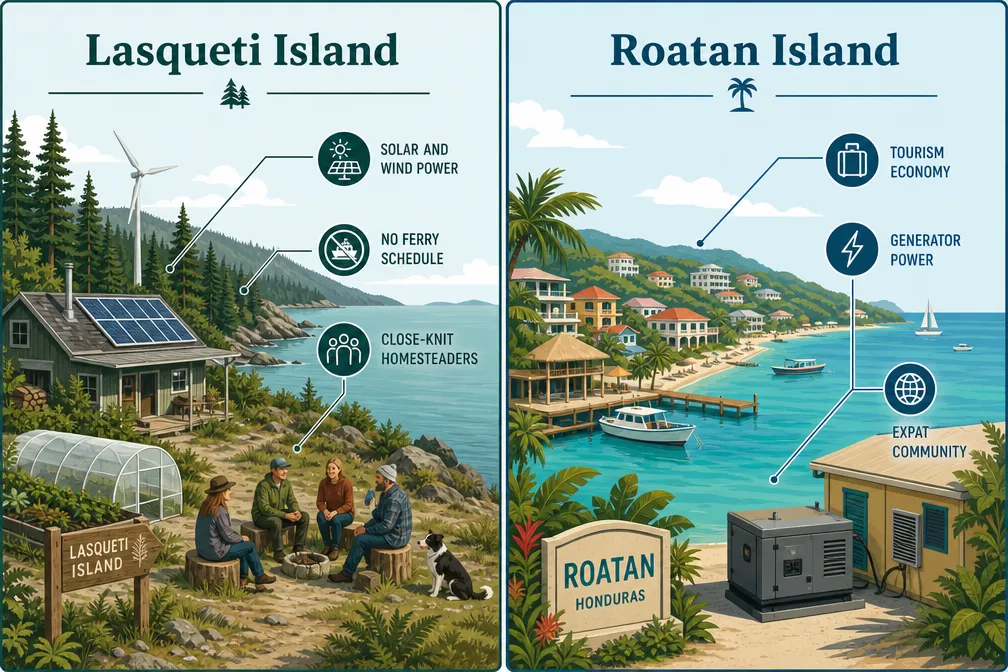
Roatan, in Honduras, offers a useful contrast. Off-grid living there often blends with a tourism-driven expat economy, where generators and hybrid solar setups support guesthouses and short-term rentals alongside full-time residents. Lasqueti, by comparison, has almost no tourism infrastructure and a tighter-knit homesteading culture built around subsistence rather than hospitality income [1]. Both prove off-grid island life is viable, but the social and economic context around each shapes how it’s lived day to day.
Lessons for Long-Horizon Projects
Twenty-one years is a long timeline for any personal project. It mirrors the patience seen in long-horizon ecological restoration efforts, where results only become visible after decades of consistent, unglamorous work. The homestead’s durability didn’t come from a single clever design choice. It came from two decades of small adjustments, repairs, and learning by doing.
Conclusion
The story of 21 years on a remote island with no power grid, no building codes, and no regrets offers a clear lesson: self-sufficiency is less about rejecting modern systems and more about patiently building reliable alternatives to them. For anyone considering off-grid living, the practical next steps are straightforward. Start small, learn local climate and material realities before committing to a structure, and treat the absence of building codes as a reason for more caution, not less. Communities like Lasqueti show that off-grid life works best when it’s supported by shared local knowledge rather than attempted in total isolation.
References
[1] Living Off Grid On A Remote Island In British Columbia – https://naturalbuildingblog.com/living-off-grid-on-a-remote-island-in-british-columbia/ [2] 21 Years Living Offgrid On A Remote Island In A Selfbuilt Cabin And Homestead – https://www.filmsforaction.org/watch/21-years-living-offgrid-on-a-remote-island-in-a-selfbuilt-cabin-and-homestead/ [5] Tristan Da Cunha – https://www.nationalgeographic.com/travel/article/tristan-da-cunha [7] 21 Years Living Offgrid On A Remote Island In A – https://www.reddit.com/r/mealtimevideos/comments/1v69ls6/21_years_living_offgrid_on_a_remote_island_in_a/ [8] Millionaire David Glasheen Remote Island Restoration Island – https://www.express.co.uk/finance/personalfinance/1157190/millionaire-David-glasheen-remote-island-restoration-island [9] Sea Room – https://books.google.com/books/about/Sea_Room.html?id=r3mde_8Vf1EC [10] I Ran Away To A Remote Scottish Island It Was Perfect – https://www.theguardian.com/lifeandstyle/2020/jul/26/i-ran-away-to-a-remote-scottish-island-it-was-perfect


