More than fifty formal declassification requests have already been filed by a small group of scientists tasked with advising the federal government on unidentified anomalous phenomena. That detail alone separates this conversation from the usual UFO chatter. The episode of “Astroparticle Physicist Matthew Szydagis on UAP Science | Reality Check,” hosted by Ross Coulthart, positions a working dark-matter physicist inside one of the most sensitive scientific debates in modern government: how to study UAP without abandoning the rigor of peer-reviewed physics.
Szydagis is not a fringe commentator. He is an Associate Professor of Physics at the University at Albany, SUNY, known for his work on liquid-xenon dark-matter detectors and rare-event physics. His appearance on Reality Check matters because he brings laboratory-grade skepticism to a topic often dominated by speculation.
Key Takeaways
- Matthew Szydagis sits on a UAP Science Advisory Council that advises the White House and multiple federal agencies, though members lack formal security clearances.[2][4][5]
- The council has submitted over 50 declassification requests to push for transparency on government-held UAP data.[2][4][5]
- Szydagis wants the 1996 Varginha, Brazil case declassified and clarified as a scientific test case.[2][4]
- He argues relativistic travel could theoretically make interstellar UAP visits physically possible, challenging common distance-based dismissals.[5]
- His lab analysis of an “Art’s Parts” metal sample found features more consistent with human engineering than anomalous technology.[5]
Astroparticle Physicist Matthew Szydagis on UAP Science: Inside the Advisory Council
The core news from this Reality Check episode centers on Szydagis’s role advising government agencies on UAP research. He describes serving on a UAP Science Advisory Council that provides scientific guidance on data collection, sensor design, and analytical methods to federal bodies, including channels connected to the White House.[2][4][5] Notably, he clarifies that council members do not hold formal security clearances, meaning their influence comes from scientific expertise rather than access to classified files.[2][4][5]
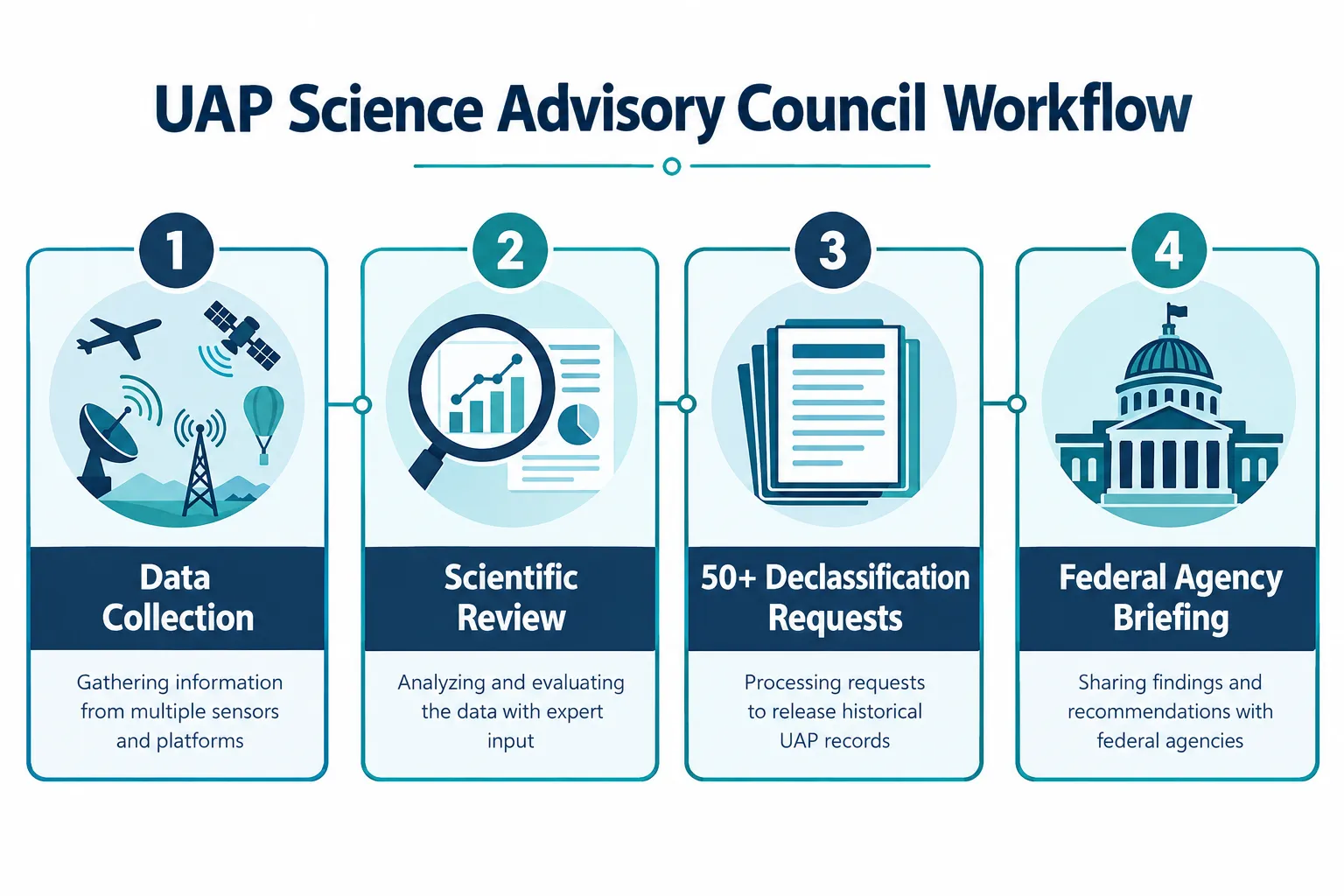
That distinction matters. It reframes the council’s function as a technical resource rather than an intelligence body, which helps explain why transparency efforts have taken the form of formal requests rather than direct disclosure. According to Szydagis, the council has already filed more than 50 declassification requests tied to UAP material, an effort aimed at opening government data to independent scientific review.[2][4][5]
This approach reflects what Szydagis calls “bottom-up disclosure,” a model where civilian scientists, academic researchers, and independent sensor networks generate credible data that can stand on its own, regardless of whether government agencies release additional records.[4][5][13] The idea shifts the burden of proof away from anecdote and toward reproducible measurement, a hallmark of astroparticle physics itself.
Why Varginha Still Matters
Among all historical UAP cases, Szydagis singles out the 1996 Varginha incident in Brazil as the one he most wants declassified and clarified.[2][4] The case, long tied to alleged creature sightings and military involvement, serves as a useful test: if official records exist, releasing them would either validate or dismantle decades of speculation. Szydagis’s interest signals a broader theme in his approach: high-profile claims deserve the same evidentiary standard applied in dark-matter research, where a single unexplained signal is treated with caution rather than certainty.
Astroparticle Physicist Matthew Szydagis on UAP Science: Physics of the “Tic Tac” Case and Material Evidence
A central technical segment of the episode tackles the 2004 “Tic Tac” UAP encounter, often cited as one of the most credible cases due to radar and visual corroboration. Szydagis walks through the energy requirements implied by the object’s reported acceleration and directional changes.[5] His key point challenges a common dismissal: that interstellar travel is physically impossible due to distance. He argues this claim frequently misunderstands relativity. In principle, relativistic time dilation could make long-distance travel feasible for a traveler, even if the trip appears to take much longer from Earth’s frame of reference.[5] That does not confirm alien origin, but it does remove one flawed argument often used to reject the possibility outright.
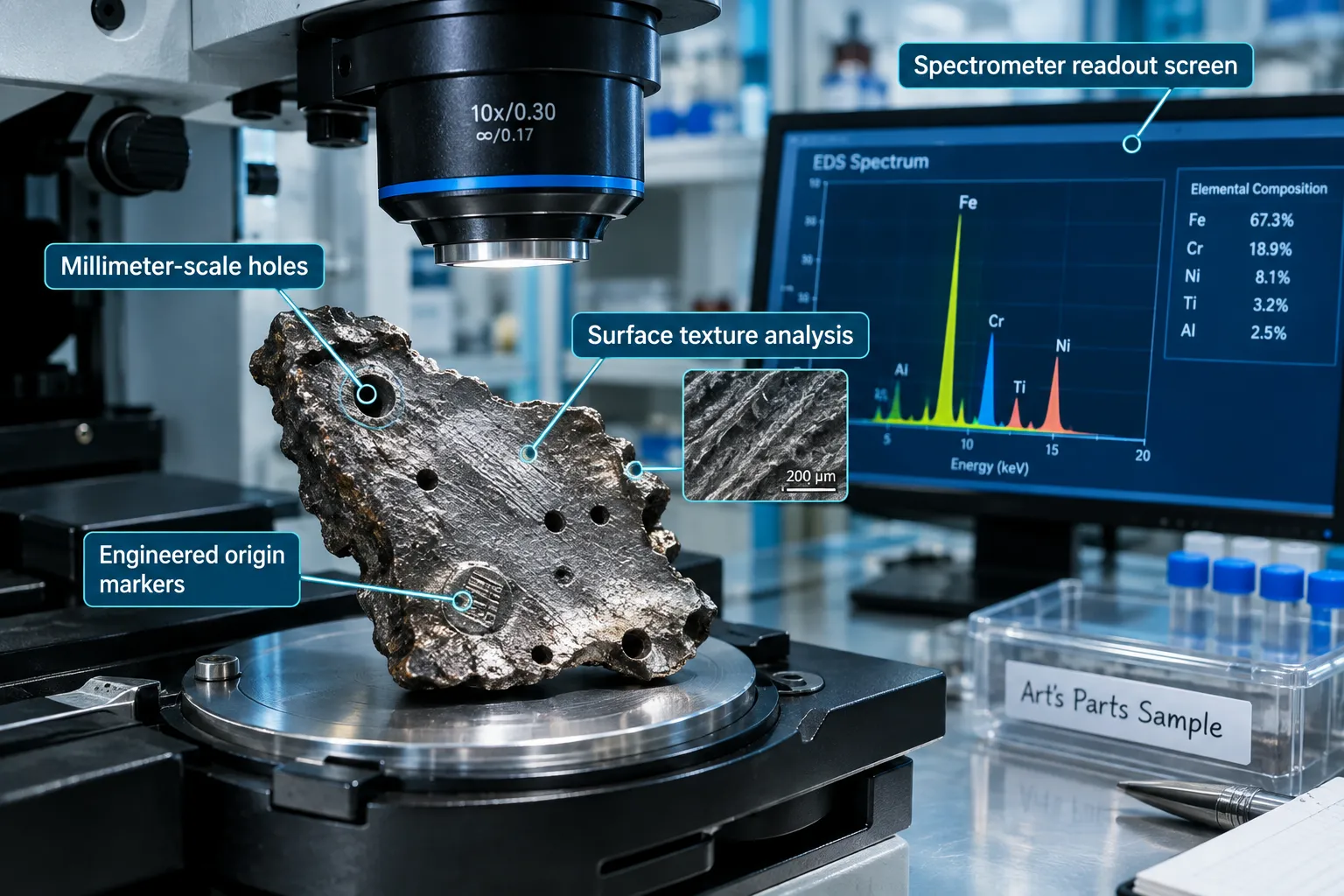
Szydagis extends the same rigor to physical evidence. He discusses ongoing laboratory analysis of a metal sample from the so-called “Art’s Parts” collection, material reportedly supplied through Tom DeLonge and Hal Puthoff.[5] Using standard materials-science techniques, he examined the sample for anomalies such as unusual alloys, isotope ratios, or fabrication marks.
His findings so far point toward a mundane explanation. The sample contains millimeter-scale holes and structural features that, in his assessment, are more consistent with a human-engineered origin than with non-human technology.[5] This is a notable moment in the episode: a scientist publicly stating that a widely circulated “exotic” artifact likely has an earthly explanation, reinforcing that skepticism cuts both ways in his methodology.
“Extraordinary claims deserve extraordinary scrutiny, not extraordinary shortcuts.”, a guiding theme throughout the discussion of UAP evidence standards.
Background: From Dark Matter to UAP Hotspots
Szydagis’s credibility on this topic stems from a research career built on detecting things that barely interact with ordinary matter. He has contributed to the LUX and LZ liquid-xenon dark-matter experiments, developed the NEST simulation software for rare-event detection, and worked on “snowball chamber” supercooled-water detector technology.[1][7][10] These are precision instruments designed to catch faint, rare signals buried in noise, a skill set directly transferable to sorting genuine anomalies from misidentified aircraft, drones, or atmospheric phenomena.
He also serves as a science and technology consultant for UAPx and is active in the Scientific Coalition for UAP Studies, contributing to field campaigns that deploy multi-sensor arrays at known UAP “hotspots.”[1][10][15] A 2025 University at Albany news release described one such deployment: researchers found that rigorous instrumentation could explain nearly every candidate sighting except one ambiguous case involving bright white dots inside a dark spot recorded on video.[13] The team explicitly reported no evidence linking the phenomena to non-human intelligence.[13]
This caution echoes elsewhere in his work. In September 2026 reporting on a possible single dark-matter detection event, University at Albany physicists, including Szydagis, stressed that one event is “extremely far from being conclusive.”[14][1][7] That same standard, patience over premature conclusions, defines his UAP research philosophy.
| Focus Area | Method | Standard Applied |
|---|---|---|
| Dark matter detection | Liquid-xenon detectors, NEST software | Multiple confirmed events required |
| UAP hotspot research | Multi-sensor field deployments | Rule out conventional explanations first |
| Material sample analysis | Standard materials science | Compare against known human fabrication |
| Historical case review | Declassification requests | Verify with primary government records |
Conclusion
The Reality Check conversation with Matthew Szydagis reframes UAP research as a legitimate scientific frontier rather than a fringe curiosity. His dual role, advising federal agencies while running independent field research, illustrates a path toward “bottom-up disclosure” built on transparent, reproducible data rather than classified promises. For readers interested in following this space responsibly, the practical next step is straightforward: track peer-reviewed publications, university research updates, and formal declassification outcomes rather than relying solely on viral claims. As Szydagis’s own dark-matter caution shows, one unexplained signal is a starting point for investigation, not a conclusion.
References
[1] Drmatthewszydagis – https://www.uapexpedition.org/drmatthewszydagis [2] Id1837783062 – https://podcasts.apple.com/us/podcast/reality-check-with-ross-coulthart/id1837783062 [4] Reality Check With Ross Coulthart – https://podscan.fm/podcasts/reality-check-with-ross-coulthart [5] Astroparticle Physicist Matthew Szydagis On Uap Science Reality Check – https://www.newsnationnow.com/podcasts-newsnation/reality-check/astroparticle-physicist-matthew-szydagis-on-uap-science-reality-check/ [7] Matthew Szydagis – https://www.albany.edu/physics/faculty/matthew-szydagis [10] Matthew Szydagis – https://www.altpropulsion.com/people/matthew-szydagis/
astroparticle physics, UAP science, Matthew Szydagis, Reality Check podcast, Ross Coulthart, UAP disclosure, dark matter research, Tic Tac UFO case, Varginha case, UAP Science Advisory Council, University at Albany, non-human intelligence research


