
What actually happens to neural architecture when the mind enters deep contemplation? A new cross-continental collaboration between Swiss neuroscientists and Bengaluru researchers seeks to map the meditative brain with unprecedented precision. On October 1, 2026, that question moved from philosophy into the laboratory when Swiss and Bengaluru scientists team up to map the brain during meditation through a live public demonstration at S-VYASA University, projecting real-time brain signals from meditators onto screens for audiences to watch unfold minute by minute [1][4][9].
The event, organized by Geneva-based research group All Here alongside the World Meditation League and S-VYASA, used electroencephalography and brain-computer interface technology to translate electrical brain activity into dynamic visuals, giving onlookers a rare glimpse of a traditionally invisible mental process [1][4].
Key Takeaways
- Swiss and Bengaluru scientists team up to map the brain during meditation using EEG, brain-computer interfaces, and emerging fMRI protocols to study neural changes during contemplative states [1][9][14].
- Breath-focused meditation produces measurable shifts in brain rhythms within 2-3 minutes, with peak changes around 7-10 minutes, according to Bengaluru-based EEG research [3][8].
- Long-term meditators show enhanced gamma oscillations and stronger inhibitory brain circuits, according to a study from the Indian Institute of Science [5][7][13].
- The partnership moves beyond simple stress-reduction claims, examining microstate dynamics, network connectivity, and default mode network behavior tied to altered states of awareness [6][12].
- Swiss fMRI trials and Indian EEG studies are converging to link fast temporal brain changes with slower, whole-network spatial patterns [9][14].
Why Swiss and Bengaluru Scientists Team Up to Map the Brain During Meditation
Bengaluru has quietly become a global hub for contemplative neuroscience. Institutions such as the National Institute of Mental Health and Neurosciences and the Indian Institute of Science routinely partner with European research teams to study how traditional practices affect measurable brain function [3][5]. Switzerland brings complementary strength through institutions like EPFL and the University of Geneva, where functional brain-mapping expert Prof. Christoph Michel has contributed methods for analyzing electrical neuroimaging data [9][15].
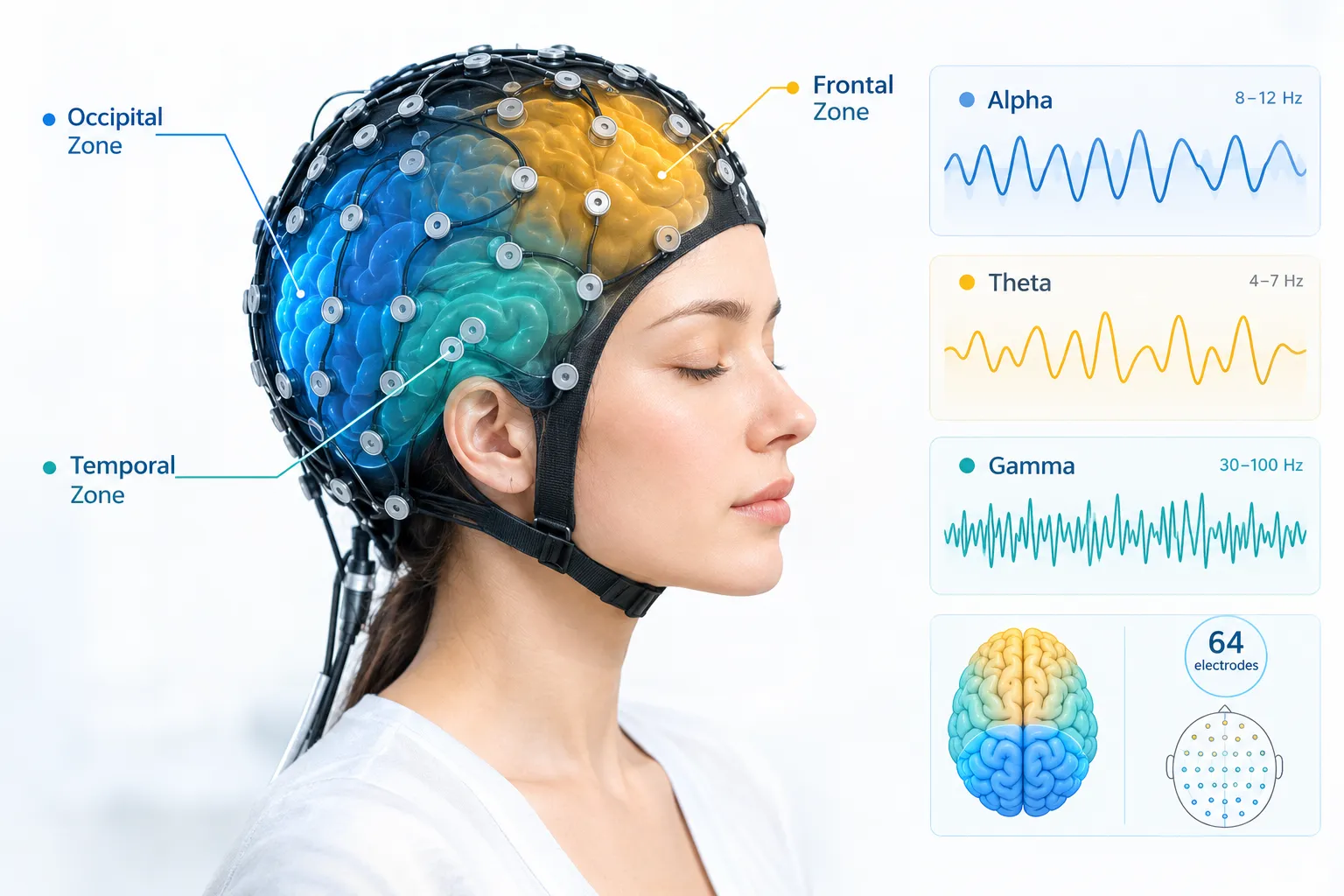
This is not a casual wellness crossover. The collaboration applies dynamic electrical neuroimaging, millisecond-resolution microstate analysis, time-frequency power analysis, and complexity metrics to quantify what the organizers call the “Meditative Mind & Brain” [9]. All Here operates physical measurement spaces where EEG recordings become standardized Quantified Meditation Reports, building a growing database of meditative brain signatures [9][15].
Inside the October 2026 Demonstration
During the Bengaluru event, meditators wore EEG caps while audiences watched their brain signals change in real time on large displays. Organizers describe the goal as making meditation “measurable and trainable,” rather than treating it as a purely subjective experience [1][4]. The demonstration built on an earlier April 2026 study in which 22 experienced meditators practiced breath-focused Ānāpānasati meditation at Pyramid Valley International, revealing how quickly brain rhythms and network dynamics shift during focused attention [2].
What the Research Reveals About Meditative Brain States
A peer-reviewed study published in April 2026 examined microstate dynamics during focused-attention meditation in the same group of 22 practitioners. Researchers found systematic changes in how long specific brain-state patterns lasted, how often they occurred, and how much cortical territory they covered, suggesting meditation reorganizes large-scale brain networks within fractions of a second [6][12].
Separately, NIMHANS researchers studied Isha Yoga breath-watching meditation across three groups: non-meditators, beginners, and experienced practitioners, each fitted with 128-sensor EEG caps. The findings showed that:
- Brain activity shifts toward relaxed alertness within 2-3 minutes of starting meditation [3][8]
- Alpha and theta waves, associated with calmness and focus, increase steadily [3][8]
- Beta-1 activity linked to engaged attention rises alongside falling delta waves tied to drowsiness [3][8]
- Peak neural changes typically occur between 7 and 10 minutes, though advanced meditators show distinct signatures within about 30 seconds [3][8]
“Meditation is increasingly being treated as a measurable, trainable mental skill grounded in observable changes to neural activity,” according to reporting summarizing the Bengaluru research landscape [1][4].
Gamma Waves, Inhibitory Circuits, and the Swiss Connection
Perhaps the most striking findings come from the Indian Institute of Science. Researchers in the NeurOscillations Lab studied 35 long-term Rajyoga meditators, each with more than five years and roughly 10,000 hours of practice, comparing them to 36 matched non-meditators using high-density 64-channel EEG [5][7][13]. The meditators showed significantly stronger gamma oscillations and steeper power-spectrum slopes, markers typically associated with robust inhibitory neural function that tends to decline with age [5][7][10][13].
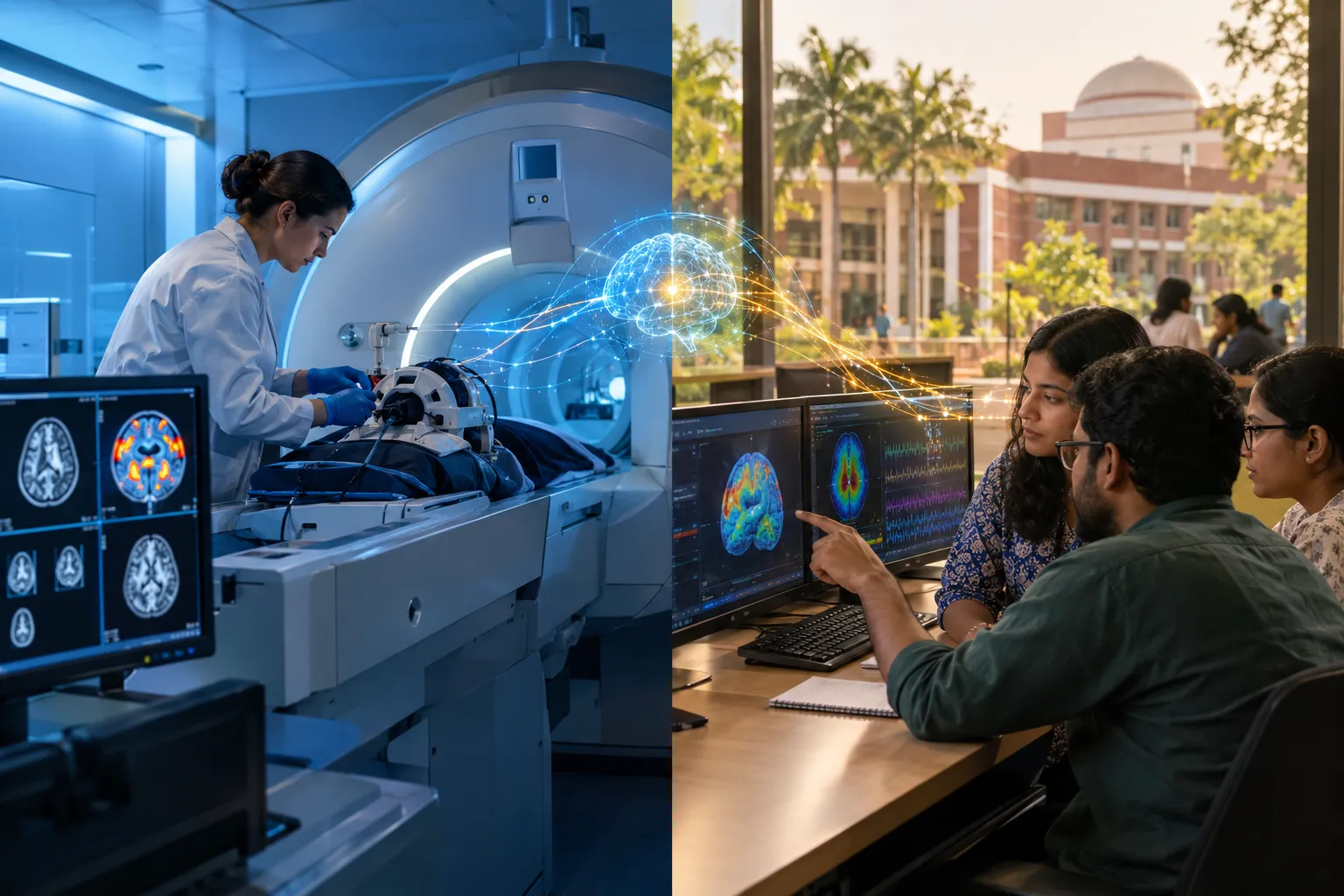
Notably, this enhanced gamma activity appeared before, during, and after meditation sessions, pointing to lasting trait-level changes rather than temporary states [5][7][10]. Meanwhile, a Swiss neuroimaging trial registered in 2026 is using functional MRI to examine brain network changes before and after a three-day mindfulness retreat, adding high-resolution spatial detail that complements the fast EEG timescales captured in Bengaluru [14][9]. Together, these efforts show how Swiss and Bengaluru scientists team up to map the brain during meditation across both millisecond and network-wide scales.
Beyond Wellness Trends: Why Rigor Matters
Much of the popular meditation conversation centers on stress relief apps and relaxation claims. This research program instead investigates default mode network activity, gamma synchrony, and altered states of consciousness using standardized, peer-reviewed methods [6][9][12]. Experts suggest future work could combine EEG microstates, gamma metrics, and fMRI connectivity with brain-computer interfaces to create personalized meditation training and objective progress tracking, potentially informing treatments for stress, attention disorders, and age-related cognitive decline [2][5][7][9][14][15].
Conclusion
The collaboration between Swiss and Bengaluru scientists to map the brain during meditation signals a shift toward treating contemplative practice as measurable science rather than anecdote. From rapid EEG shifts within minutes to lasting gamma enhancements after years of practice, the data suggests meditation reshapes the brain across multiple timescales. Readers interested in the science can follow updates from All Here, S-VYASA, and IISc publications, and consider how objective brain-based feedback might inform personal meditation practice going forward.
References
[1] Business News Swiss Researchers Join Bengaluru Scientists To Measure What Happens In The Brain During Meditation 7628448 – https://www.latestly.com/agency-news/business-news-swiss-researchers-join-bengaluru-scientists-to-measure-what-happens-in-the-brain-during-meditation-7628448.html [2] How Breath Focused Meditation Reshapes The Brain At The Speed Of Thought – https://allhere.org/updates/how-breath-focused-meditation-reshapes-the-brain-at-the-speed-of-thought/ [3] Eduarddewilde Meditation Mindfulness Livehelfi Activity 7469689433403990016 M6np – https://www.linkedin.com/posts/eduarddewilde_meditation-mindfulness-livehelfi-activity-7469689433403990016-m6nP [4] healthvision.in – https://healthvision.in/ [5] Iisc Meditation Study Gamma Brain Activity Inhibitory Circuits 9746 – https://www.academicjobs.com/research-publication-news/iisc-meditation-study-gamma-brain-activity-inhibitory-circuits-9746 [6] pubmed.ncbi.nlm.nih.gov – https://pubmed.ncbi.nlm.nih.gov/42029842/ [7] timesofindia.indiatimes – https://timesofindia.indiatimes.com/science/long-term-meditation-may-sharpen-brains-signals-finds-iisc-study/articleshow/130339632.cms [8] 2026 04 Meditation Brain Quickly Peak Minutes – https://medicalxpress.com/news/2026-04-meditation-brain-quickly-peak-minutes.html [9] The Science – https://allhere.org/the-science/ [10] Iisc Indian Scientists Discover Meditation Rewires Brain Boosting Gamma Waves Study 9849 – https://www.academicjobs.com/in/research-publication-news/iisc-indian-scientists-discover-meditation-rewires-brain-boosting-gamma-waves-study-9849


