
Long before wellness apps and retreat centers promised inner peace through stillness, one of history’s most famous meditators described splitting headaches so severe he had to change his entire practice. Even the Buddha experienced challenges with meditation: historical texts reveal its potential downsides that modern practitioners rarely hear about in guided sessions or mindfulness marketing. Ancient scriptures, not just contemporary clinical studies, document real physical and psychological costs of intensive contemplative practice.
This matters because meditation is often presented as universally safe and beneficial. The historical record, paired with a growing body of modern research, tells a more complete story: contemplative practice is powerful precisely because it can also go wrong.
Key Takeaways
- Early Buddhist texts describe the Buddha himself suffering headaches and bodily distress from overconcentration before he adjusted his methods.
- A story in the Samyukta Agama describes monks dying by suicide after intensive practice of a body-contemplation technique, prompting the Buddha to revise his teaching.
- A fifth-century text, Secret Essentials for Curing Meditation Sickness, shows ancient practitioners recognized meditation-induced mental disturbance and tried to treat it.
- Modern surveys find that 58 to 60 percent of meditators report at least one side effect, and roughly 9 to 13 percent experience lasting functional impairment.
- Risk rises with intensive retreats, extreme concentration techniques, and pre-existing psychological distress, echoing warnings found in ancient sources.
What Historical Texts Reveal About Even the Buddha’s Struggles With Meditation
Buddhist scripture is often read as a flawless instruction manual for enlightenment. But the earliest texts are more honest than that. In a discourse frequently associated with the Buddha’s exchange with the ascetic Saccaka, he recounts practicing extreme forms of concentration and breath control that produced overwhelming bodily pain, including headaches so intense they felt like “a strong man splitting my head open with a sharp sword.” Only after recognizing that this approach caused harm rather than progress did he moderate his technique, moving toward a balanced method that avoided both self-indulgence and self-punishment [9].

This was not an isolated incident. Early scriptures such as the Samyukta Agama describe a troubling episode in which the Buddha taught a group of monks to contemplate the unattractive, decaying nature of the body as a way to reduce craving. Several monks, overwhelmed by the intensity of this contemplation, took their own lives. The account led the Buddha to revise his instructions, shifting emphasis toward breath-based mindfulness instead. This episode is one of the clearest ancient acknowledgments that a meditation technique, applied without adequate support, could produce catastrophic psychological outcomes rather than liberation [9].
Centuries later, a fifth-century Central Asian text known as Secret Essentials for Curing Meditation Sickness went further, documenting meditators who reportedly “went mad” after being startled by sudden noises while in deep states of absorption. Rather than dismissing these reactions, the text offered remedial practices meant to treat the disturbance, showing that pre-modern Buddhist communities had already developed a working understanding of meditation-related harm long before the term existed in psychology [9].
Other early manuscripts and inscriptions reinforce this caution. They warn that concentration cannot be safely attained if practitioners have not first addressed envy, craving, and other mental “intoxicants.” Meditation without accompanying ethical grounding and wisdom, these texts suggest, is not just less effective, it is potentially destabilizing [9].
Even the Buddha Experienced Challenges With Meditation: What Modern Research Confirms
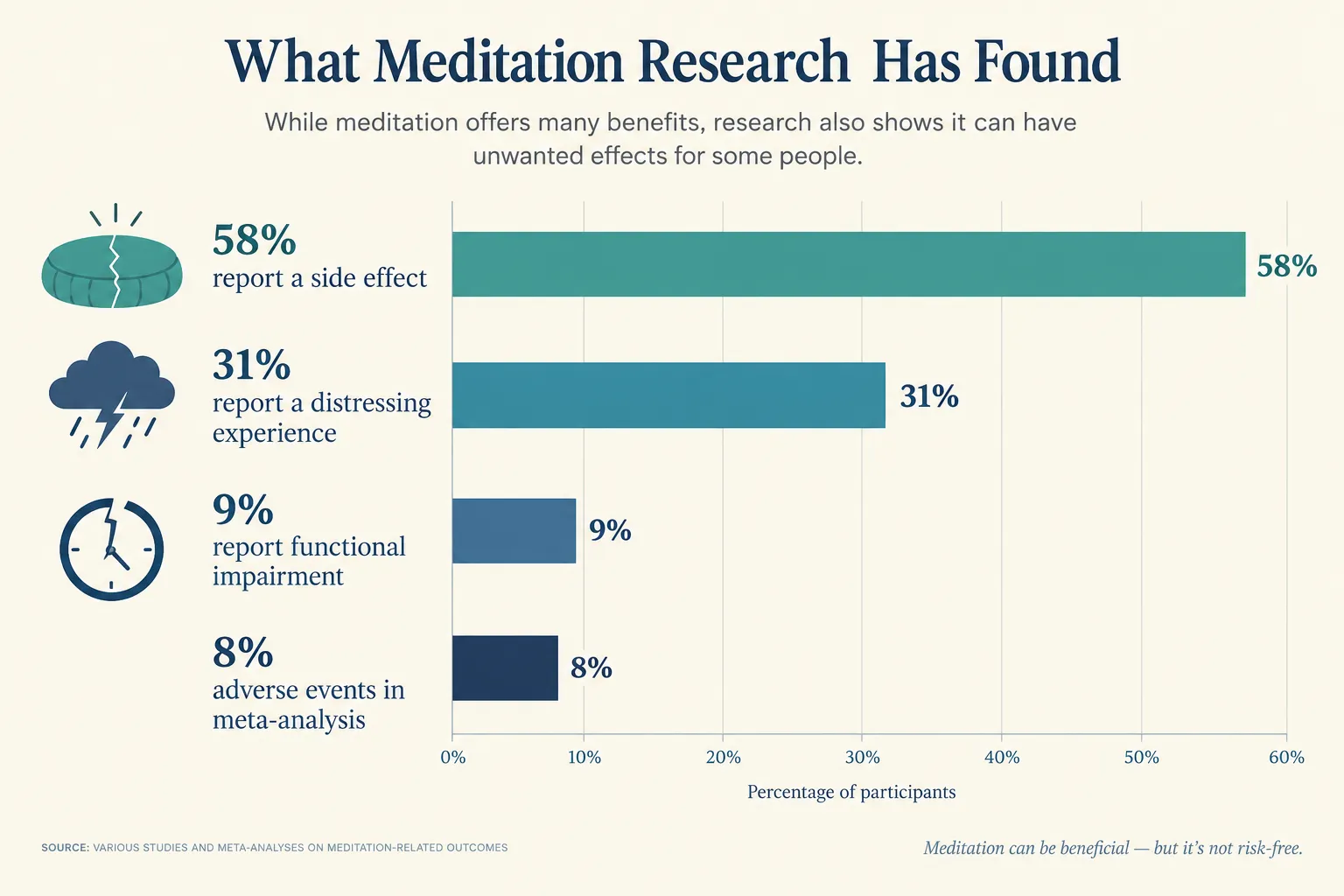
Modern science has, in many ways, caught up to what ancient texts already implied. A large 2025 survey of U.S. meditators found that 96.6 percent reported at least one unusual experience during practice, 58.4 percent reported an adverse effect, 31.4 percent described the experience as challenging or distressing, and 9.1 percent experienced functional impairment severe enough to disrupt daily life [10].
A clinical review updated in September 2026 estimates that between 25 and 87 percent of meditators report some adverse effect, with 3 to 37 percent experiencing functional impairment such as an inability to work. The most common problems include anxiety, depression, and traumatic re-experiencing, particularly among people who begin practice while already under psychological strain [7][8].
A meta-analysis summarized by physicians in May 2024 reviewed 83 studies and found meditation-related adverse events in about 8.3 percent of participants. Some long-term meditators required hospitalization or experienced suicidality. Researchers extrapolated that roughly 1 million people in the United States may have experienced a significant negative event connected to meditation [1][5].
An August 2025 analysis added further detail: nearly 60 percent of U.S. meditators experienced at least one side effect such as anxiety or a sense of disembodiment, about 30 percent found the effects challenging, and 9 percent experienced functional impairment. Intensive residential retreats and recent mental health symptoms were flagged as key risk factors [6].
| Study or Source | Reported Rate | Type of Outcome |
|---|---|---|
| 2025 U.S. survey [10] | 58.4% | Any adverse effect |
| 2025 U.S. survey [10] | 9.1% | Functional impairment |
| Clinical review [7][8] | 25-87% | Any adverse effect |
| Meta-analysis, 83 studies [1][5] | 8.3% | Adverse events |
| August 2025 analysis [6] | ~60% | Any side effect |
| General population estimates [2][3] | 20-25% | Unpleasant experience |
Independent epidemiological reviews converge on similar patterns: roughly 20 to 25 percent of meditators report unpleasant experiences, and about 10 to 13 percent report adverse effects involving some degree of functional impairment, with emotional sensitivity and anxiety among the most frequently cited problems [2][3].
Why Meditation Can Backfire: Lessons From Even the Buddha’s Experience With Meditation
The historical and clinical evidence point to overlapping risk factors rather than a single cause.
- Excessive intensity. Just as the Buddha’s extreme concentration produced physical pain, modern intensive retreats are consistently linked to higher rates of adverse effects [6].
- Lack of preparation. Ancient texts warn that concentration is unreliable without prior ethical and mental groundwork; clinicians today similarly note that unaddressed distress increases risk [7][9].
- Unsupervised deep practice. The Secret Essentials text describes disturbance triggered by sudden stimuli during deep absorption, echoing modern reports of dissociation and disorientation [9].
- Underlying vulnerability. Both traditions point to pre-existing psychological strain as a magnifier of risk, not a bystander factor [4][8].
As one clinical review summary puts it, “these are not rare curiosities but common enough experiences to warrant public health attention” [7].
How to Practice Meditation More Safely
- Start with shorter, guided sessions rather than intensive silent retreats, especially if new to practice.
- Avoid extreme techniques involving forced concentration or breath restriction without qualified supervision.
- Disclose any recent trauma, anxiety, or depression to a retreat leader or teacher beforehand.
- Stop and seek support if physical pain, panic, or disorientation appears, rather than pushing through it.
- Choose teachers or programs trained to recognize and respond to adverse meditation experiences [4][6].
Conclusion
The idea that meditation is risk-free does not hold up against either ancient scripture or contemporary data. Even the Buddha experienced challenges with meditation: historical texts reveal its potential downsides that were serious enough to force him to change his own methods, and modern research confirms that similar risks persist today, from anxiety and dissociation to rare but severe psychological crises. This does not mean meditation should be avoided. It means it should be approached with the same care given to any powerful practice: appropriate pacing, honest self-assessment, and support from knowledgeable guides. Anyone considering an intensive retreat or advanced technique should start gradually, monitor their own reactions closely, and consult a mental health professional if distress emerges rather than assuming discomfort is simply part of the process.
References
[1] 4b027zu60nxgh5wh7pthqx – https://www.mdlinx.com/article/when-mindfulness-backfires-the-overlooked-risk-of-adverse-events/4b027ZU60nxGH5WH7PTHqX [2] medicalnewstoday – https://www.medicalnewstoday.com/articles/325167 [3] Pmc8693904 – https://pmc.ncbi.nlm.nih.gov/articles/PMC8693904/ [4] Mindfulness Meditation May Have Downsides – https://www.psychologytoday.com/us/blog/talking-about-trauma/202408/mindfulness-meditation-may-have-downsides [5] sciencedaily – https://www.sciencedaily.com/releases/2024/05/240520155544.htm [6] 2025 Aug Meditation Side Effects – https://www.psychologicalscience.org/news/2025-aug-meditation-side-effects.html [7] pubmed.ncbi.nlm.nih.gov – https://pubmed.ncbi.nlm.nih.gov/41176868/ [8] Acps – https://onlinelibrary.wiley.com/doi/10.1111/acps.13225 [9] Meditation In Multiple Contexts Early Buddhist Manuscripts And Inscriptions – https://buddhism.org/pages/Meditation-in-Multiple-Contexts-Early-Buddhist-Manuscripts-and-Inscriptions [10] journals.sagepub – https://journals.sagepub.com/doi/pdf/10.1177/21677026241298269


