Neuroimaging researchers recently found that long-term meditators show measurably greater structural integrity in a pea-sized gland once dismissed as spiritual folklore: the pineal gland, historically called the “third eye.”[10][4] This finding gives fresh context to an ancient practice. Understanding how opening your third eye can deepen your spiritual connections requires looking at both the symbolic tradition and the emerging science behind focused, brow-centered meditation.
Key Takeaways
- Third-eye work centers on focused attention at the brow point combined with visualization of indigo or violet light.[1][8]
- Long-term meditation practice correlates with greater pineal gland integrity and altered brain activity patterns linked to clarity and intuition.[10][14]
- A gradual, gentle protocol, breath awareness, visualization, and grounding, is safer and more sustainable than chasing dramatic sensations.[13][5]
- Yoga poses like lotus, dolphin, and child’s pose can support brow-centered focus by calming the body.[8]
- Genuine progress often shows up as increased compassion and stronger relationships, not supernatural visions.[9][8]
What Does Opening the Third Eye Actually Mean
Opening the third eye is largely a metaphor for training attention on the space between the eyebrows, often paired with visualizing a violet or indigo light glowing brighter with each breath.[1][8] Verywell Mind’s psychology-based framing treats the third eye as a symbol for deepened self-knowledge rather than a literal mystical organ, recommending breath-focused meditation and visualization of light entering through the crown and filling the body to build a felt sense of oneness.[9]
Esoteric traditions describe the practice differently but arrive at a similar goal. Grimoire’s contemporary encyclopedia entry lists recurring techniques, brow-centered meditation, chanting the seed mantra “OM,” working with indigo imagery or crystals, and disciplined dream journaling, as tools for strengthening “inner vision.”[2] The stated aim is not dramatic revelation but progressively clearer inner imagery and a stronger sense of guidance that practitioners interpret as connection to their higher self or spiritual guides.[2][8]
The Science Behind How Opening Your Third Eye Can Deepen Your Spiritual Connections
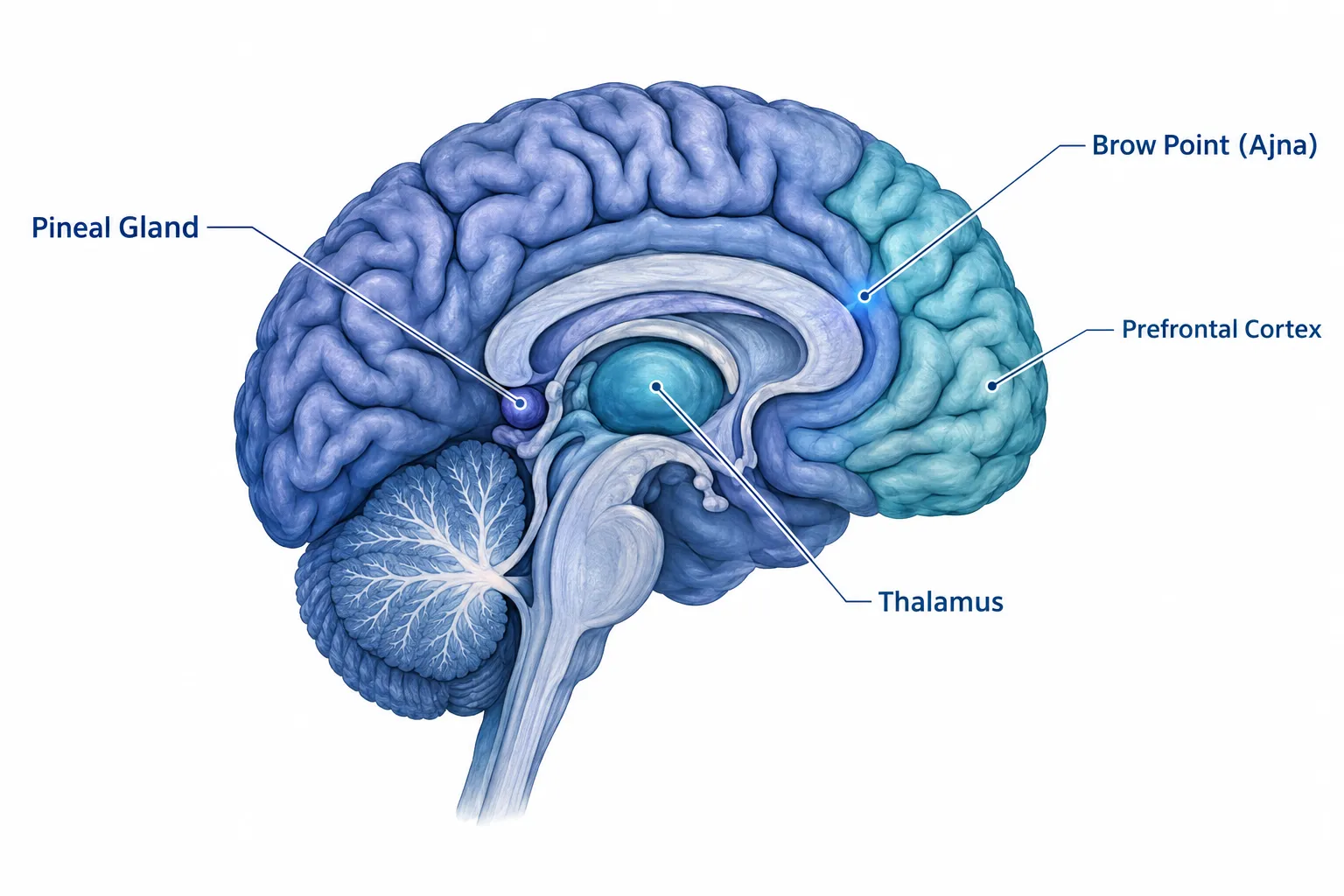
A 2024-2026 neuroimaging study found that meditation experience correlated linearly with pineal gland integrity, and long-term meditators showed a lower predicted “brain age” than non-meditators.[10][4] Related MRI research has observed increased signal intensity in the pineal body during meditation, which some researchers cautiously connect to intrinsic awareness often associated with spiritual experience, while calling for more rigorous studies before drawing firm conclusions.[7][15]
A 2025 University of Amsterdam thesis on Ajna-focused meditation found increased activity in the dorsolateral prefrontal cortex alongside reduced thalamic activity, compared with a resting yogic baseline.[14] This pattern echoes open-monitoring meditation research and suggests third-eye practices may support executive control and altered sensory filtering, changes practitioners often describe subjectively as heightened clarity and intuitive insight.[14][10]
A broader review of the pineal gland notes its established roles in circadian rhythm and melatonin production, and explores why many spiritual traditions symbolically frame it as a bridge between physical and spiritual worlds.[15] The gland’s sensitivity to light-dark cycles and its involvement in sleep and dream states may partly explain its long association with mystical insight.[10][15]
“The goal is not dramatic visions but progressively clearer inner imagery and a stronger sense of guidance.”
A Practical Protocol for Third-Eye Meditation
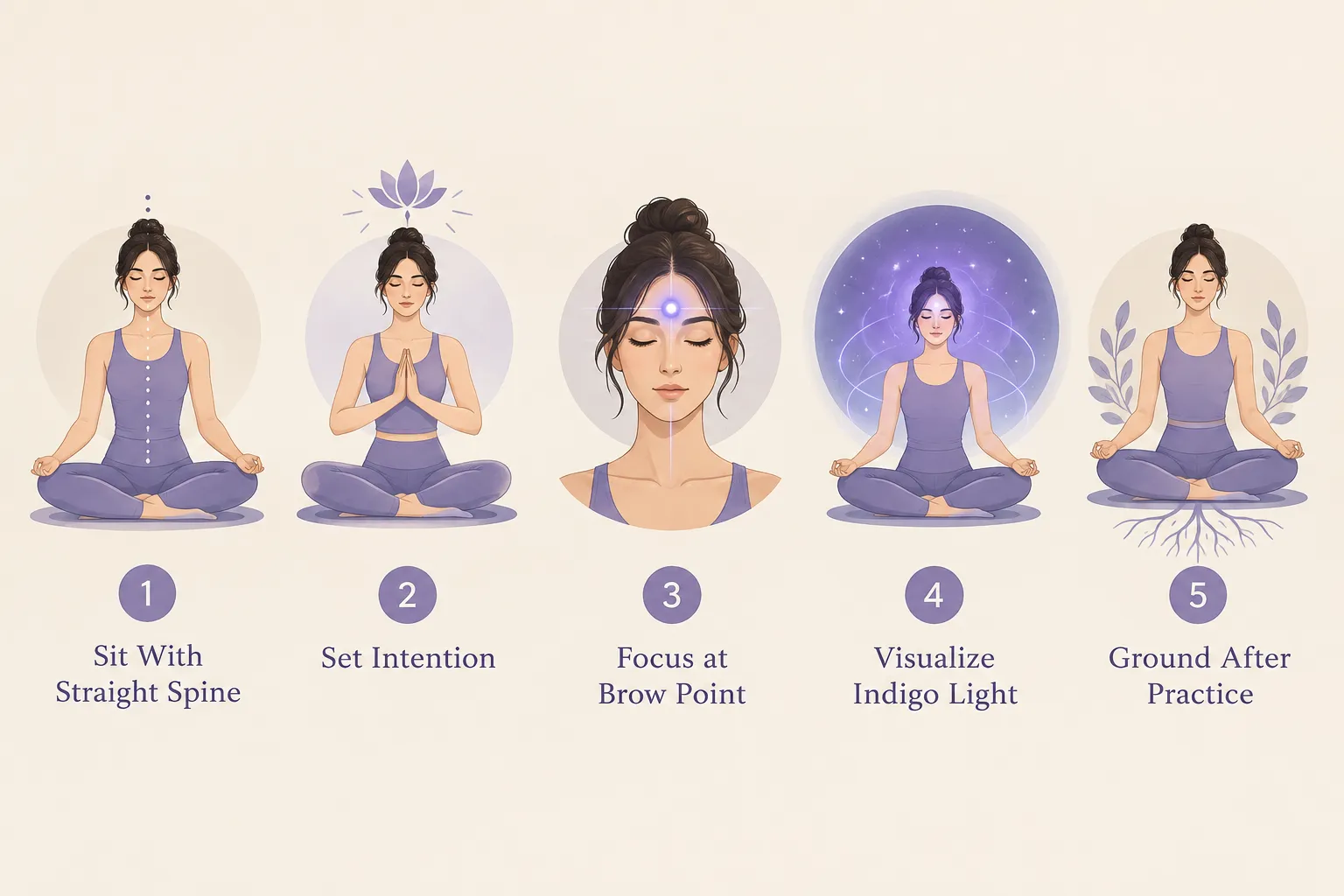
Multiple 2026 practice guides converge on a similar, accessible sequence:
| Step | Action | Purpose |
|---|---|---|
| 1 | Sit with a straight spine in a quiet space | Settles the nervous system |
| 2 | Set a clear intention (clarity, intuition, connection) | Directs focused attention |
| 3 | Rest awareness gently at the brow point | Trains sustained inward focus |
| 4 | Visualize indigo light growing brighter with each breath | Builds symbolic inner imagery |
| 5 | Notice warmth or tingling without alarm | Normal sensory response |
This structure appears consistently across Yogasniff, Thalira, and similar 2026 guides, all emphasizing that “opening” is gradual and experiential rather than instantaneous.[1][3][6]
Candle-gazing, or trataka, is another widely recommended technique: staring softly at a flame, then observing its afterimage at the brow with calm attention.[11][1] Practitioners report this trains the mind to sustain inner imagery, which many find deepens dream vividness and a sense of being inwardly supported during meditation.[2][11]
Yoga Postures That Support the Practice
Certain postures help quiet the body and center attention near the forehead and heart, making brow-focused meditation easier to sustain:
- Lotus pose, stabilizes the spine for longer sitting sessions
- Dolphin pose, draws blood flow and awareness toward the head
- Child’s pose, calms the nervous system before seated meditation
Goodnet’s coverage recommends pairing these postures with compassionate intention, such as dedicating practice to understanding or serving others, which helps translate third-eye work into more empathic, spiritually attuned relationships.[8][2]
Practicing Safely While Deepening Spiritual Connection
Several 2026 safety-focused articles caution against chasing extreme sensations or mistaking anxiety, insomnia, or derealization as proof of dramatic awakening.[5][12][13] Recommended safeguards include:
- Starting with 5-10 minutes of breath awareness, gradually extending to about 20 minutes
- Practicing in a dim, quiet, well-ventilated space
- Limiting screen time beforehand, since blue light can suppress melatonin and disrupt sleep
- Staying hydrated and grounding afterward with stretching or a short walk
- Journaling emotional and physical changes over time
These sources stress that if distressing symptoms persist, consulting a qualified mental-health or medical professional is essential.[12][13] Taroculus’s analyses also note that third-eye experiences are highly subjective and shaped by expectations and prior beliefs, recommending the third eye be treated as a symbolic framework layered onto evidence-based practices like mindfulness and sleep hygiene.[13][5]
Signs That Third-Eye Work Is Deepening Spiritual Connection
Verywell Mind’s experts frame third-eye development as cultivating psychological skills, intuitive pattern recognition, emotional attunement, and mindful self-observation, rather than supernatural power.[9] Vivid imagery, synchronicities, or strong gut feelings are best treated as invitations to reflect, not automatic proof of external forces.[9][8]
The clearest markers of genuine progress, according to Goodnet and related commentary, are relational and ethical: increased compassion, a stronger drive to serve others, and closer alignment with personal values.[8][2] As attention stabilizes and inner clarity grows, many practitioners report more meaningful relationships and a sustained sense of connection to humanity and nature.[8][9]
Conclusion
Understanding how opening your third eye can deepen your spiritual connections means blending symbolic tradition with grounded, evidence-informed practice. Brow-centered meditation, visualization, supportive yoga postures, and disciplined breathwork can meaningfully shift attention and inner awareness, with emerging neuroscience offering cautious support for these subjective experiences.[10][14][15] Begin small: five minutes of breath awareness in a quiet space, a clear intention, and gentle visualization at the brow. Track sensations in a journal, ground the body afterward, and seek professional guidance if anything feels overwhelming. Over time, the most reliable sign of progress is not a dramatic vision but a steadier mind, deeper empathy, and stronger connection to the people and world around you.
References
[1] Third Eye Opening Guide – https://www.yogasniff.com/third-eye-opening-guide/ [2] The Third Eye – https://www.grimoire.love/encyclopedia/the-third-eye/ [3] How To Open Third Eye Chakra – https://thalira.com/blogs/quantum-codex/how-to-open-third-eye-chakra [4] 2024.03.04 – https://www.medrxiv.org/content/10.1101/2024.03.04.24303649v1 [5] Third Eye Activation Myths Safe Practices Warnings 2 – https://taroculus.com/blog/2026/07/22/third-eye-activation-myths-safe-practices-warnings-2/ [6] S1 17456 43281888 – https://www.yardbarker.com/entertainment/articles/third_eye_chakra_in_2026_how_to_strengthen_your_intuition_and_inner_vision/s1_17456_43281888 [7] B50d8fba9a83931688e19972eff00417614390e1 – https://www.semanticscholar.org/paper/Meditation-Linked-to-Enhanced-MRI-Signal-Intensity-Plini-Melnychuk/b50d8fba9a83931688e19972eff00417614390e1 [8] How Opening Your Third Eye Can Deepen Your Spiritual Connections – https://www.goodnet.org/me/how-opening-your-third-eye-can-deepen-your-spiritual-connections/ [9] Opening Your Third Eye 7501747 – https://www.verywellmind.com/opening-your-third-eye-7501747 [10] Pmc10942509 – https://pmc.ncbi.nlm.nih.gov/articles/PMC10942509/


