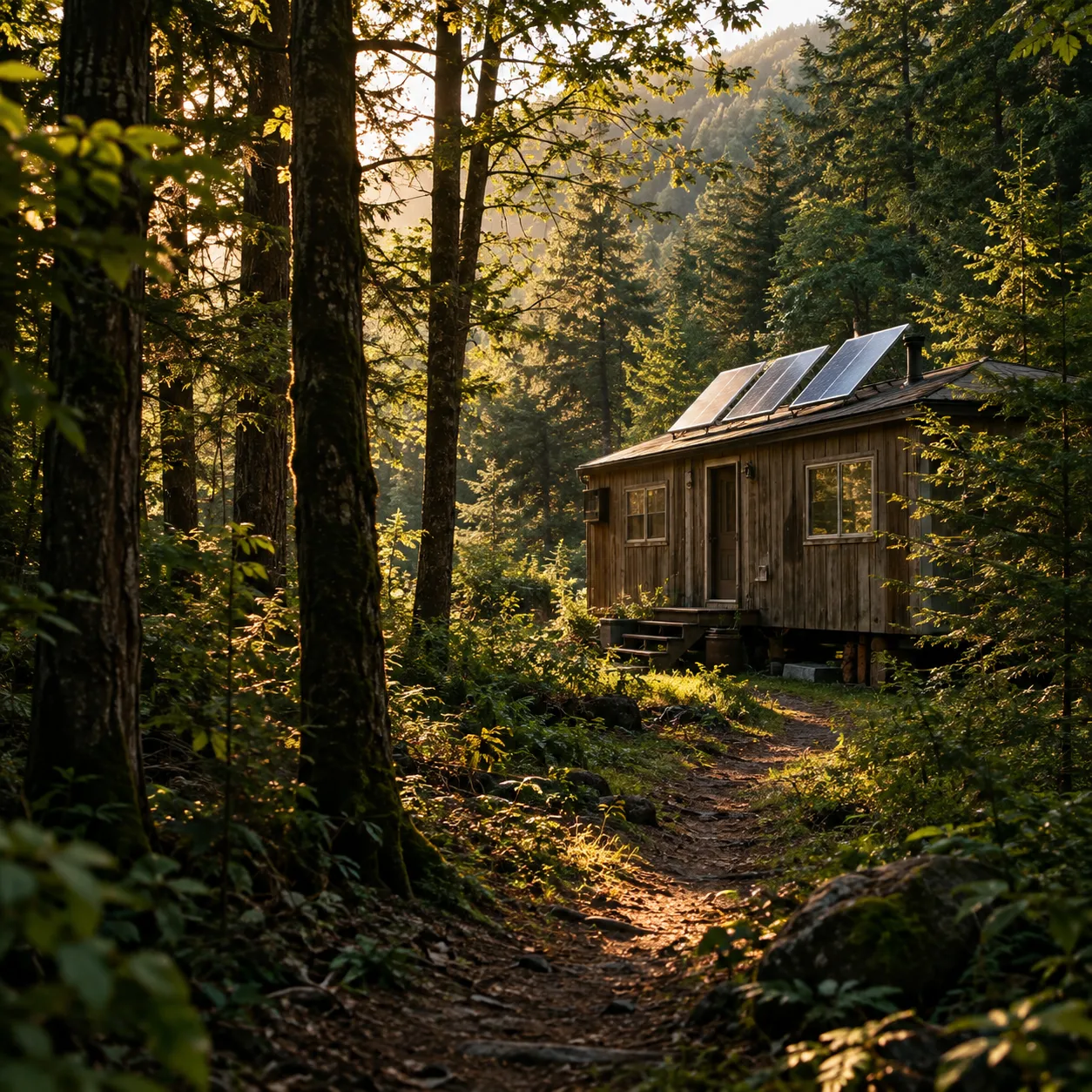
A ten-minute walk is all that separates one man’s wooden trailer from the nearest road, yet that short distance has become the defining line of his entire lifestyle. According to a September 2026 profile by The Cool Down, a man named Mickey lives off-grid in a tiny home at a forest’s edge, and he says he deliberately keeps “one foot in society” rather than vanishing into total wilderness isolation [1]. His story has quickly become a talking point among readers curious about simpler, lower-impact living without the extremes often associated with off-grid life.
Unlike survivalists who cut every tie to modern infrastructure, Mickey’s approach is a hybrid. He generates his own electricity, burns wood for heat, and showers outdoors, but he still shops in town, hauls in drinking water, and borrows a washing machine from friends [1]. That balance is exactly what makes his case study worth examining closely.
Key Takeaways
- Mickey lives off-grid in a tiny home at a forest’s edge, reachable by a roughly 10-minute walk from the nearest access point [1].
- His power comes from three solar panels producing about 400 watts total, enough for basic daily needs [1].
- He has no running water, heats his home with burned wood, cooks with gas, and showers outside under trees [1].
- He intentionally avoids full self-sufficiency, buying most food in town and using a friend’s washing machine, describing his life as having “one foot” in nature and “one foot” in society [1].
- His model contrasts with fully self-sufficient tiny homes, like a Danish rainwater-and-solar house built for about $12,000 [3], and with more extreme experiments such as Robin Greenfield’s uninsulated Wisconsin cabin [9].
Why the Man Lives Off-Grid in a Tiny Home at the Forest’s Edge
Mickey’s setup is intentionally modest. His trailer sits just far enough into the trees to feel secluded, but close enough to town that he is not truly isolated [1]. Three solar panels supply roughly 400 watts of electricity, which covers lighting and small essentials rather than powering a full household [1]. Wood heats the space during colder months, gas fuels his cooking, and bathing happens outdoors, exposed to the forest air [1].
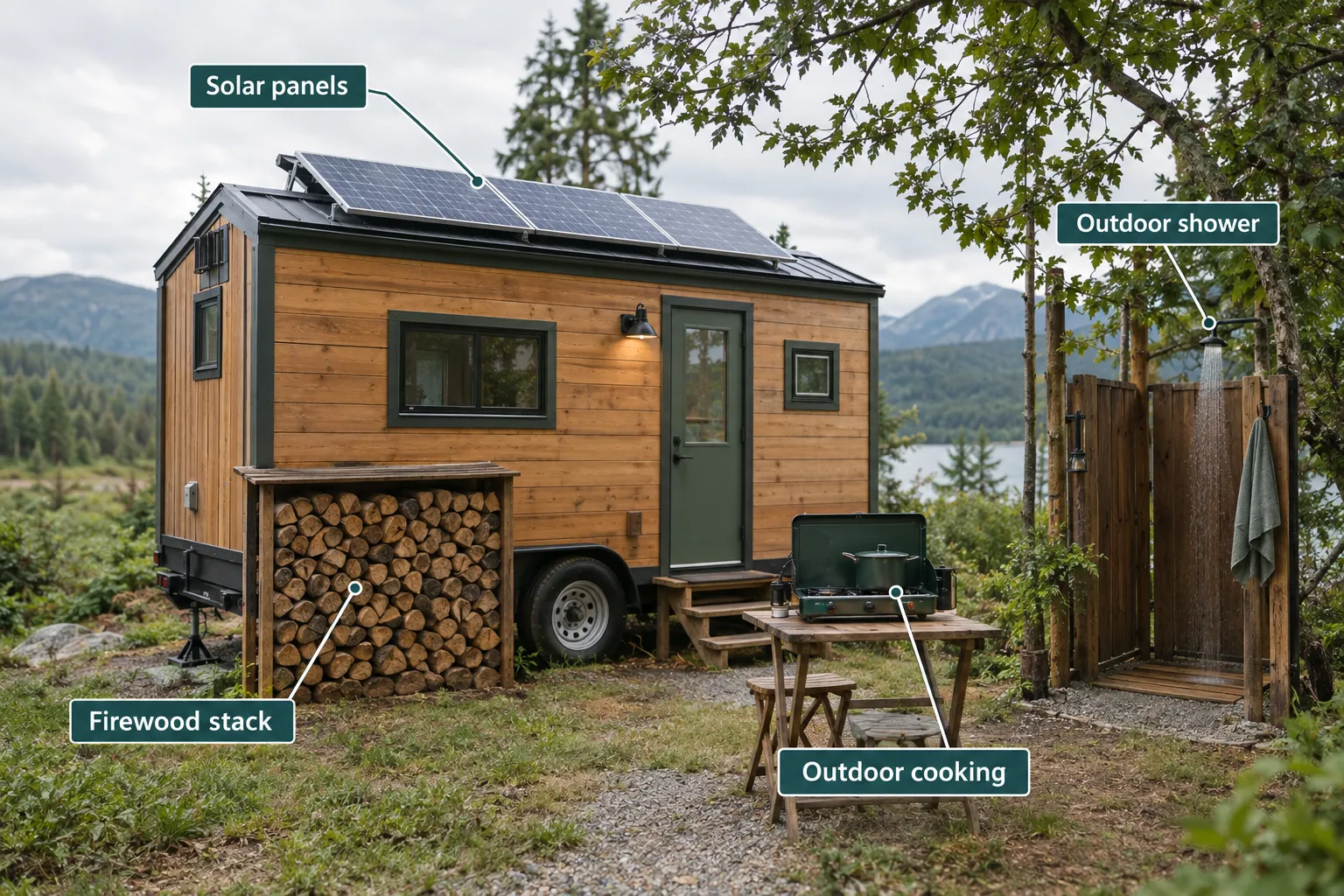
This is not a showcase of high-tech self-sufficiency. It is a stripped-down, low-cost way of reducing dependence on utilities while still functioning within a wider economic system. Mickey buys most of his groceries in town, transports in his own drinking water, and relies on a friend’s washing machine instead of installing costly water and laundry systems [1]. That reliance on nearby services is central to his own description of the lifestyle.
The “One Foot in Society” Philosophy Explained
Mickey summarizes his outlook simply: one foot stays in a slightly different, quieter life, and the other remains firmly part of society [1]. This framing matters because it separates his experiment from the popular image of off-grid living as total withdrawal.
The Cool Down’s reporting frames his lifestyle as a deliberate balance between solitude and community, not a permanent escape [1]. He is not trying to prove he can survive alone forever. Instead, he is testing how much comfort, cost, and clutter can be stripped away while still keeping access to modern conveniences when needed.
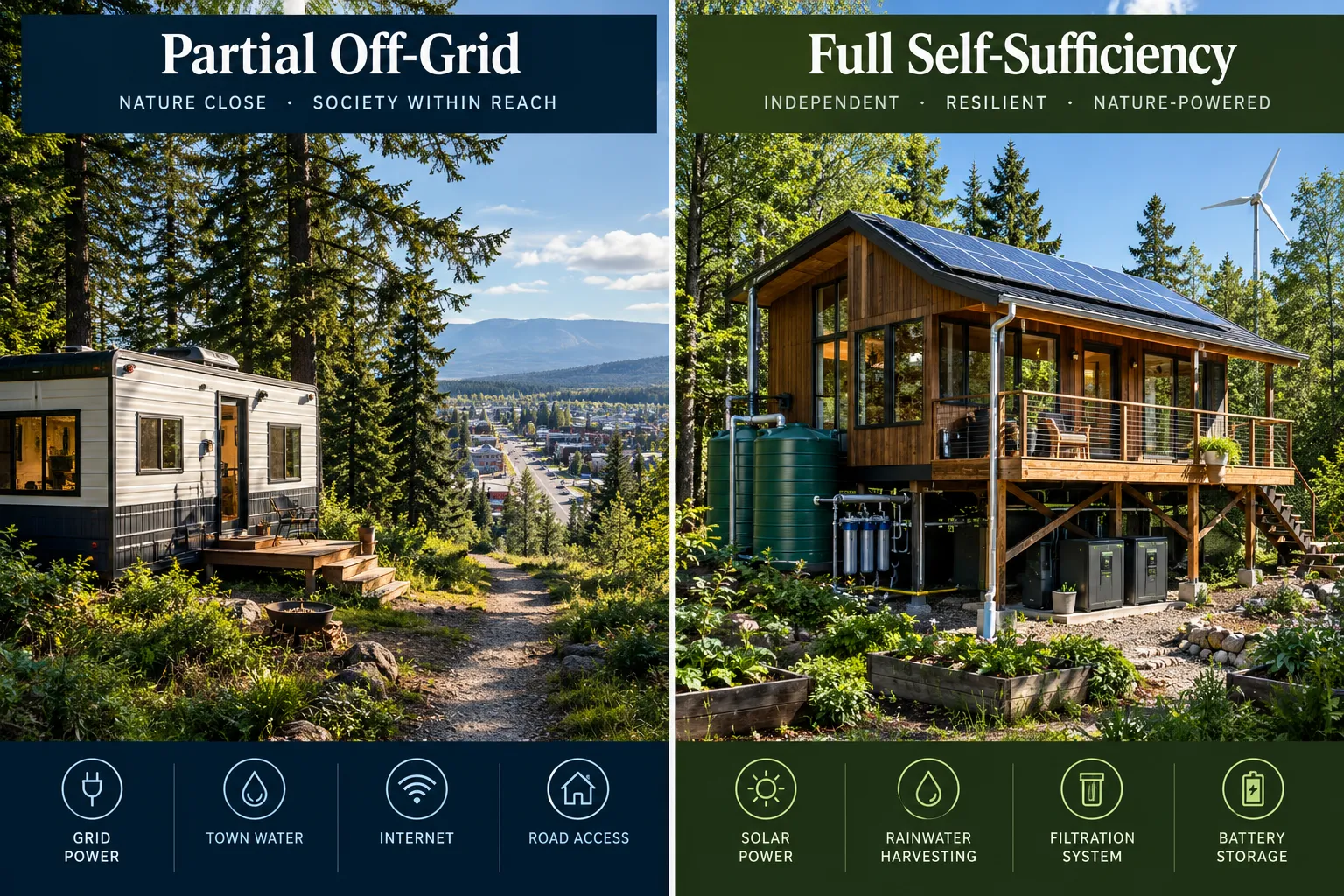
This middle-ground model sits within a broader spectrum of off-grid living covered in 2026 media:
- Partial off-grid, town-supported: Mickey’s trailer, relying on solar power, wood heat, and town-bought supplies [1].
- Fully self-sufficient tiny homes: A Danish tiny house built for about $12,000, measuring 21.3 by 6.6 feet, with rainwater filtration, solar panels, and battery storage covering water, electricity, and heat without town dependence [3].
- Extreme minimalist off-grid: Environmental activist Robin Greenfield’s uninsulated Wisconsin tiny home, which has no running water or electricity and relies on heated stones, wool blankets, and foraged food through freezing winters [9].
- Long-term off-grid evolution: Charles Bello, 87, has lived off-grid for about 50 years on 400 acres of redwood forest, starting without electricity or refrigeration and gradually adding comforts over decades [8].
- Infrastructure-heavy remote living: A Montana couple living in a yurt and a 420-square-foot off-grid tiny house, managing their own power, water, and sewage with no utility bills for nearly three years [5].
What This Means for the Off-Grid Living Trend
Financial details from related coverage help explain why models like Mickey’s are gaining attention. Greenfield reportedly lives on less than $11,000 a year, with no rent or standard monthly bills, using a compost toilet and foraging all of his food and medicine during the current phase of his project [11]. While Mickey’s exact budget was not reported, his combination of small-scale solar, wood heat, and purchased food suggests a hybrid model: lower fixed housing costs without fully exiting the cash economy [1] [11].
Mainstream outlets have also spotlighted other innovative low-impact builds, including designer Kevin McCloud’s off-grid cabin made from salvaged materials and powered partly by animal waste [10]. Coverage clustering across lifestyle, business, and environmental media in 2026 suggests growing interest in these partial off-grid arrangements, particularly as small-scale renewables and community resource-sharing become more accessible [1] [4] [10] [11].
Conclusion
Mickey’s story shows that off-grid living does not have to mean total isolation. By using solar power, wood heat, and outdoor bathing while still relying on town resources for food and laundry, he demonstrates a practical middle path many readers may find more attainable than full self-sufficiency. For anyone curious about simplifying their own life, the takeaway is clear: consider starting small, identify which utilities can realistically be reduced, and decide how much connection to mainstream society still makes sense for daily needs. Mickey’s balance of solitude and community offers a realistic blueprint worth studying before attempting a more extreme off-grid transition.
References
[1] Man Lives Off Grid In Tiny Home – https://www.thecooldown.com/green-home/man-lives-off-grid-in-tiny-home/ [3] Building A New Life In A Tiny Home – https://naturalbuildingblog.com/building-a-new-life-in-a-tiny-home/ [4] A 52796338 – https://www.dw.com/en/meet-rob-greenfield-aspiring-millionaire-turned-radical-environmental-activist/a-52796338 [5] These Guys Live In A Yurt Tiny House Off The Grid In Montana – https://www.tetongravity.com/story/Culture/these-guys-live-in-a-yurt-tiny-house-off-the-grid-in-montana [8] 87 Year Old 50 Years Off Grid – https://tinyhousetalk.com/87-year-old-50-years-off-grid/ [9] Man In Uninsulated Tiny Home Reveals His Hack For Keeping Warm In Wisconsin Winters Exclusive 11933442 – https://people.com/man-in-uninsulated-tiny-home-reveals-his-hack-for-keeping-warm-in-wisconsin-winters-exclusive-11933442 [10] economictimes.indiatimes – https://economictimes.indiatimes.com/news/international/us/in-2012-kevin-mccloud-built-a-tiny-woodland-home-from-salvaged-materials-a-year-later-he-moved-and-upgraded-it-on-a-somerset-cliff-using-waste-powered-electricity/articleshow/133962457.cms


