A February 2026 analysis pooling 17 randomized trials and 1,641 adults found that mindfulness meaningfully lowers everyday stress [14]. Yet the same body of research is now revealing something less comforting: meditation can also backfire, particularly during intensive retreats or for people with certain vulnerabilities [7]. The emerging science of when meditation helps, and when it doesn’t is no longer a fringe question. It has become the central focus of researchers trying to move past hype and toward precision.
For years, meditation was marketed as a near-universal fix, for stress, sleep, focus, even chronic disease. New peer-reviewed work complicates that story. Meditation works well for specific problems, in specific doses, for specific people. Outside those boundaries, evidence gets thin, and in rare cases, harm is possible.
Key Takeaways
- Mindfulness-based interventions reliably reduce perceived stress in non-clinical adults, based on 17 randomized trials [14].
- Emotion regulation benefits are real but modest, Hedges g around 0.28, and stronger for “letting go” than for simply noticing feelings [9].
- Intensive retreats and high lifetime practice hours are linked to elevated distress in some practitioners, contradicting the idea that meditation is always calming [7].
- Benefits for cognition, sleep, and brain health are promising as add-on therapy, not as stand-alone treatment, especially for older adults with cognitive decline [6][11].
- More practice is not automatically better; benefits may plateau or reverse beyond a personal threshold [1].
Where the Evidence Is Strong
The clearest data point in one direction: meditation reduces perceived stress in healthy, non-clinical adults. The February 2026 meta-analysis found this effect held across different program formats and cultural settings, suggesting it is not a fluke of one app or one teaching style [14]. This is the strongest, most replicated finding in the field.
A related 2025 meta-analysis of 110 studies and over 8,000 participants looked specifically at emotion regulation. It found a small-to-moderate effect (Hedges g approximately 0.28), meaning mindfulness does help people manage difficult emotions, but the effect is not dramatic [9]. Interestingly, techniques built around equanimity, accepting an emotion without fighting it, outperformed simple awareness or “monitoring” of feelings. This distinction matters for anyone choosing a practice style: acceptance-based approaches appear to do more heavy lifting than passive noticing.
Behavior change is another area with solid support. A 2025 review found mindfulness programs produced measurable improvements in sleep quality, physical activity, reduced drinking, and tobacco cessation, with evidence quality rated high specifically for quitting smoking [11]. These are concrete, measurable outcomes, not vague feelings of wellness, which gives this finding more weight than self-reported mood improvements alone.
Where the Science of When Meditation Helps and When It Doesn’t Gets Complicated
The picture darkens once research moves from everyday stress to clinical and high-intensity contexts. A July 2025 Harvard Gazette report on intensive meditation retreats found that retreat intensity, altered states of consciousness, and high total lifetime practice hours were all associated with distress that exceeded normal post-retreat adjustment [7]. In other words, doing more meditation, more intensely, is not automatically safer or better, for some people, it raises risk.
This finding directly challenges the dose-response assumption baked into wellness marketing. An ongoing research program tracking meditation dosage against well-being outcomes reports that benefits may plateau or even decline past a certain intensity threshold, and that “optimal dose” likely differs from person to person [1]. Because most of this data relies on self-reported practice time, which is subject to memory bias and social desirability bias, researchers are cautious about drawing firm conclusions, but the pattern is consistent enough to take seriously.
Older adults present another gray zone. A 2025 Frontiers in Public Health meta-analysis on subjective cognitive decline, mild cognitive impairment, and Alzheimer’s disease found meditation useful as an adjunct, alongside standard care, not instead of it, for improving global cognitive performance, sleep, and overall health status [6]. The authors were explicit that small sample sizes, high heterogeneity, and limited evidence quality mean this should not yet drive routine clinical decisions [6].
Table: What the Data Actually Shows
| Outcome Area | Strength of Evidence | Key Caveat |
|---|---|---|
| Everyday stress reduction | Strong [14] | Non-clinical adults only |
| Emotion regulation | Moderate [9] | Small-study and publication bias present |
| Tobacco cessation | High [11] | Weaker for diet and long-term brain health |
| Cognitive decline support | Preliminary [6] | Adjunct only, small samples |
| Intensive retreats | Mixed/risk signal [7] | Can elevate distress in vulnerable people |
New Technology, New Uncertainty
Meditation delivery is changing fast, and the evidence hasn’t fully caught up. A 2025 review of virtual reality-enhanced mindfulness found VR improved engagement and subjective mindfulness outcomes compared with traditional formats, especially among general and student populations [8]. But chronic illness samples were small and the research was limited to Chinese and English-language studies, so it’s premature to assume VR mindfulness works equally well in clinical or culturally diverse settings [8].
Meditation apps show a similar pattern. A 2025 NIH-linked review found no reported serious adverse events from meditation apps, but noted this is likely because harms are rarely measured in app trials, not because harms don’t exist [3]. This is a critical distinction: absence of evidence is not evidence of absence.
“The current evidence base is skewed toward short-term benefits, with adverse effects and long-term impacts of app-based meditation essentially unexplored.”
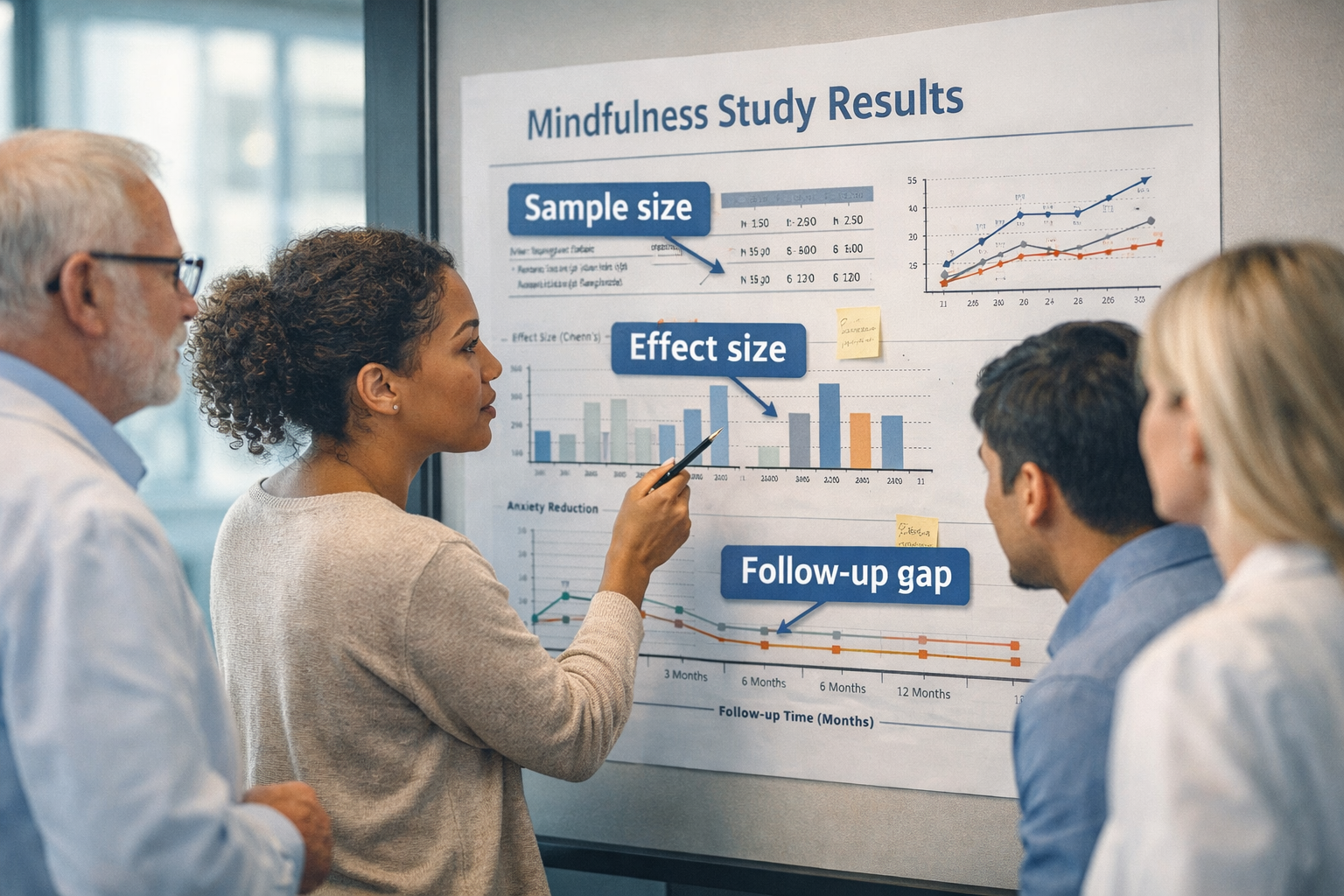
One notable real-world example: a 2025 trial using a short video app to guide mindfulness among failed entrepreneurs in China found a five-week program reduced depressive symptoms and psychological distress compared with a waitlist control [10]. It’s an encouraging result for economically stressed groups, but the study used self-report, had no follow-up, and compared against a waitlist rather than an active control, meaning it shows promise, not proof of durability [10].
Why Brain Scans Don’t Settle the Debate
Neuroimaging headlines often overstate certainty. A 2025 Mount Sinai study found that a single meditation session produced measurable changes in deep brain regions tied to memory and emotional regulation [5]. This sounds dramatic, but the sample was small and the study only examined one-time practice, it says nothing about whether those changes last or translate into real-world benefit [5].
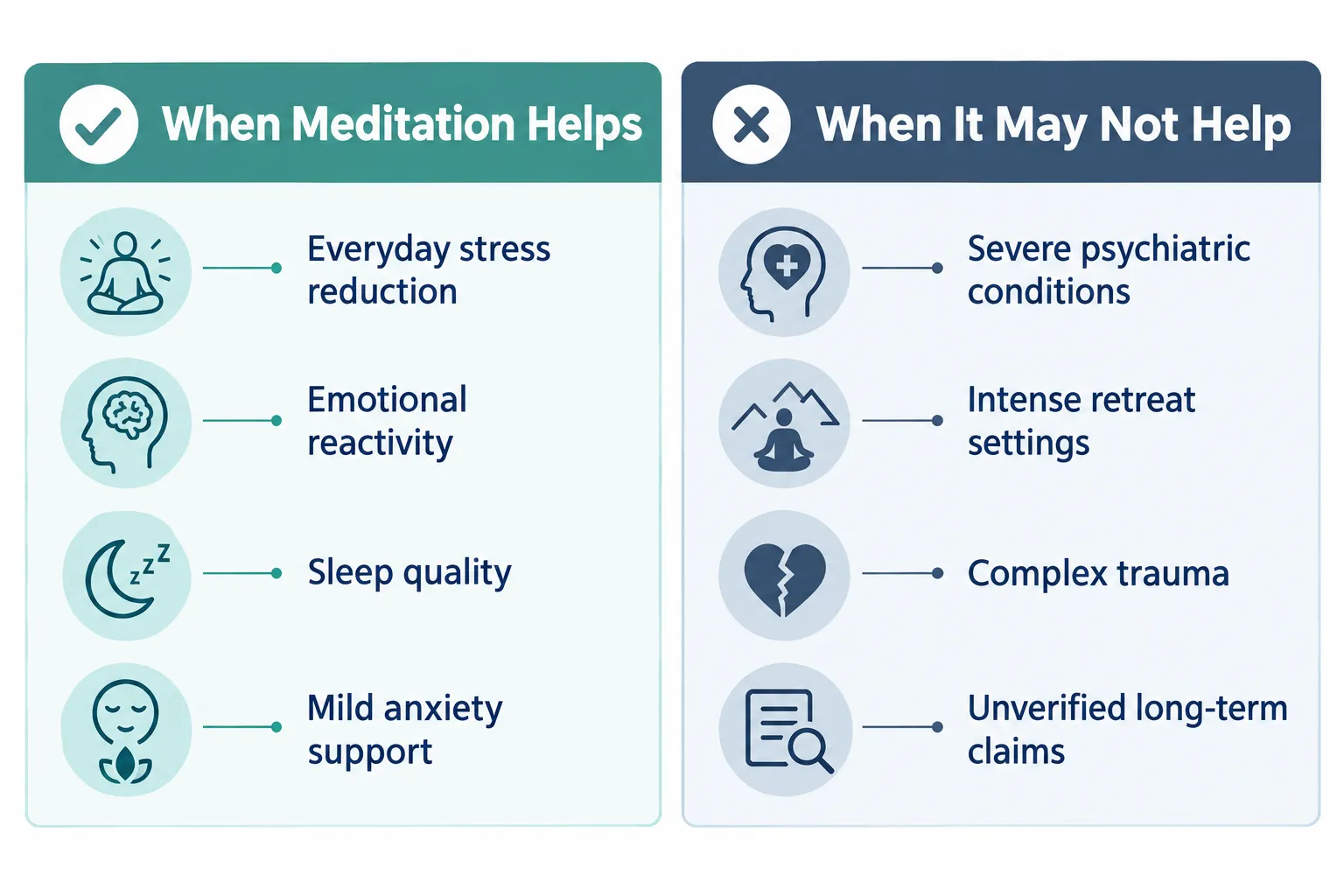
Broader critical reviews echo this caution. Analyses published in 2025 and 2026 note that many positive meditation studies rely on small, non-randomized samples and self-reported outcomes, with inconsistent interventions and measurement tools across studies [2][4]. These design issues can inflate apparent benefits. The consistent conclusion: meditation likely helps with mild anxiety, everyday stress, and mood for many people, but claims about major effects on severe psychiatric illness, complex trauma, or significant functional outcomes are not yet backed by strong evidence [2][4].
Conclusion
The emerging science of when meditation helps, and when it doesn’t points to a nuanced middle ground. Meditation has solid, replicated support for reducing everyday stress, improving emotion regulation modestly, and assisting with specific behavior changes like quitting smoking. It shows real promise as a supportive therapy for cognitive decline and stress in vulnerable populations. But it is not a universal cure, and intensity matters, more practice or more intense retreats can increase distress for some people rather than reduce it.
Practical next steps: start with modest, consistent practice rather than intensive retreats, especially if new to meditation. Track personal response honestly rather than assuming benefits will keep growing with more time invested. Anyone managing a diagnosed psychiatric condition should treat meditation as a complement to professional care, not a replacement. And when evaluating apps, retreats, or programs, look for those grounded in peer-reviewed research rather than marketing claims alone.
References
[1] E72786 – https://www.researchprotocols.org/2025/1/e72786 [2] hrcak.srce.hr – https://hrcak.srce.hr/file/500856 [3] Pmc12333550 – https://pmc.ncbi.nlm.nih.gov/articles/PMC12333550/ [4] allsubjectjournal – https://www.allsubjectjournal.com/assets/archives/2025/vol12issue7/12181.pdf [5] New Research Reveals That Meditation Induces Changes In Deep Brain Areas Associated With Memory And Emotional Regulation – https://www.mountsinai.org/about/newsroom/2025/new-research-reveals-that-meditation-induces-changes-in-deep-brain-areas-associated-with-memory-and-emotional-regulation [6] Full – https://www.frontiersin.org/journals/public-health/articles/10.3389/fpubh.2025.1524898/full [7] Meditation Provides Calming Solace Except When It Doesnt – https://news.harvard.edu/gazette/story/2025/07/meditation-provides-calming-solace-except-when-it-doesnt/ [8] Full – https://www.frontiersin.org/journals/public-health/articles/10.3389/fpubh.2025.1709782/full [9] pubmed.ncbi.nlm.nih.gov – https://pubmed.ncbi.nlm.nih.gov/40094043/ [10] Full – https://www.frontiersin.org/journals/psychiatry/articles/10.3389/fpsyt.2025.1706661/full


