
Roughly 30 experienced meditators sat quietly, eyes closed, wired to dense-array EEG caps, and reported something most brain scientists assumed was nearly impossible to capture: moments of thought-free, contentless awareness. A new peer-reviewed analysis says it found a measurable brain fingerprint for exactly that state. The study identifies neural signature of pure awareness during meditation using a combination of entropy measures, aperiodic brain dynamics, and connectivity patterns that differ sharply from ordinary rest [1][3].
This matters because “pure awareness”, sometimes called pure presence or nondual awareness, has been described for centuries in contemplative traditions but has resisted scientific measurement. The new findings suggest the brain does have a distinct, detectable signature for this state, even though it is far more complex than a single brainwave or hotspot [2][10].
Key Takeaways
- Researchers report that the study identifies neural signature of pure awareness during meditation through changes in temporal entropy and aperiodic (non-rhythmic) brain activity, not just classic frequency bands [1][3].
- The signature involves whole-brain, distributed activity rather than one isolated region, challenging the idea of a simple “meditation center” in the brain [2][3].
- A double dissociation was found: some neural markers tracked the intensity of pure awareness, while others tracked how often it occurred, separate systems for separate qualities of the experience [1][3].
- Low-frequency functional connectivity during pure awareness looked notably different from standard resting-state brain activity [1][2].
- Independent experts caution that the state is “not neurally simple” and call for replication before drawing firm conclusions [7].
What the Study Identifies Neural Signature of Pure Awareness During Meditation
The research centered on practitioners of Transcendental Meditation (TM), a technique associated with reports of a settled, objectless awareness, sometimes described as awareness without an object of focus, a background witnessing quality that persists even when thoughts, sounds, or bodily sensations fall away [1][5]. In this study, “pure awareness” was operationally defined as a self-reported period during meditation when participants noticed no specific thought, image, or sensory content, yet remained subjectively awake and aware [1][3].
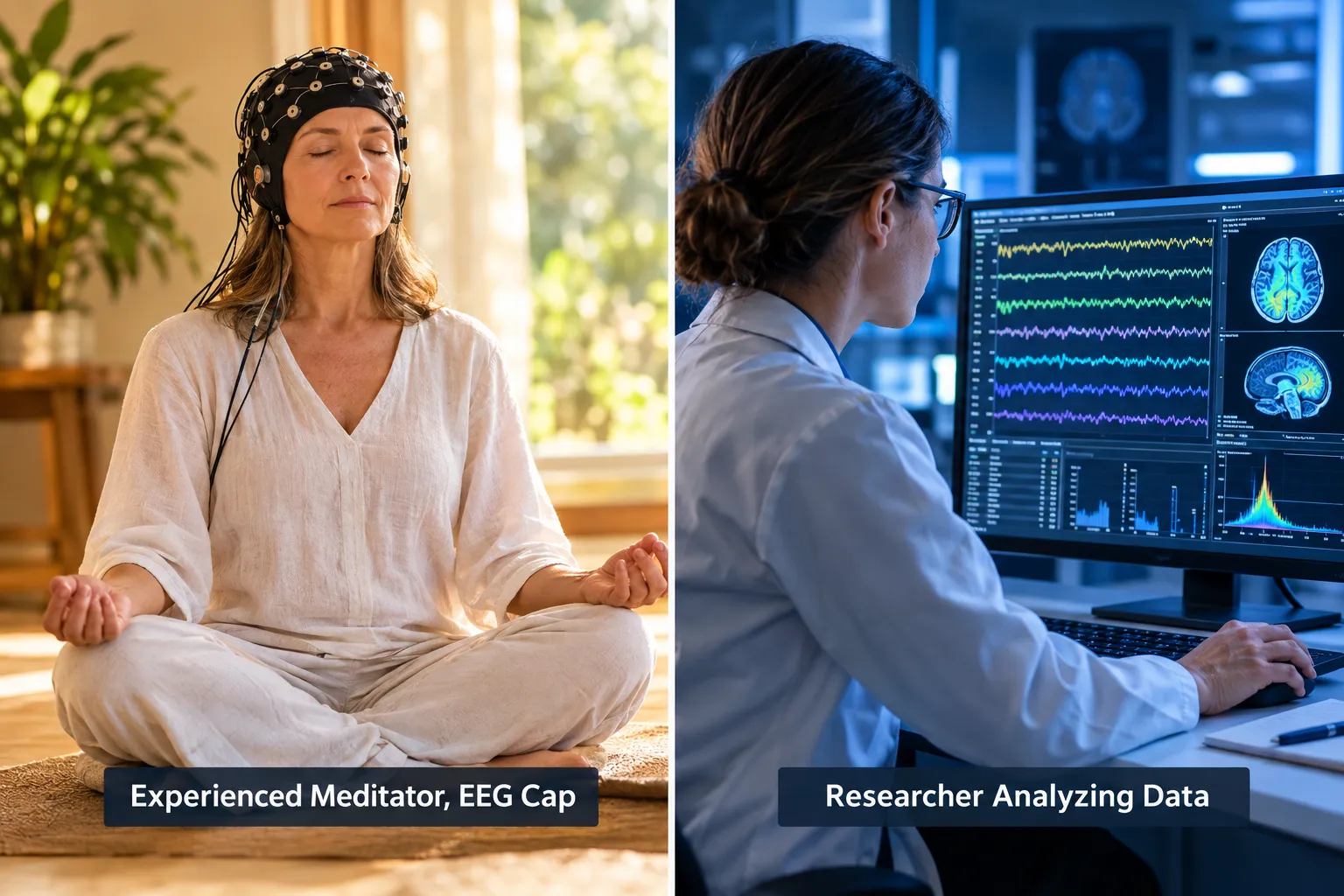
Using high-density EEG, the research team recorded brain activity while participants meditated and periodically signaled when they entered this contentless state. The sample was modest, consistent with the demands of recruiting long-term meditators capable of reliably identifying and reporting pure awareness, and the analysis leaned heavily on within-subject comparisons rather than large group averages [3][9]. This design lets researchers compare a person’s own brain during pure awareness against their own resting baseline, reducing the noise that comes from comparing across very different individuals.
The Brain Signals Behind Pure Awareness
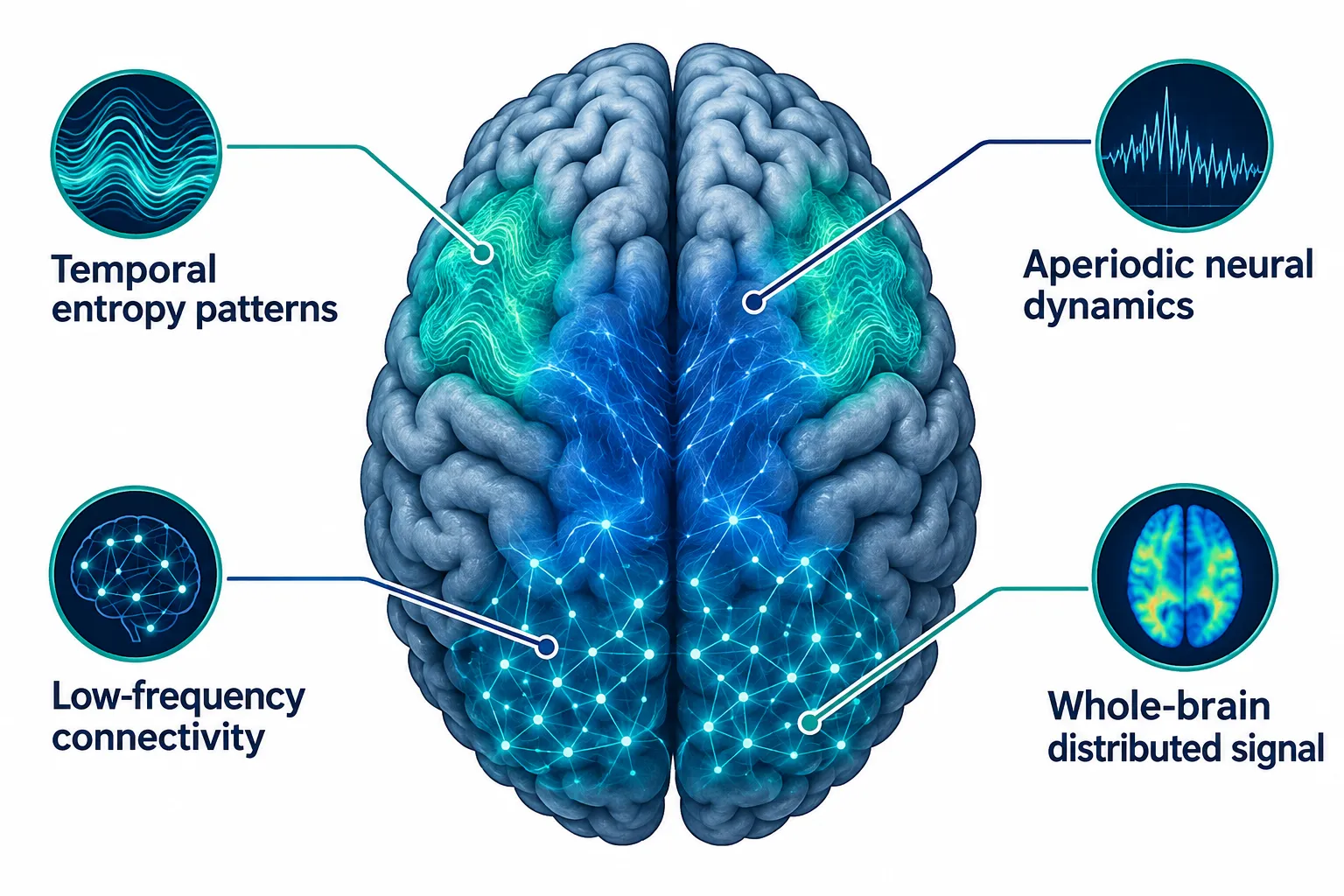
Rather than relying only on traditional alpha or theta power, the usual suspects in meditation research, the team focused on two less conventional measures: temporal entropy and aperiodic neural dynamics [1][3]. Temporal entropy essentially measures how unpredictable or “disordered” a brain signal is over time. Aperiodic dynamics capture the broad, non-rhythmic backdrop of brain activity, separate from the rhythmic oscillations most EEG studies emphasize.
According to the reporting, these two measures were the strongest discriminators between pure awareness and ordinary resting states [1][2]. In simple terms, the brain during pure awareness appeared to settle into a distinctive pattern of unpredictability and background activity that ordinary quiet rest does not produce.
A second major finding was a shift in low-frequency functional connectivity, how different brain regions coordinate with each other in slow-wave activity, compared to a standard resting baseline [1][3]. This suggests pure awareness is not just “less brain activity” but a reorganization of how regions talk to one another.
Perhaps the most conceptually important result was a double dissociation. One set of neural markers correlated with how intense or deep the reported pure awareness was, while a separate, independent set of markers correlated with how frequently these episodes occurred during the session [1][3]. Double dissociations are a hallmark of solid neuroscience because they show two functionally distinct systems, not just one signal varying in strength.
Crucially, the researchers emphasize this is a whole-brain signature, not a localized one. No single region, not the default mode network alone, not the frontal cortex alone, accounted for the effect. The pattern was distributed across the brain [2][3].
| Feature Measured | What Changed | Why It Matters |
|---|---|---|
| Temporal entropy | Increased unpredictability in signal | Strong discriminator of pure awareness |
| Aperiodic dynamics | Distinct background activity pattern | Separates state from ordinary rest |
| Low-frequency connectivity | Different inter-region coordination | Shows network-level reorganization |
| Intensity markers | Track depth of the experience | Dissociates from frequency markers |
| Frequency markers | Track how often it occurs | Independent neural pathway |
Connecting to Pure Presence and Nondual Awareness Research
This is not the first attempt to locate a brain basis for contentless awareness. Earlier work on “pure presence” and nondual awareness, states described in contemplative and Buddhist-influenced traditions as awareness without subject-object division, has proposed related EEG signatures involving reduced default mode network activity and altered gamma or theta patterns [4][10]. The new TM-based findings echo some of these efforts while adding entropy and aperiodic measures that earlier studies rarely emphasized [3][4].
Together, this body of research is converging on a shared idea: subjective reports of thought-free awareness correspond to measurable, if intricate, brain states, not simply the absence of activity, but a reorganized pattern of it [4][9][10].
Expert Reactions and Healthy Skepticism
Commentary accompanying the findings stresses caution. One expert response bluntly notes the brain state is “not neurally simple,” warning against reducing pure awareness to a single tidy marker [7]. Critics in the broader contemplative neuroscience field have long questioned whether subjective states like these can be objectively verified at all, given the reliance on self-report and the philosophical difficulty of studying an experience defined partly by the absence of ordinary content [6].
Sample size limitations are also worth noting. With a few dozen highly trained meditators, generalizing to novice practitioners or other meditation styles remains uncertain [3][9]. Still, the double dissociation and consistent low-frequency connectivity shifts give the results more weight than a single correlational finding would carry [1][3].
What This Means for the Future of Meditation Neuroscience
This research fits a broader trend: neuroscientists are increasingly willing to study rare, advanced meditative states rather than only basic relaxation or focused-attention practices [2][9]. As EEG and analysis techniques improve, entropy-based and aperiodic measures may become standard tools alongside traditional frequency-band analysis, offering a richer picture of what happens when the mind quiets dramatically.
Conclusion
The finding that this study identifies neural signature of pure awareness during meditation marks a meaningful, if early, step toward objectively studying one of contemplative practice’s most elusive claims. The whole-brain pattern, built from temporal entropy, aperiodic dynamics, and shifted low-frequency connectivity, offers researchers concrete measures to test, replicate, and refine. For readers interested in meditation research, the practical next step is simple: watch for replication studies with larger and more diverse samples, and treat single-study findings, however compelling, as a starting point rather than a final answer.
References
[1] Study Identifies Neural Signature Of Pure Awareness During Meditation – https://www.news-medical.net/news/20260916/Study-identifies-neural-signature-of-pure-awareness-during-meditation.aspx [2] Meditation Reveals A Strange State Of Pure Awareness In The Brain – https://www.earth.com/science/meditation-reveals-a-strange-state-of-pure-awareness-in-the-brain/ [3] 2025.09.25 – https://www.biorxiv.org/content/10.1101/2025.09.25.678494v1 [4] Nondual Awareness Consciousness As Such As Non 43dcvplkun – https://scispace.com/pdf/nondual-awareness-consciousness-as-such-as-non-43dcvplkun.pdf [5] Pure Awareness Brain Meditation – https://www.selfpause.com/articles/pure-awareness-brain-meditation [6] Absences Contemplative Neuroscience – Rappert Colombetti Coopmans – https://ore.exeter.ac.uk/repository/bitstream/handle/10871/25464/Absences%20Contemplative%20Neuroscience%20-%20Rappert%20Colombetti%20Coopmans.pdf?isAllowed=y&sequence=1 [7] 3fd1cefa 8d31 4b44 92d3 19cb806ab15f – https://www.news-medical.net/opinion/3fd1cefa-8d31-4b44-92d3-19cb806ab15f.aspx [9] Pmc13527413 – https://pmc.ncbi.nlm.nih.gov/articles/PMC13527413/ [10] 30443 Neural Correlates Of Pure Presence – https://consciousnesslibrary.org/research/30443-neural-correlates-of-pure-presence


