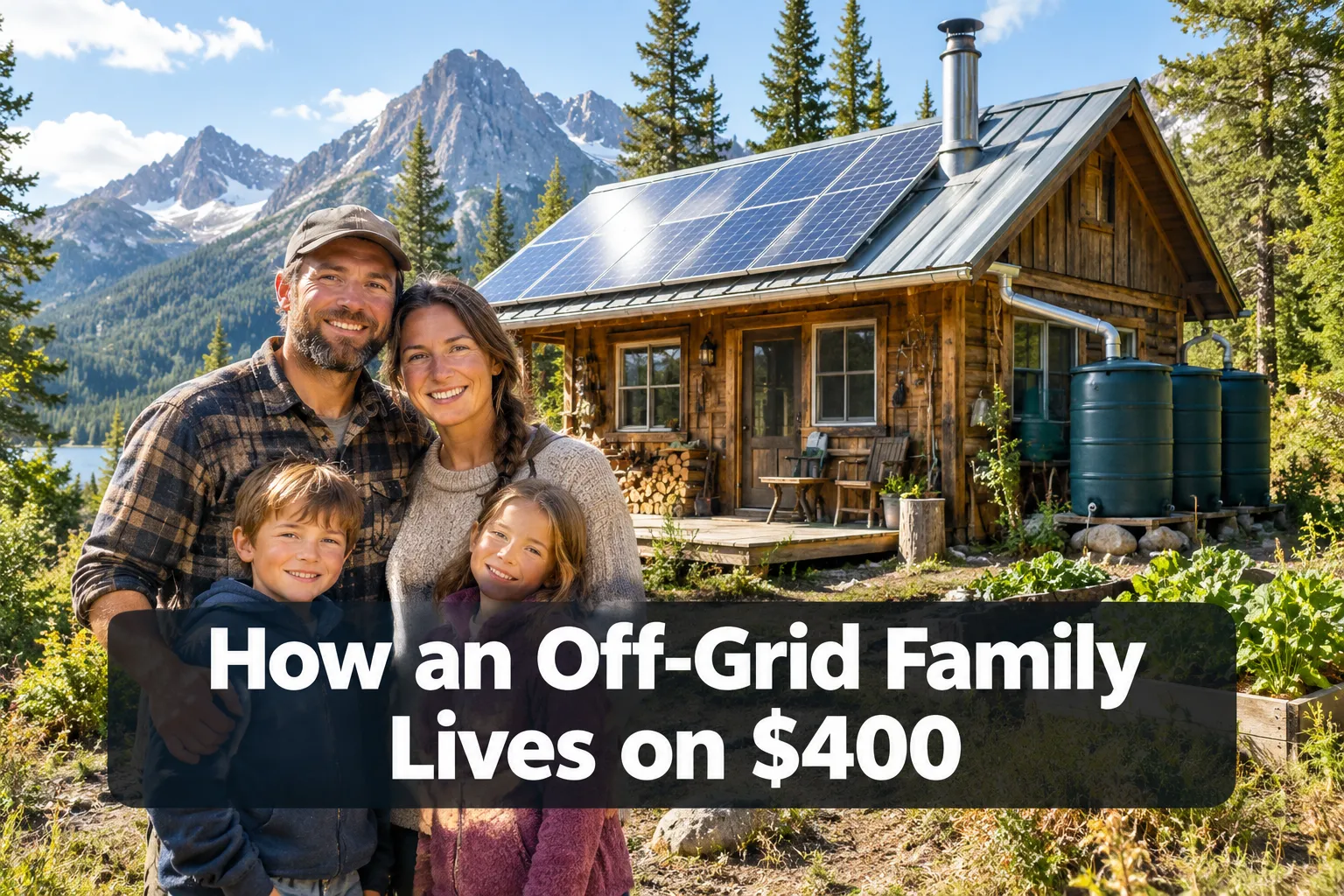
Most American households spend $400 or more on electricity alone. One off-grid couple in the Rocky Mountains spends that same amount on their entire life, and none of it goes toward power, water, or climate control. How an off-grid family lives on $400 a month with zero utility bills comes down to a simple but demanding formula: build the infrastructure once, then let it work for free every month after.
According to a September 2026 report from The Cool Down, Brock and Anna have reduced their recurring costs to roughly $400 monthly, with “$0 for power, water, and HVAC” [1]. That figure is not a fluke or a temporary phase. It is the result of years of deliberate, staged construction, and it illustrates both the promise and the real trade-offs of true self-sufficiency.
Key Takeaways
- A Rocky Mountain off-grid couple reports total monthly living costs near $400, with $0 spent on electricity, water, or HVAC [1].
- Their systems, solar power, battery storage, rainwater catchment, and passive heating and cooling, were built gradually over several years, not all at once [1] [7] [10].
- Upfront investment for off-grid infrastructure typically runs $50,000 to $150,000, meaning the $400/month lifestyle follows a large capital outlay [4].
- Most off-grid households spend far more monthly, commonly $250 to $1,800, depending on food, fuel, taxes, and lifestyle choices [4] [8] [9] [12].
- The remaining $400 in this family’s budget covers homeschooling supplies, property taxes, groceries, and connectivity, not utilities [1].
The Systems Behind Zero Utility Bills
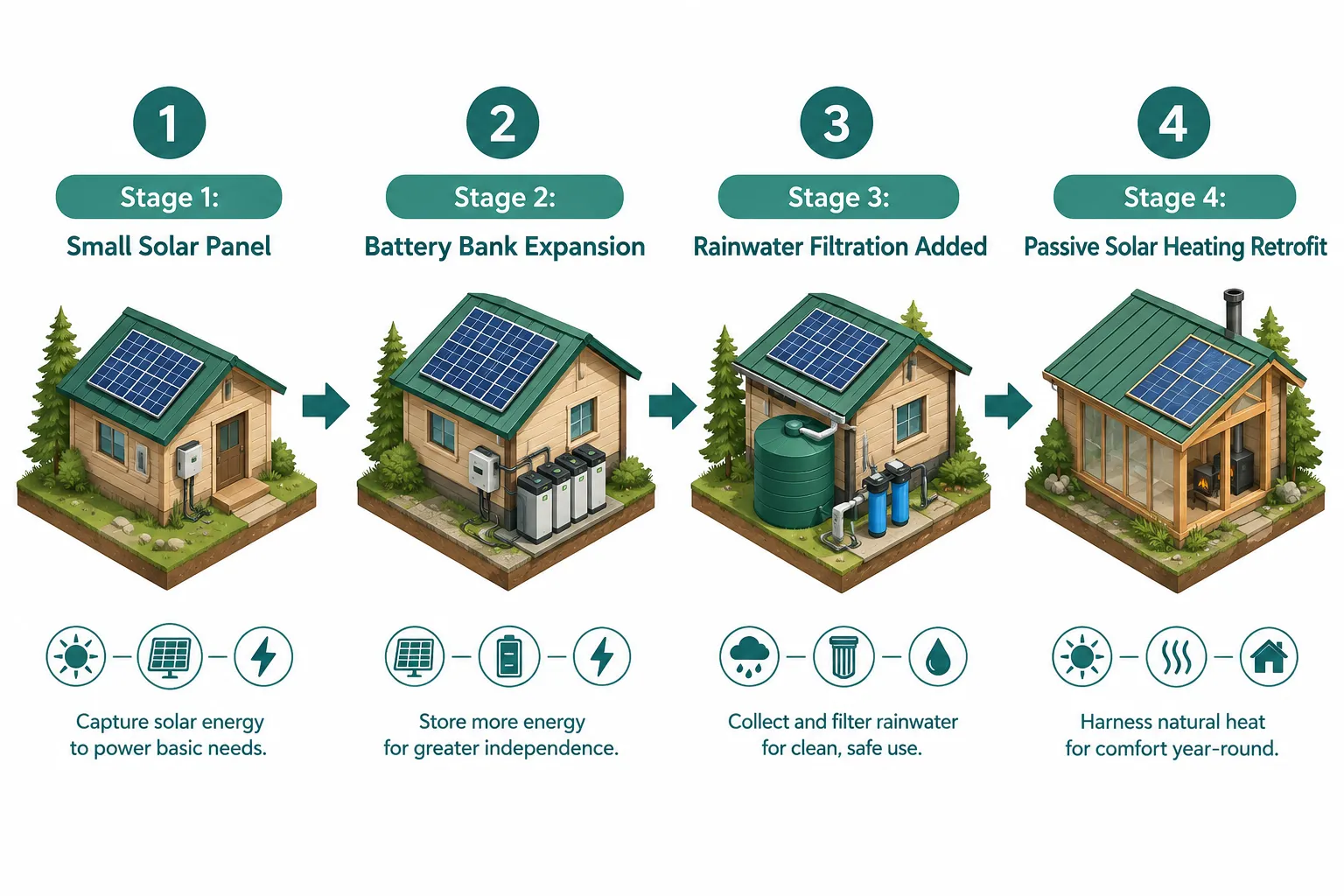
Eliminating a power bill, a water bill, and an HVAC bill simultaneously is unusual, even among off-grid households. It requires four separate systems working together, each engineered to run without a monthly service charge.
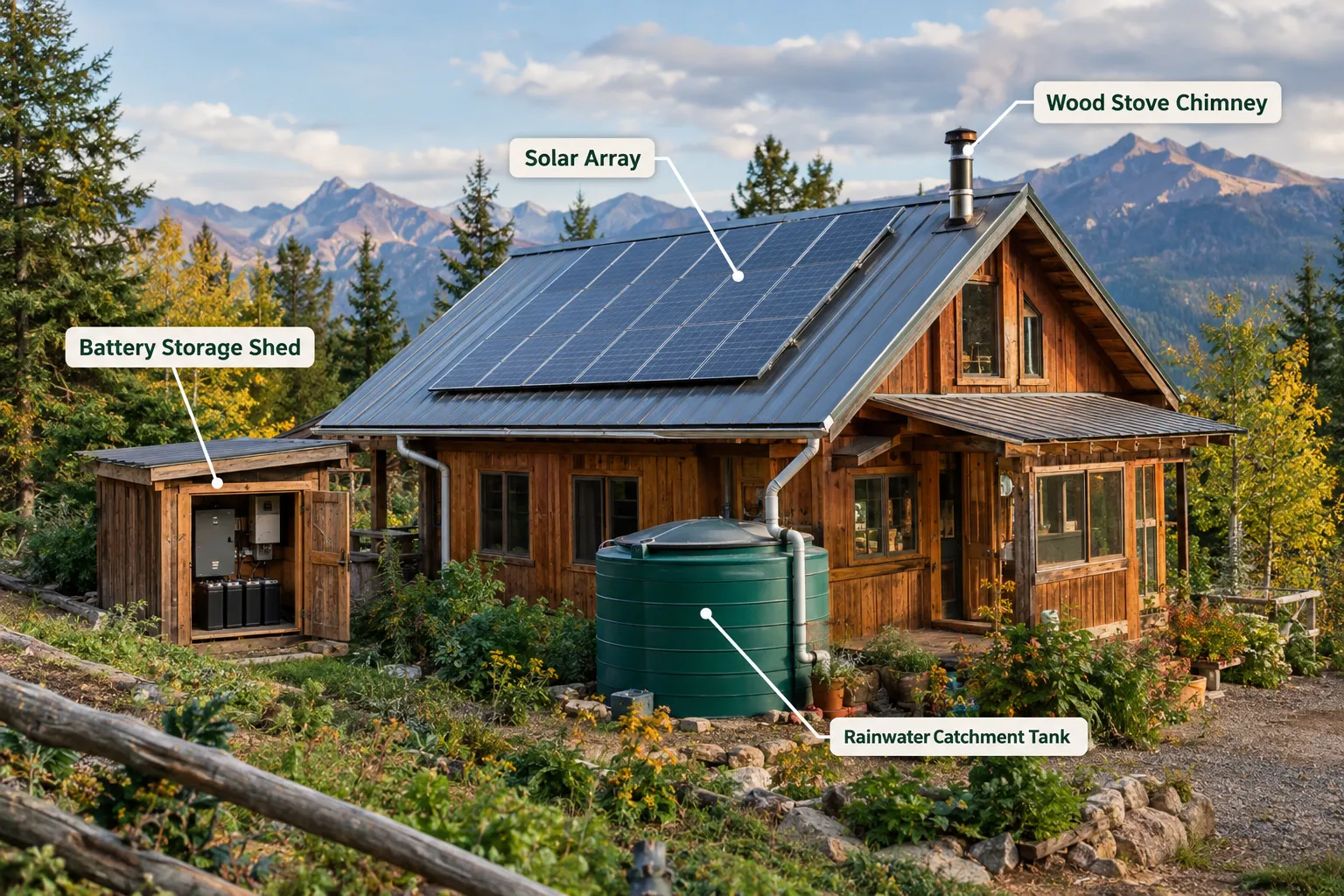
Solar power and battery storage. Rooftop solar panels capture daytime sunlight and feed it into a battery bank sized to cover overnight and cloudy-day usage. The Briggs & Stratton off-grid living guide stresses that reliable, bill-free power depends on careful load calculations, correct solar sizing, and adequate battery storage, cutting corners on any one of those elements risks running short of electricity in winter months [7].
Rainwater catchment and filtration. Instead of a municipal water bill, the family relies on gravity-fed or pump-assisted rainwater harvesting, paired with filtration to make the water safe for daily use. This approach removes recurring water charges entirely, though it depends on consistent rainfall and properly maintained storage tanks.
Passive heating and cooling architecture. Rather than running an electric furnace or air conditioner, the home uses passive solar design, strategic window placement, thermal mass, and insulation, supplemented by a wood stove for cold months. This combination handles most temperature regulation without drawing from the battery bank or burning through fuel budgets.
Staged construction over time. Perhaps the most important detail is that none of this was built in one project. The Cool Down reports the couple added capacity “a little at a time” [1], a pattern echoed by other off-grid case studies. A separate Naturally Built case study of a homeowner named Maria found that achieving zero electricity, propane, and water bills required an estimated $78,000 in careful engineering and efficient design, again built incrementally rather than as a single purchase [10].
Where the $400 a Month Actually Goes
If utilities cost nothing, what fills the monthly budget? The Cool Down’s breakdown of this family’s spending shows a picture dominated by everyday living, not infrastructure:
| Monthly Expense | Approximate Cost |
|---|---|
| Homeschooling materials | About $35 [1] |
| Property taxes | About $50 [1] |
| Groceries and household goods | Remainder of budget |
| Internet/connectivity (e.g., satellite service) | Ongoing but modest |
| Building supplies and system upgrades | Primary recurring cost [1] |
The report notes that most of the family’s cash flow now goes into building supplies and incremental upgrades, not bills [1]. That distinction matters: the $400 figure is closer to a maintenance-and-living budget than a true “cost of survival” number, since it already assumes the expensive systems are paid off.
This lifestyle is not the norm, even within the off-grid community. A related Cool Down feature on another off-grid resident found that spending under $400 monthly on “the majority of necessities” is achievable, but only through a highly minimalist lifestyle, homegrown food, and debt-free land ownership. That resident summed up the low bar bluntly: the budget is small enough that “you could run a lemonade stand and make that” [3].
The Upfront Cost of Reaching How an Off-Grid Family Lives on $400 a Month With Zero Utility Bills
The zero-bill outcome does not arrive cheaply. Anker Solix’s 2026 cost analysis estimates that a typical American off-grid setup requires roughly $50,000 to $150,000 upfront for land, solar arrays, battery banks, water systems, and structures [4]. That same analysis places ongoing monthly costs for most off-grid households between $400 and $1,500, depending on fuel needs, repairs, taxes, and lifestyle choices [4], meaning Brock and Anna’s $400 figure sits at the low end of a wide range, not the average.
Other guides reinforce this pattern. Wild Hearth Life’s 2026 beginner’s guide cites utility-equivalent costs of roughly $200 to $400 a month once systems are fully built [5]. Grid Free Life and Harvest Savvy both place typical ongoing off-grid expenses between $250 and $900 monthly, driven mainly by food, propane, taxes, repairs, and internet service [8] [9]. A broader 2025-2026 breakdown from Mind Garden Press estimates average off-grid living costs at $450 to $1,800 monthly once rent and utility bills are eliminated [12], again suggesting the $400 household is operating near the very bottom of realistic cost bands.
There is also a parallel path worth noting. NPR’s 2025 profile of the “Green Idea House” describes a grid-connected but net-positive home that has avoided electricity and gas bills for 13 years, saving an estimated $4,800 annually, close to $400 a month, while still paying basic connection fees [15]. SolarQuotes’ analysis similarly shows that large rooftop solar paired with favorable feed-in tariffs can erase bills for grid-tied households using around 400 kWh monthly, without the cost or complexity of leaving the grid entirely [6]. In other words, zero-dollar utility outcomes are possible both on and off the grid, the trade-off is capital investment versus grid dependence.
Conclusion
The story of how an off-grid family lives on $400 a month with zero utility bills is less about extreme frugality and more about extreme planning. Solar panels, battery storage, rainwater catchment, and passive heating and cooling architecture do not eliminate costs, they shift them. Instead of paying monthly for electricity, water, and climate control, the family paid upfront, in stages, over several years, for systems that now run for free.
For anyone considering a similar path, the practical next steps are clear: start small, add capacity gradually, and budget realistically for the $50,000-plus investment that typically precedes a genuine $0 utility bill. Prospective off-gridders should also expect ongoing costs, for food, property taxes, connectivity, and repairs, that most industry guides place between $250 and $1,800 a month, not $400. Treat this family’s numbers as an inspiring floor, not a guaranteed outcome, and plan infrastructure investment before expecting utility-free living.
References
[1] Off Grid Living Costs North Carolina Family – https://www.thecooldown.com/green-home/off-grid-living-costs-north-carolina-family/ [3] Off Grid Living Expenses Monthly – https://www.thecooldown.com/green-home/off-grid-living-expenses-monthly/ [4] How Much Does It Cost To Live Off Grid – https://www.ankersolix.com/blogs/home-power-backup/how-much-does-it-cost-to-live-off-grid [5] A Beginners Guide To Living Off Grid – https://wildhearthlife.com/blog/a-beginners-guide-to-living-off-grid/ [6] Zero Dollar Bills – https://www.solarquotes.com.au/blog/zero-dollar-bills/ [7] Off Grid Living Guide1 – https://energy.briggsandstratton.com/en-us/resources/article-categories/resource-articles/off-grid-living-guide1 [8] Real Costs Of Living Off Grid What To Expect – https://gridfreelife.com/real-costs-of-living-off-grid-what-to-expect/ [9] Living Off The Grid – https://harvestsavvy.com/living-off-the-grid/ [10] Why My Latest Off Grid House Project Changed Everything I Thought I Knew About Energy Independence – https://naturallybuilt.co.uk/why-my-latest-off-grid-house-project-changed-everything-i-thought-i-knew-about-energy-independence/
off-grid living, zero utility bills, solar power systems, battery storage, rainwater catchment, passive solar heating, self-sufficiency, homesteading budget, off-grid family, minimalist lifestyle, renewable energy, sustainable living


