
For centuries, meditation teachers have told students to close their eyes and look inward. That instruction just got a technological challenge. Spatial wellness company Liminal has built an application that flips the script entirely, using Meta’s smart glasses to generate guided mindfulness sessions based on whatever is directly in front of a person’s open eyes [1]. The result, Smart Glasses for the Present Moment: Liminal Debuts Real-Time Visual Meditation, treats the ordinary world as the meditation object rather than an obstacle to it.
Key Takeaways
- Liminal’s new app pairs with Meta AI smart glasses to analyze a wearer’s field of view and deliver responsive, real-time spoken meditation guidance [1].
- The experience shifts mindfulness from closed-eye, seated sessions toward contextual, open-eye awareness woven into daily walks [1][2].
- Announced in late September 2026, the launch marks a milestone for ambient AI and wearable wellness technology heading into Q4 2026 [1][2][4].
- The app launches in October 2026 on iOS and Android, priced at $9.99 monthly or $99.99 yearly, with 12 themes and 30 contextual walks monthly [1].
- Privacy is handled through zero data retention image processing and no microphone access, addressing concerns about always-on cameras [1].
How Smart Glasses for the Present Moment Work in Real Time
Liminal: Walking Meditation requires a companion smartphone app that pairs with compatible Meta AI glasses. Users open the app, select a theme, voice, and pacing, then start walking [1]. From that point, the phone can stay tucked away. The glasses’ built-in camera periodically snaps images of the surroundings, and those snapshots get turned into spoken meditation narration that responds to what the walker is actually seeing [1][2][4][6].
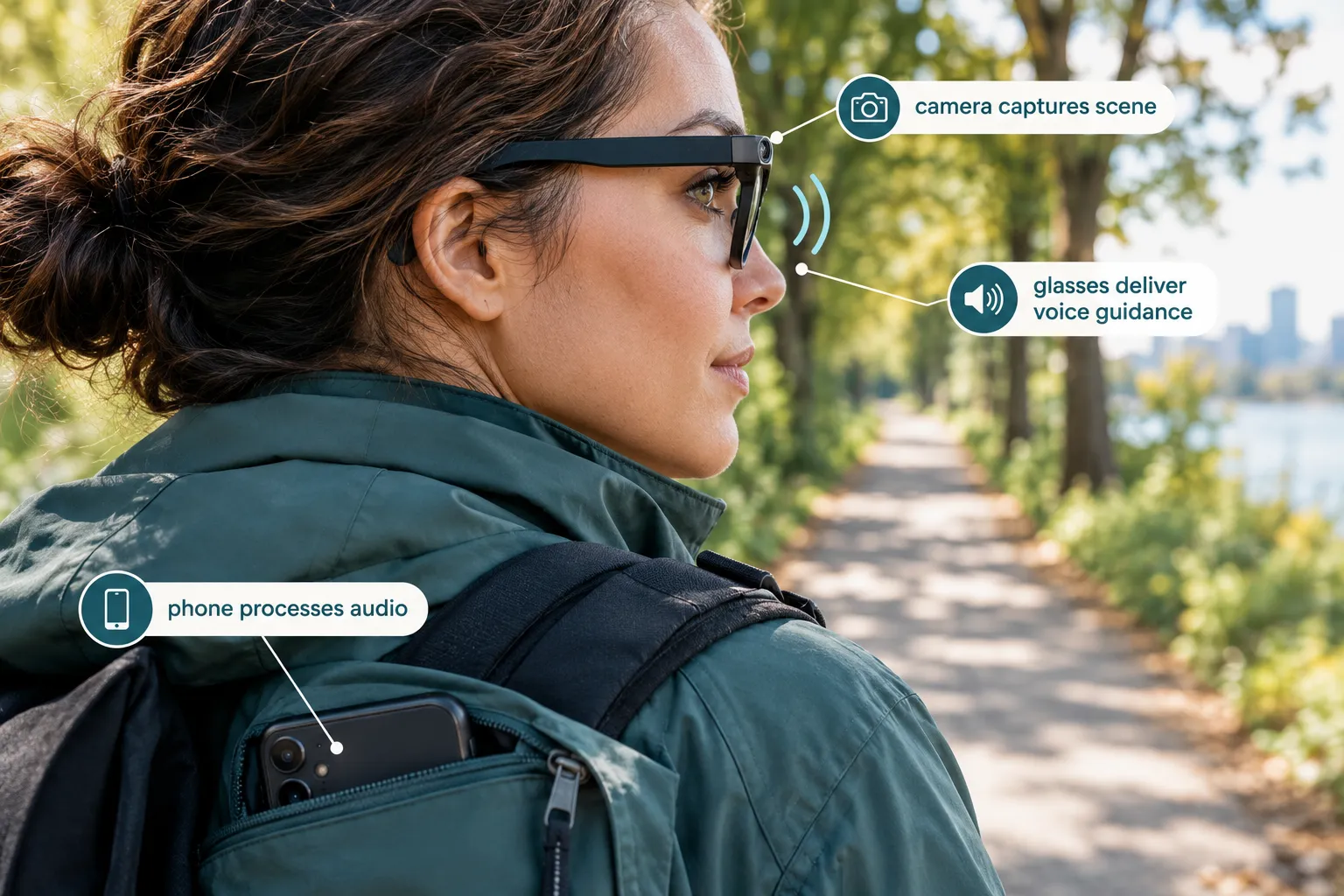
This is not a navigation tool. Liminal deliberately left out route guidance, choosing instead to keep attention fixed on the immediate environment rather than a destination [1]. A walk through a quiet park might trigger grounding language about trees and light. A walk down a busy street might prompt breathing cues suited to noise and motion. The app processes images through Google Gemini configured for zero data retention, meaning pictures are discarded right after generating a response, and the app never requests microphone access [1]. Liminal co-founder Nguyen has described this as an intentional privacy-first design choice for a product that watches the world instead of the user [1].
At launch, the experience includes 12 meditation themes, with the shortest sessions running about 10 to 13 minutes [1]. Subscribers get 30 contextual walks each month plus unlimited access to offline scripted versions of every theme, useful when live AI contextualization is not running [1]. Pricing sits at $9.99 monthly or $99.99 annually, and the app is expected on iOS and Android in October 2026 [1][2].
From Eyes-Closed Stillness to Open-Eye Awareness: A Mindfulness Shift
Traditional meditation apps like Headspace or Calm typically ask users to sit down, close their eyes, and disconnect from surroundings. Liminal’s approach does the opposite. It asks people to keep walking, keep looking, and let the environment itself become the meditation script.
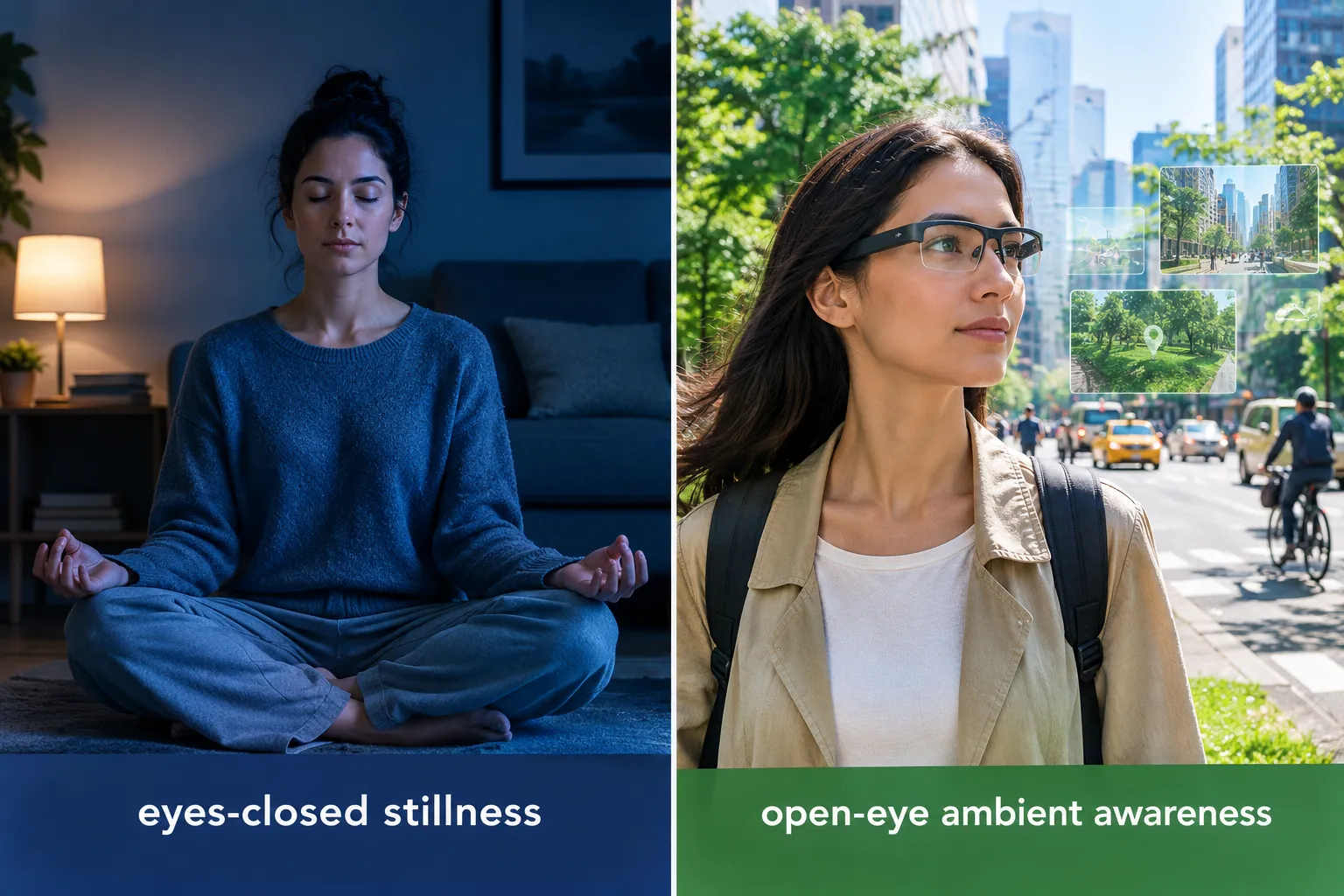
This is where computer vision becomes central. By detecting whether a scene contains natural elements, urban chaos, or something in between, the system can tailor breathing exercises or grounding cues to match the moment [1]. A cluttered intersection might call for a slower breath count to counter stress. A stretch of open sky might invite a longer pause to notice color and light. This contextual responsiveness is a meaningful departure from static, one-size-fits-all audio tracks.
Industry coverage frames this as “wellness outside the headset,” a signal that sophisticated, context-aware mindfulness tools are moving from VR headsets into everyday wearables [1][2][4][6]. Liminal already has credibility here. Its VR wellbeing platform includes more than 120 short, evidence-based experiences across six arenas: Calm, Energy, Relief, Awe, Sleep, and Focus, refined using more than 1.5 million psychometric data points [3][7][8][11]. That platform draws on neuroscience concepts like Attention Restoration Theory and neural entrainment to shift emotional states quickly [8][15][12]. On the Meta Quest store, Liminal holds roughly a 4.5-star rating among about 500 approved VR apps, and reviewers have praised its console-level visual quality [9][10][11][13].
That track record informs expectations for Walking Meditation. It suggests the smart glasses experience will likely deliver more nuanced, responsive content than typical audio-only mindfulness apps, even in its first release [1][8][9].
Frequently Asked Questions
Does Walking Meditation require the phone to stay out during a walk? No. Users set up the session in the app first, then the phone can remain pocketed while audio plays through the glasses [1].
Is the camera recording constantly? No. The app captures occasional single-moment snapshots rather than continuous video, and images are discarded immediately after processing under a zero data retention policy [1].
What does the subscription include?
Subscribers get 30 contextual walks monthly plus unlimited offline scripted versions of all 12 launch themes [1].
Smart Glasses for the Present Moment: Liminal Debuts Real-Time Visual Meditation signals a genuine shift in how mindfulness tools might work going forward. Instead of asking people to shut out the world, this approach asks them to look closer at it. For anyone curious about ambient wellness tech, the practical next step is simple: watch for the October 2026 iOS and Android launch, check glasses compatibility, and consider whether an open-eye, walking-based practice fits better into a busy day than a seated session ever did.
References
[1] Liminal Walking Meditation Uses Meta Ai Glasses To Deliver A Meditation Based On What You See – https://www.uploadvr.com/liminal-walking-meditation-uses-meta-ai-glasses-to-deliver-a-meditation-based-on-what-you-see/ [2] News – https://vrdb.app/news [3] Enterprise – https://www.liminalvr.com/enterprise [4] vr – https://vr.org/ [5] Consumer – https://liminalvr.com/consumer [6] New Games Announced For Meta Vr Glasses – https://www.uploadvr.com/new-games-announced-for-meta-vr-glasses/ [7] Corporate – https://www.liminalvr.com/corporate [8] Delivering Immersive Experiences That Move The Mind How Liminal Vr Leverages Neuroscience And Psychology On Aws – https://aws.amazon.com/blogs/physical-ai/delivering-immersive-experiences-that-move-the-mind-how-liminal-vr-leverages-neuroscience-and-psychology-on-aws/ [9] I Tried Five Vr Meditation Apps – https://lifehacker.com/tech/i-tried-five-vr-meditation-apps [10] Liminal Vr – https://arborxr.com/content-creator/liminal-vr


