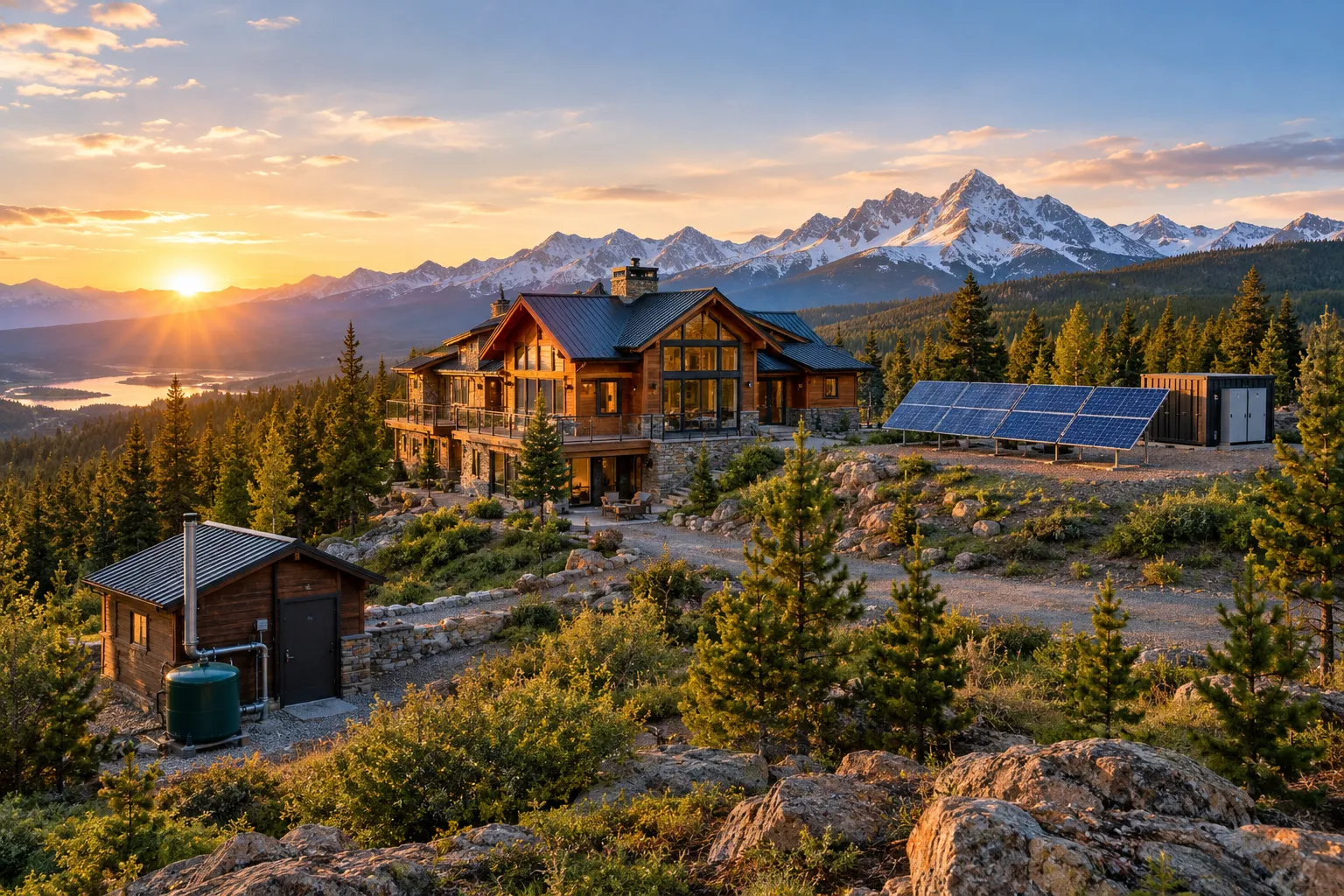
Forget the weekend cabin. America’s wealthiest escapees are building something far more ambitious.
Across parts of Idaho, Montana and Colorado, wealthy buyers are snapping up remote acreage and transforming it into highly self-sufficient mountain compounds — complete with private power systems, wells, backup generators and food-production facilities.
For some, the dream isn’t simply to get away from the city.
It’s to stop depending on it altogether.
The trend is fueling what could become one of the most striking shifts in rural real estate in 2026: the rise of the luxury off-grid compound.
Welcome to the New Off-Grid Exodus
Off-grid living was once associated with cash-strapped homesteaders, survivalists and people willing to sacrifice comfort for independence.
That stereotype is rapidly changing.
Today’s buyers can arrive with seven-figure budgets and expect their remote retreat to have many of the comforts of a modern home — just without relying on the public utility network.
Reports on migration into northern Idaho and northwest Montana point to affluent households purchasing 10- to 20-acre parcels, with some properties selling for roughly $750,000 to $1.25 million.
The new philosophy is simple:
Why buy a vacation home when you can build a private fortress of self-sufficiency?
The New Luxury Status Symbol? Your Own Power Grid
For these buyers, a mountain view isn’t enough.
The property has to work.
That means solar panels feeding large battery banks, backup generators ready for emergencies and carefully engineered systems designed to keep the lights on even when the outside grid isn’t available.
The most ambitious compounds can feature:
- Solar-powered microgrids backed by large battery storage.
- Diesel or propane generators for additional resilience.
- Private wells and large water-storage systems.
- Greenhouses and gardens for food production.
- Root cellars and storage areas capable of holding substantial food supplies.
- Buildings designed for year-round occupancy rather than occasional weekend visits.
In other words, the off-grid lifestyle is becoming less about roughing it — and more about owning every piece of the infrastructure that keeps your household running.
How Much Does a Private Mountain Haven Cost?
The price of going off-grid varies wildly.
A basic weekend setup with modest solar equipment, battery storage, hauled water and a composting toilet can cost just a few thousand dollars.
A more serious seasonal property with a drilled well, larger solar array and conventional septic system can push infrastructure costs into the tens of thousands of dollars.
Then there’s the ultra-luxury end of the market.
Custom mountain compounds can run into the millions.
One Colorado wilderness property, for example, has been marketed at around $2.5 million, featuring a remote luxury retreat constructed in challenging terrain.
At that level, buyers aren’t simply purchasing land.
They’re purchasing an entirely different way of life.
Where Are the Wealthy Buyers Going?
The American West remains a major destination for people looking to combine privacy, acreage and dramatic scenery.
Idaho, Montana and Colorado are among the states attracting attention, alongside Utah, Arizona, New Mexico and Oregon.
Colorado offers spectacular mountain landscapes and cooler conditions, while Idaho and Montana have become particularly attractive to buyers looking for larger parcels and greater privacy.
But not every off-grid buyer is a millionaire.
There is another market developing alongside the luxury compounds: relatively affordable cabins, rural homes and small parcels aimed at middle-income buyers who simply want more independence.
That has created a two-tier off-grid market.
At the top: multimillion-dollar private compounds.
At the other end: modest cabins and homesteads built around affordability.
The Catch: Your Dream Compound Could Be Illegal
The biggest mistake new buyers can make is assuming that owning remote land means they can do whatever they want with it.
It doesn’t.
County regulations can determine whether a property can actually support the off-grid lifestyle advertised by a seller.
Potential buyers need to investigate everything from zoning and building restrictions to water rights, road access, easements and utility requirements.
Some jurisdictions may even require properties to connect to the public electrical grid under certain circumstances.
That means the dream of disappearing into the mountains can hit a very expensive wall before construction even begins.
And Locals Aren’t Always Happy
There is another complication — and it has nothing to do with building permits.
In some rural communities, an influx of wealthy newcomers has created tension.
Longtime residents may see large, heavily secured compounds as symbols of outsiders buying up land and changing the character of their communities.
New arrivals, meanwhile, often point to privacy, rising property prices, personal security and self-sufficiency as reasons for making the move.
The result is an increasingly familiar clash:
Old rural America versus wealthy newcomers looking for an escape from modern America.
The Off-Grid Market Could Get Much Bigger
The movement isn’t showing signs of disappearing.
Cheaper solar technology, improving battery storage and growing interest in energy independence are helping make sophisticated off-grid systems more accessible.
One market projection cited in recent reporting puts the global off-grid housing market at around $2.59 billion in 2024, with the potential to reach approximately $5.13 billion by 2033.
If those projections prove accurate, today’s luxury mountain compounds could be an early glimpse of a much larger housing trend.
The Ultimate Luxury: Not Needing Anyone Else?
The most fascinating part of the off-grid boom isn’t the solar panels or the acres of wilderness.
It’s what they represent.
For a growing group of wealthy buyers, luxury is no longer simply about having the biggest house, the fastest car or the best view.
It’s about independence.
Your own electricity.
Your own water.
Your own food supply.
Your own land.
And, if the systems are designed well enough, the ability to keep your household running when the outside world can’t.
The old American dream was about owning a piece of land.
In 2026, a new version is emerging:
Own the land — then build a private world on top of it.


