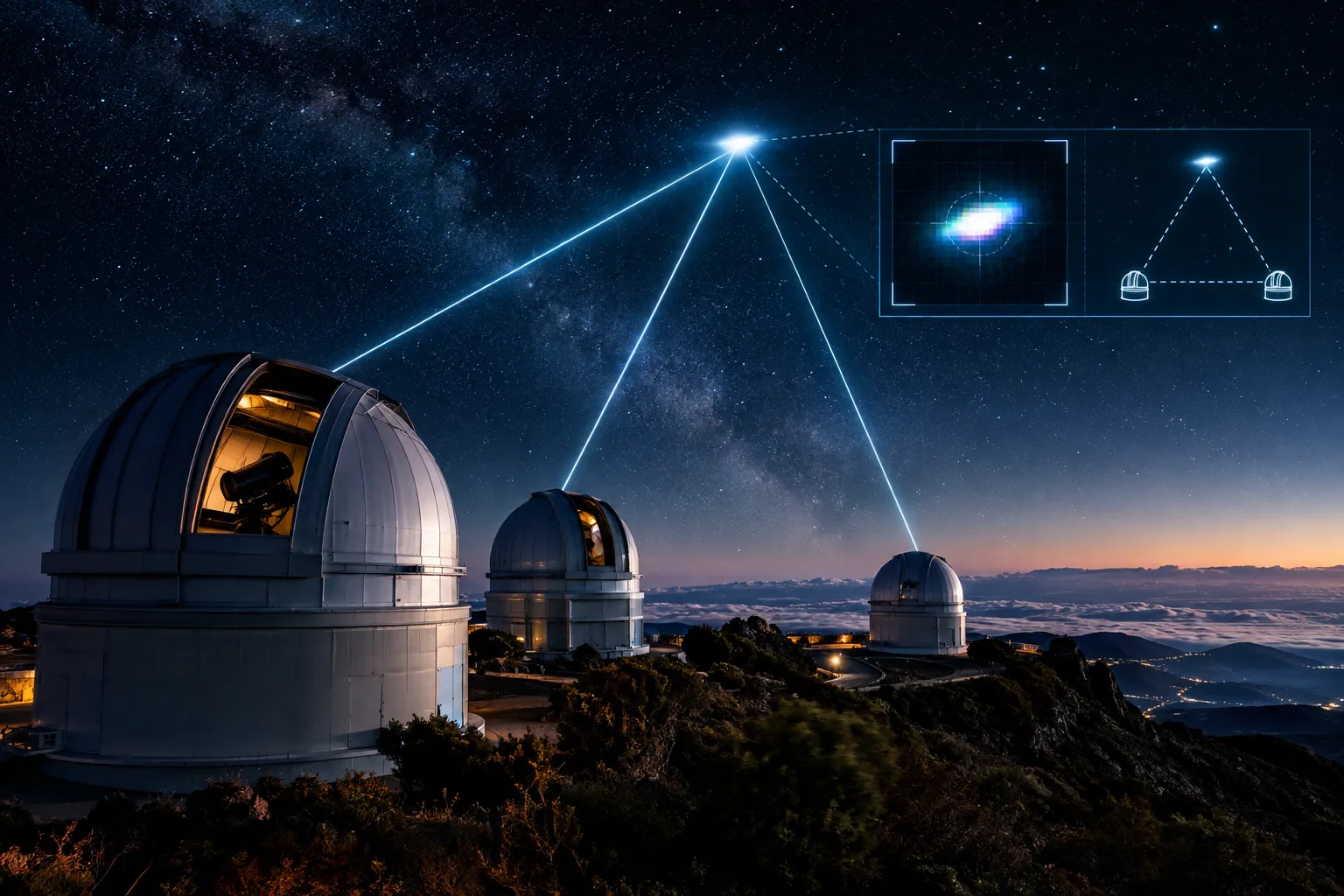
A single number stands out from the latest UAP research update: 5,626. That is how many aircraft the Galileo Project’s Nevada camera network used to test its own accuracy before turning its instruments toward unexplained targets. The First Triangulation Results in Search for UAP by the Galileo Project Observatories mark a turning point in how scientists measure objects in the sky, replacing guesswork with calibrated geometry.
The results, tied to a new article by astrophysicist Avi Loeb dated September 24, 2026, on his Center for Astrophysics page, do not claim discovery of anything extraterrestrial.[2] Instead, they demonstrate that a network of ground stations can now pin down distance, speed, and acceleration of flying objects with real precision.[1]
Key Takeaways
- The Galileo Project’s Nevada network of three synchronized stations can triangulate object distances to better than 10% accuracy using baselines of roughly 10 kilometers.[12]
- Validation against known aircraft using ADS-B flight data shows distance errors often below 1-5%, confirming the system works before it is used on unidentified targets.[5]
- The commissioning run processed roughly half a million aerial trajectories over five months, leaving only 144 unresolved cases for closer human review.[7]
- No journal, publication date, or preprint number had been publicly confirmed for the new triangulation paper as of September 10, 2026.[4]
- This milestone closes a long-standing “range-ambiguity gap” that has made most UAP video evidence scientifically unusable.[1][15]
What the First Triangulation Results in Search for UAP by the Galileo Project Observatories Actually Show
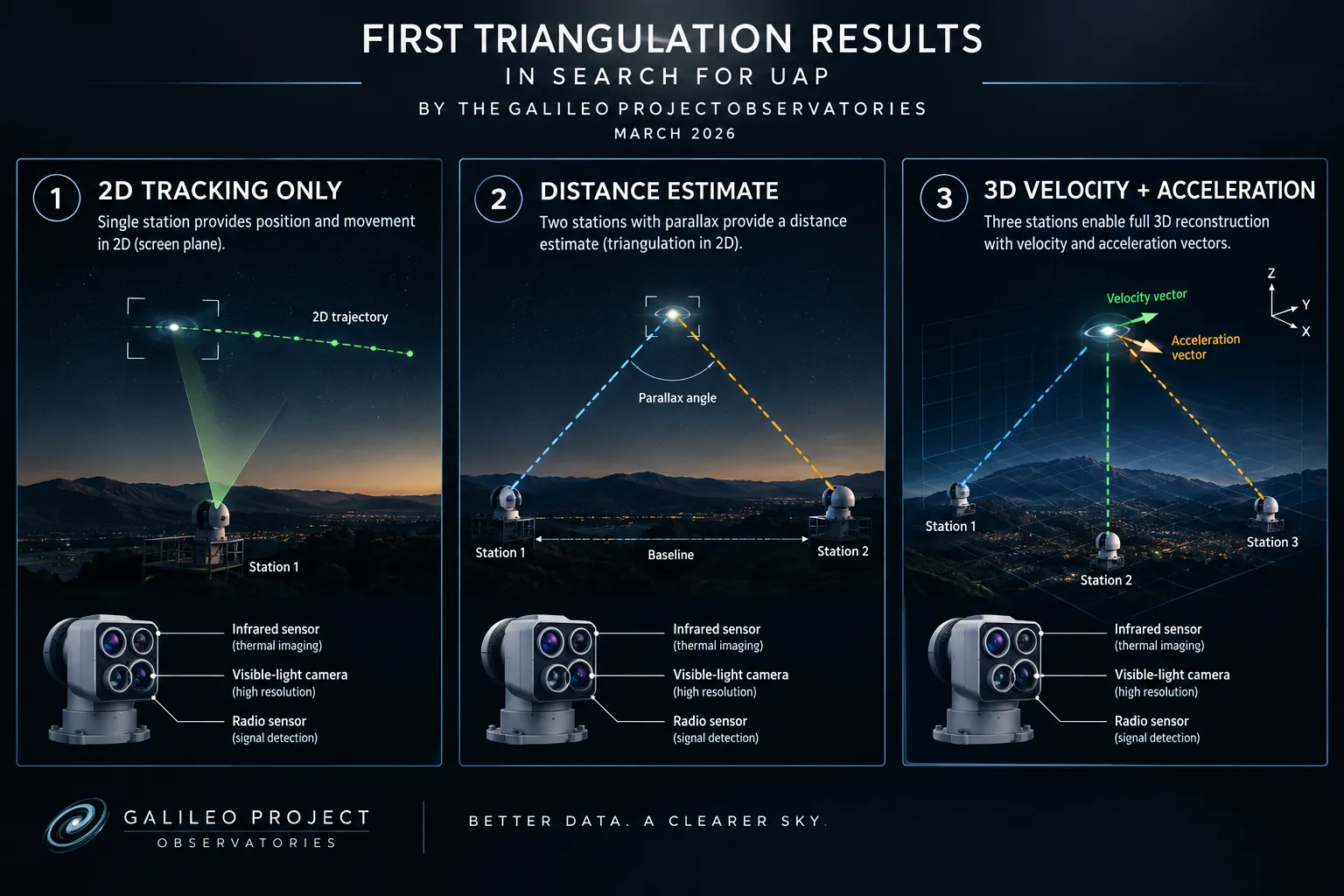
Loeb first announced this capability in March 2026, describing it as a milestone for the project’s observatories.[12] By watching the same object from multiple directions with stations spaced about 10 kilometers apart, the team can now calculate full three-dimensional velocity and acceleration, not just a flat image.[12] That distinction matters. A blurry dot moving across a camera frame means little without knowing how far away it is. Once distance is known, apparent motion converts into real physical speed.
The stated purpose is direct: test whether any tracked object moves in ways that fall outside the known limits of drones, balloons, airplanes, helicopters, or satellites.[12] If something accelerates or travels faster than those categories allow, that becomes a measurable, testable claim rather than a matter of opinion.
How the Nevada Observatory Network Achieves Triangulation
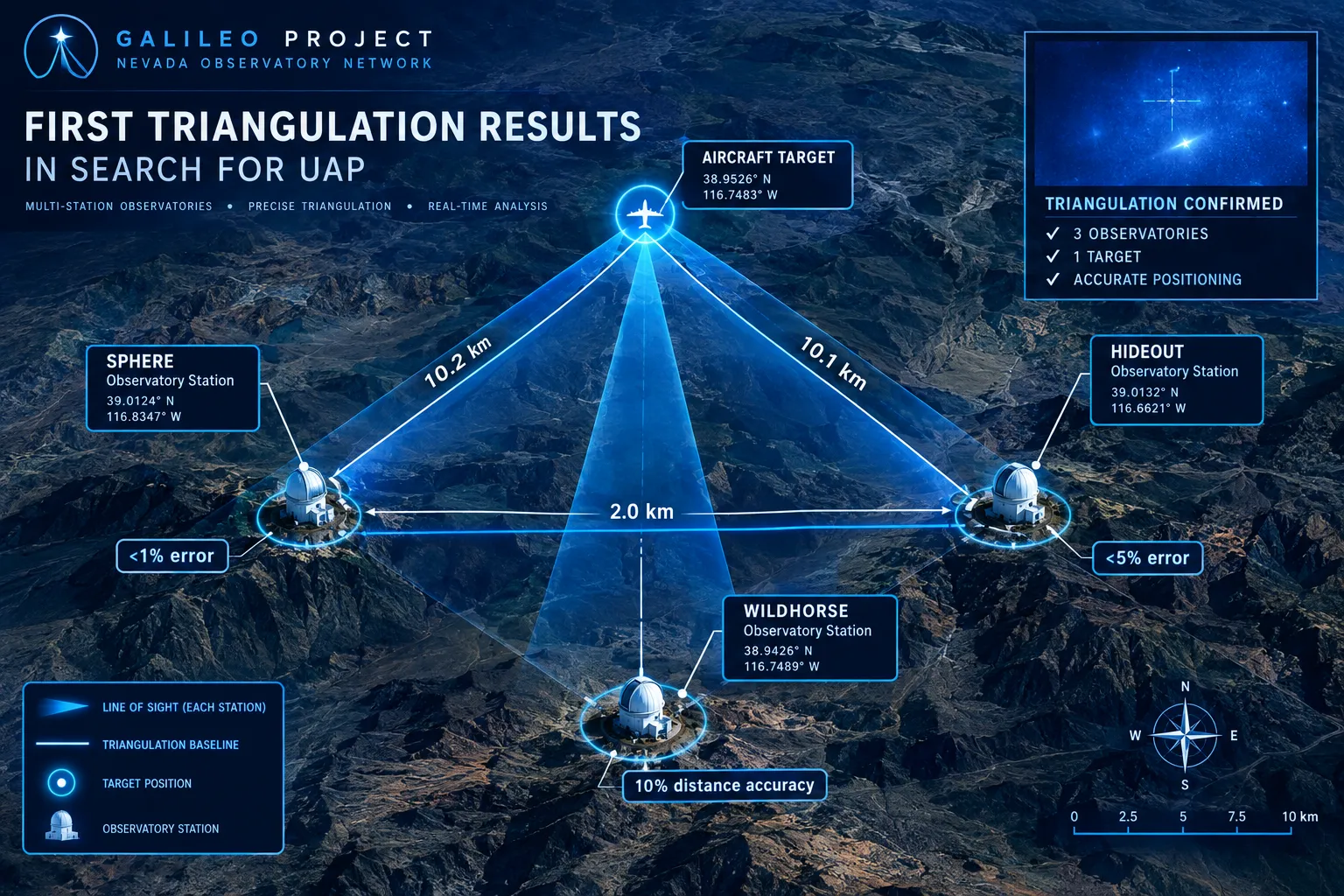
The Nevada setup near Las Vegas uses three multispectral stations nicknamed “sphere,” “hideout,” and “wildhorse,” forming a nearly isosceles triangle with sides of about 10.2, 10.1, and 2.0 kilometers.[3][7] Each station carries infrared and visible-light cameras along with radio and audio sensors.[1][10] Machine-learning software automatically detects and tracks moving targets before triangulation calculations begin.[1][3]
The math itself, described in a Spanish-language summary of the new work, recovers three-dimensional position from simultaneous observations at two or more sites without assuming any particular flight-path shape in advance.[5] The algorithm weighs each camera’s line-of-sight data based on its pointing precision and geometric reach, then minimizes the combined error across all stations.[5]
Validating Accuracy Against Known Aircraft
Before trusting any result on an unidentified object, the team checked its math against real airplanes tracked by public ADS-B transponder data. For aircraft seen from all three stations, distances came out accurate to better than 5% for every target checked, and better than 1% for two-thirds of them.[5] For the larger set of 5,626 aircraft resolved from just a pair of stations, 83% landed within 5% accuracy and 40% within 1%, with an average error near 1.4%.[5]
Velocity numbers held up too: 78% of three-station aircraft tracks and 63% of two-station tracks came in with better than 5% speed accuracy.[5] A field test from July 2026 pointed to one specific case on May 30, where triangulation placed an object 20 to 30 kilometers away with an uncertainty of only a few hundred meters, matching independent ADS-B tracking within a fraction of a percent.[3]
Why First Triangulation Results in Search for UAP by the Galileo Project Observatories Matter for UAP Science
Commentary around this update stresses one point repeatedly: this is a tool passing its own accuracy test, not a discovery of anything anomalous.[1][4] During the commissioning phase, the Nevada network processed close to 500,000 aerial trajectories over five months.[7] After automated filtering and human review, only 144 trajectories remained genuinely ambiguous, and none have been confirmed through peer review as anomalous.[7]
Loeb frames this open, instrument-based approach as an alternative path to understanding UAP claims, one that does not depend on classified government files or political disclosure debates.[1][11][12] Notably, the project’s own reviews of some declassified military footage have favored ordinary explanations, including identifying one well-known clip as likely a tactical missile.[11][12]
Conclusion
The first triangulation results confirm that the Galileo Project’s camera network can measure distance and motion with genuine scientific rigor, tested and proven against thousands of known aircraft before ever pointing at anything unexplained.[5][12] The next phase includes a proposed radar-cued “orb imager” observatory pairing wide-area radar with a fast-moving telescope for spectral analysis of low-altitude targets.[4][7][14] Readers following this story should watch for the formal publication details still pending as of the most recent briefing, and should treat any future claims with the same demand for calibrated, peer-reviewed evidence this milestone represents.[4]
References
[1] Harvards Sphere Top Ufo Cameras Finally Did The One Thing Government – https://www.thequietbreakthrough.com/articles/harvards-sphere-top-ufo-cameras-finally-did-the-one-thing-government [2] Opinion – https://lweb.cfa.harvard.edu/~loeb/Opinion.html [3] Galileo Uap Triangulation Aircraft Calibration 2026 – https://www.ufouap.net/en/news/galileo-uap-triangulation-aircraft-calibration-2026 [4] Briefing – https://uaprad.org/briefing [5] orbitaceromendoza.blogspot – https://orbitaceromendoza.blogspot.com/ [6] Ufos Trump Aliens Uaps Government 01088254 – https://www.politico.com/news/magazine/2026/09/26/ufos-trump-aliens-uaps-government-01088254 [7] Galileo Project Orb Imager Observatory – https://uaptimes.com/articles/galileo-project-orb-imager-observatory/ [10] Scientific Investigation Unidentified Aerial Phenomena Uap Using Multimodal – https://galileo.hsites.harvard.edu/publications/scientific-investigation-unidentified-aerial-phenomena-uap-using-multimodal [11] Ufos Trump Aliens Uaps Government 01088254 – https://www.politico.com/news/magazine/2026/09/26/ufos-trump-aliens-uaps-government-01088254 [12] Opinion – https://lweb.cfa.harvard.edu/~loeb/Opinion.html [14] Galileo Project Orb Imager Observatory – https://uaptimes.com/articles/galileo-project-orb-imager-observatory/


