
A person brushing their teeth for two minutes performs roughly 200 small hand movements, yet almost nobody notices even one of them. That gap between motion and attention is exactly what Mayo Clinic is asking people to close, according to a Hindustan Times report. The article explains that Mayo Clinic says you can practise mindfulness without meditating: here’s how, by simply paying closer attention to ordinary moments like eating, walking, and pausing between tasks [1].
This reframing matters because many people avoid mindfulness altogether, assuming it requires a cushion, a quiet room, and twenty spare minutes. Mayo Clinic’s guidance suggests otherwise.
Key Takeaways
- Mayo Clinic says you can practise mindfulness without meditating by noticing sensory details during routine activities like brushing teeth, eating, and walking [1].
- Mindfulness is defined as nonjudgmental, present-moment awareness that does not require formal training or a meditation class [8].
- Mayo Clinic’s official exercises include breath focus, body scans, mindful walking, and simply “living in the moment” [4].
- Short “micro-practices,” such as a few conscious breaths or noticing sounds and surroundings, can be done in seconds between tasks [1].
- Experts advise pausing mindfulness practice and consulting a professional if it causes distress rather than calm [12].
What Mayo Clinic Actually Recommends
According to the Hindustan Times summary of Mayo Clinic’s advice, mindfulness does not live only in seated meditation sessions. It lives in the texture of toothpaste, the taste of a meal, the feeling of feet touching the ground, and the sounds surrounding a person at any given moment [1]. The core instruction is simple: notice these sensory details, and when the mind drifts, which it will, gently bring attention back without judgment.
This approach lines up with Mayo Clinic’s published “Mindfulness exercises” resource, which lists specific techniques anyone can try. These include focusing on breathing patterns, doing a mental body scan to check in with physical sensations, and practising mindful walking that emphasizes balance and foot placement [4]. None of these require a special posture, a quiet room, or extended free time.
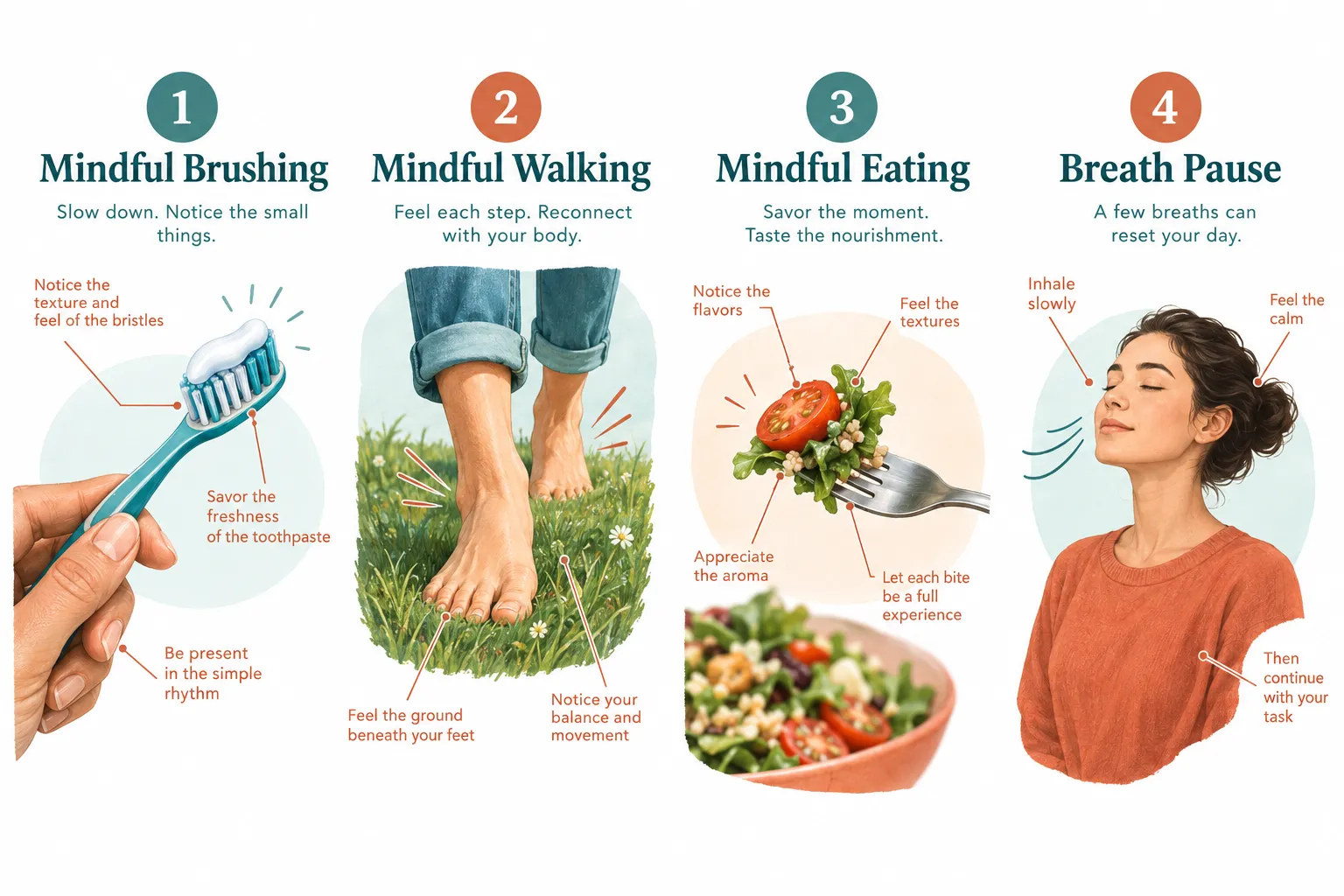
Mayo Clinic Health System has echoed this idea in earlier guidance, suggesting something as small as noticing the taste of coffee while taking a sip counts as a genuine mindfulness moment [5]. The message across these resources is consistent: attention, not ritual, is the active ingredient.
Mayo Clinic Says You Can Practise Mindfulness Without Meditating Through Micro-Practices
The Hindustan Times piece highlights “micro-practices” that fit into seconds rather than minutes. Examples include:
- Taking a few conscious breaths while transitioning between tasks
- Looking around and naming what is visible in the room
- Noticing background sounds without labeling them good or bad
- Feeling the pressure of feet against the floor before standing up
These tiny resets are designed to interrupt autopilot thinking, which Mayo Clinic’s News Network has described as a state most people spend far too much time in [8]. The network notes that mindfulness “doesn’t require formal training,” reinforcing that these small, self-guided pauses count as legitimate practice [8].
Why This Broader Shift Matters
The idea that mindfulness can be practised without meditating is not confined to one report. A Buddhist monk has separately shared everyday techniques that skip seated meditation entirely, according to Hindustan Times [2]. Spiritual teacher Tara Brach has recommended anchoring attention to whatever is happening right now, while yoga guru Himalayan Siddhaa Akshar has emphasized staying fully present during ordinary acts like eating or writing [9][13].

Harvard-linked guidance adds another layer, describing “tai chi walking” as a way to build mindfulness through slow steps, foot awareness, and breath control [7]. A related piece suggests even five minutes of ordinary slow walking, paired with attention to breathing and surroundings, can work similarly [14]. Meanwhile, Cleveland Clinic’s widely cited 5-4-3-2-1 grounding technique offers a structured sensory checklist, five things seen, four felt, three heard, two smelled, one tasted, as a fast way to anchor attention during stress [10].
Hindustan Times has also reported eight “tiny habits” that function as informal mindfulness, including a double-sigh breathing reset, humming during exhales, and a nighttime worry “brain dump” [15]. None of these require meditation training, yet all rely on the same principle Mayo Clinic promotes: deliberate, nonjudgmental attention to the present.
A Note of Caution
Not every mindfulness experience is uniformly pleasant. Later Hindustan Times coverage points out that mindfulness and meditation, despite well-documented cognitive and emotional benefits, can occasionally trigger distress or a sense of destabilization in some individuals [12]. The guidance is clear: if a practice feels overwhelming rather than calming, it is reasonable to scale back and speak with a qualified healthcare or mental health professional [12].
Conclusion
Mayo Clinic says you can practise mindfulness without meditating, and the surrounding wave of 2026 reporting from Hindustan Times, Harvard-linked sources, and Cleveland Clinic supports that same conclusion. Mindfulness can take the shape of a mindful walk, a few conscious breaths, a sensory grounding checklist, or simply noticing the taste of a meal. The barrier to entry is lower than most people assume.
As a next step, choose one routine activity today, brushing teeth, walking to a car, or drinking a morning beverage, and spend sixty seconds noticing its sensory details. If distress arises instead of calm, pause and consult a professional rather than pushing through alone [12].
References
[1] Mayo Clinic Says You Can Practise Mindfulness Without Meditating Here S How – https://www.hindustantimes.com/lifestyle/spiritual/mayo-clinic-says-you-can-practise-mindfulness-without-meditating-here-s-how-101790458282318.html
[2] A Buddhist Monk Shares Simple Mindfulness Practices That Go Beyond Meditation – https://htsyndication.com/hindustan-times/article/a-buddhist-monk-shares-simple-mindfulness-practices-that-go-beyond-meditation/104197151
[4] Mindfulness Exercises – Mayo Clinic – https://www.mayoclinic.org/tests-procedures/meditation/in-depth/mindfulness-exercises/art-20046356?conv_s=sh:1768176000319-0.2399711706675589*si:1*pv:1&conv_v=vi:1*sc:1*cs:1768176000*fs:1768176000*pv:1*exp:%7B%7D*seg:%7B%7D&p=1
[5] Use Mindfulness To Improve Well Being – Mayo Clinic Health System – https://www.mayoclinichealthsystem.org/hometown-health/speaking-of-health/use-mindfulness-to-improve-well-being
[7] Harvard Says Tai Chi Walking Is A Simple Way To Practise Mindfulness While You Move – https://www.hindustantimes.com/lifestyle/spiritual/harvard-says-tai-chi-walking-is-a-simple-way-to-practise-mindfulness-while-you-move-heres-how-101789688709050.html
[8] Calmer Minds Better Health With Mindfulness – Mayo Clinic News Network – https://newsnetwork.mayoclinic.org/discussion/calmer-minds-better-health-with-mindfulness/
[9] Spiritual Yoga Guru Himalayan Siddhaa Akshar Guide To Staying Sane In 2026 – https://www.hindustantimes.com/lifestyle/health/spiritual-yoga-guru-himalayan-siddhaa-akshar-guide-to-staying-sane-in-2026-indian-wisdom-teaches-balance-meditation-hack-101790057066461.html
[10] Cleveland Clinic Explains 5-4-3-2-1 Grounding – https://www.htsyndication.com/hindustan-times/article/cleveland-clinic-explains-5-4-3-2-1-grounding:-how-the-mindfulness-practice-brings-your-attention-to-the-present/103742410
mindfulness, Mayo Clinic, meditation alternatives, stress relief, grounding techniques, mindful eating, mindful walking, 5-4-3-2-1 technique, breathing exercises, mental wellness, everyday mindfulness, self care habits


